
Tractors in Paris: Why Farmers Are Rising Against the EU-Mercosur Trade Deal
A rural revolt reaches the heart of France as agriculture clashes with global trade politics

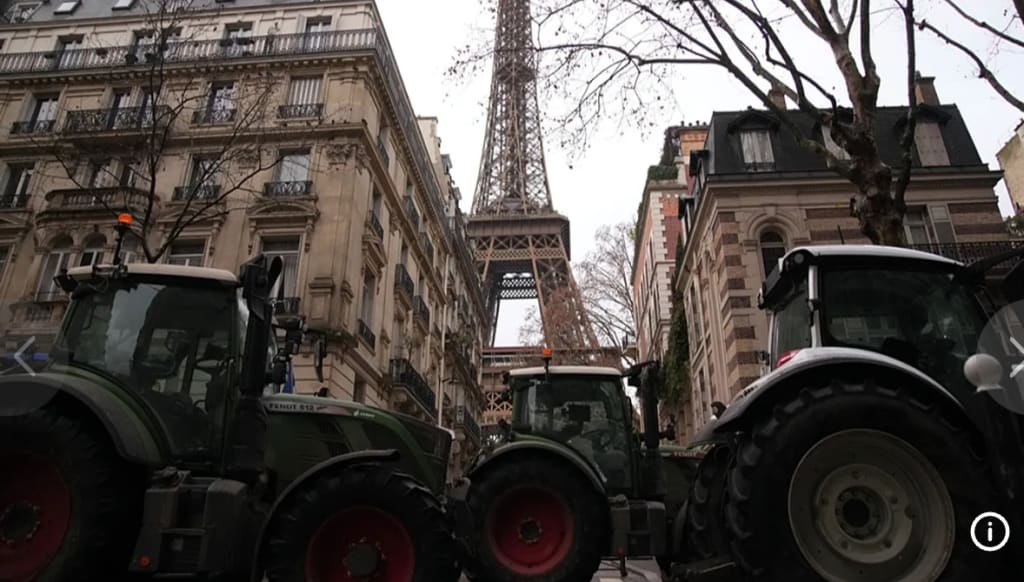
When dozens of tractors rolled into Paris, clogging highways and surrounding iconic landmarks, the message from France’s farming community was impossible to ignore. On January 8, farmers stormed the capital in a dramatic protest against the EU-Mercosur free trade deal, transforming city streets into a battlefield between rural livelihoods and international trade ambitions.
What unfolded was more than a single-day protest. It was the visible eruption of years of frustration felt by farmers who believe that European policies are steadily pushing them toward economic extinction.
Paris Wakes Up to Tractors, Not Traffic
Before dawn, farmers from across France began converging on Paris in convoys of tractors and agricultural vehicles. Despite police bans and roadblocks, many protesters successfully breached checkpoints and drove into central Paris, parking near highly symbolic locations such as the Arc de Triomphe and major government districts.
By early morning, major highways feeding into the capital were completely blocked. Traffic jams stretched for tens of kilometres, paralysing commuter routes and forcing authorities into damage-control mode. While police described some actions as reckless, the demonstrations remained largely peaceful, driven more by anger and desperation than violence.
For many Parisians, the tractors were a startling sight. For farmers, they were a last resort.
What Is the EU-Mercosur Free Trade Deal?
At the centre of the storm lies the EU-Mercosur agreement, a long-negotiated trade pact between the European Union and the South American Mercosur bloc, which includes Brazil, Argentina, Uruguay, Paraguay, and Bolivia.
The deal aims to reduce tariffs and expand trade in goods such as beef, poultry, sugar, soy, and ethanol. Supporters argue it will boost European exports, strengthen geopolitical ties, and open new markets for EU industries.
Farmers, however, see a very different picture.
Why Farmers Are Strongly Opposed
French farmers — joined by agricultural unions and rural communities — believe the agreement threatens their survival. Their concerns are rooted in three major fears:
1. Cheaper Imports Will Undercut Local Farms
South American agribusiness operates on a massive scale, often producing meat and crops at significantly lower costs. Farmers argue that opening European markets to these imports will flood shelves with cheaper products, forcing local producers out of competition.
2. Unequal Environmental and Welfare Standards
EU farmers are subject to some of the world’s strictest environmental, animal welfare, and food safety regulations. Protesters argue it is unfair to compete with imports produced under looser standards, which reduce costs but raise ethical and environmental questions.
3. Already Thin Profit Margins
Many European farmers are already struggling with rising fuel prices, fertiliser costs, climate-related disruptions, and heavy bureaucracy. The Mercosur deal is seen as the final pressure that could push small and medium-sized farms into collapse.
As one protest banner read: “Free trade for them, bankruptcy for us.”
The Protest Is About More Than Trade
Although the Mercosur agreement sparked the demonstrations, the anger runs much deeper.
Farmers also used the Paris protest to voice frustration over:
Government handling of livestock disease outbreaks
Mandatory animal culls and compensation disputes
Increasing administrative burdens
A feeling of being ignored by urban policymakers
Many rural workers believe decisions affecting their livelihoods are being made by distant officials in Paris and Brussels who have little understanding of agricultural realities.
The tractors, in this sense, became symbols of a widening gap between rural France and political power.
Political Pressure at a Critical Moment
The timing of the protest was no accident. It came just one day before an important EU discussion on the future of the Mercosur agreement.
France has officially expressed opposition to the deal, but divisions within the EU remain. Countries such as Germany and Spain are more supportive, arguing that trade expansion is vital for Europe’s global competitiveness.
For President Emmanuel Macron, the protest represents a political balancing act. Ignoring farmers risks domestic backlash and further unrest. Blocking the deal outright could strain EU unity and diplomatic relations with South America.
The tractors in Paris ensured that farmers’ voices would be part of that calculation.
A Europe-Wide Wave of Farmer Protests
France is not alone.
In recent months, farmers across Europe — including in Poland, Greece, Germany, and Belgium — have staged similar demonstrations. Roads have been blocked, ports disrupted, and government buildings surrounded, all driven by concerns over trade, climate rules, and economic survival.
This growing wave of agricultural protest reveals a broader European dilemma:
How can the EU pursue global trade ambitions while protecting local food systems and rural communities?
For many farmers, the current answer feels dangerously one-sided.
What Happens Next?
The future of the EU-Mercosur deal remains uncertain. It may be revised, delayed, or approved with additional safeguards. But one thing is clear: resistance from farmers is not fading.
If the agreement moves forward without strong protections, analysts warn that protests could intensify — not just in France, but across the continent. Farmers have shown they are willing to disrupt cities to defend their livelihoods.
For now, Paris has returned to normal traffic. The tractors have gone. But the deeper conflict between global trade policies and local agriculture is far from resolved.
Final Thoughts
The farmers who drove their tractors into Paris were not simply protesting a trade deal. They were demanding recognition, fairness, and a future.
As Europe negotiates its place in a globalised economy, the question remains:
Can progress be achieved without sacrificing those who feed the continent?
The answer may shape not just trade policy — but the future of European agriculture itself.
About the Creator
Muhammad Hassan
Muhammad Hassan | Content writer with 2 years of experience crafting engaging articles on world news, current affairs, and trending topics. I simplify complex stories to keep readers informed and connected.
Keep reading
More stories from Muhammad Hassan and writers in The Swamp and other communities.
Children in Gaza Return to School After Years Without Formal Education
For countless children in Gaza, the concept of going to school has long been an uncertain dream rather than a daily reality. Years of political unrest, economic hardship, and intermittent conflict have disrupted formal education, leaving a generation of young learners struggling to access the classrooms they deserve. Yet, amid the challenges, there is a renewed sense of hope: children in Gaza are returning to school, eager to learn, connect, and rebuild a sense of normalcy in their lives. The situation in Gaza has been dire for decades. Recurrent clashes, restricted movement, and limited access to essential services have left schools either damaged or overcrowded. According to reports from humanitarian organizations, thousands of children were forced to miss months, sometimes years, of formal education, often relying on informal or makeshift learning arrangements. For many, education became a luxury rather than a right. “The absence of school in the lives of these children is not just a gap in learning; it’s a gap in their development, their social growth, and their sense of security,” explains Laila Ahmed, an education coordinator with a local non-governmental organization in Gaza. “Returning to school is not simply about academics. It’s about restoring hope.” For children who have spent formative years in conflict zones, returning to classrooms carries both excitement and challenges. Many students face emotional trauma from years of instability, and some struggle to catch up with curriculum requirements after prolonged absences. Teachers, too, face the daunting task of addressing significant educational gaps while managing crowded classrooms with limited resources. Despite these obstacles, the determination of students and educators is evident. Schools in Gaza have reopened with new safety protocols and programs designed to support children who missed years of learning. Psychosocial support is being integrated into classrooms to help students cope with past traumas, while accelerated learning programs aim to bring students up to speed academically. Fatima, a 12-year-old student from Gaza City, shares her experience: “I haven’t been to school in almost three years because of the fighting. Coming back now, I feel nervous, but also happy. I want to learn, to be like other kids who can study every day.” Stories like hers underscore the resilience of Gaza’s children and the critical role of education in their recovery. International organizations and local authorities have been collaborating to make this return to school possible. The United Nations Relief and Works Agency (UNRWA), in partnership with local education ministries, has provided funding for school repairs, learning materials, and teacher training programs. These efforts are designed not only to restore physical access to schools but also to ensure that children receive quality education despite the challenges. “The world often hears about the conflict in Gaza in terms of politics and humanitarian crises, but it’s important to focus on the children,” says Ahmed. “Education is the pathway to a future where they can dream, create, and contribute to their community.” However, the road ahead remains fragile. Schools continue to face interruptions due to sporadic violence, electricity shortages, and limited infrastructure. The ongoing blockade and economic hardships exacerbate these difficulties, making it essential for international support and local commitment to remain strong. Without sustained investment, the progress achieved could easily be reversed, leaving children once again deprived of their right to education. Parents, too, play a vital role in encouraging their children to return to classrooms. Many families who have been hesitant due to safety concerns are now finding reassurance in community support networks and improved school conditions. “Sending my children back to school was a difficult decision,” admits Hani, a father of three. “But I see how much they need it, not just for learning, but for their happiness and sense of normal life.” The return to school is also symbolic for Gaza as a society. It represents resilience in the face of adversity and a commitment to rebuilding a generation that has endured the brunt of conflict. Educators hope that every day in the classroom will be an opportunity to cultivate curiosity, critical thinking, and creativity—tools that can empower children to imagine a future beyond the immediate struggles of their environment. Community involvement remains crucial. Volunteer programs, parent-teacher associations, and local youth initiatives are working hand-in-hand to support schools and students. Initiatives such as community tutoring sessions, extracurricular activities, and psychosocial workshops are helping children reintegrate into a structured learning environment, fostering a sense of belonging and security. Ultimately, the story of Gaza’s children returning to school is a story of hope, resilience, and determination. It is a reminder that education is not merely a service; it is a lifeline that nurtures growth, restores dignity, and builds the foundation for peace and stability. While challenges persist, the commitment of students, families, educators, and international partners signals that despite years of disruption, learning in Gaza can continue—and thrive. As Fatima reflects on her first days back in the classroom, her optimism shines through: “I missed school so much. Now, I want to learn everything I can, so one day I can help my community and make life better for everyone here.” In her words, the broader significance of education in Gaza becomes clear—it is more than a path to knowledge; it is a path to hope, resilience, and a brighter future. The journey ahead will be challenging, but each classroom reopened, every book distributed, and every child returning to school represents a small but powerful victory for Gaza. Education, in this context, becomes both a shield and a bridge—a shield against the ongoing turmoil and a bridge to a future filled with possibilities. In the face of adversity, the children of Gaza are proving that learning cannot be stopped. And as they take their seats once again, pencils in hand and curiosity in their eyes, they are not just reclaiming classrooms—they are reclaiming their right to dream, to grow, and to hope.
By Muhammad Hassan4 days ago in The Swamp
The steps to losing a child
Step One: Lose a child. Not what anyone wants to happen and nothing you can do to change it, but you can go through steps to becoming happy again. You can go through steps to loving again. You can go through steps to become a new you because after losing a child you will never be the same person you once were.
By Tabitha Hinkley3 days ago in Fiction


Comments
There are no comments for this story
Be the first to respond and start the conversation.