
Top Goldman Sachs Lawyer Kathy Ruemmler Resigns Over Jeffrey Epstein Ties: What It Means for Corporate Accountability
The resignation of Goldman Sachs’ chief legal officer highlights how lingering connections to Jeffrey Epstein continue to reshape corporate leadership, reputational risk, and governance standards across Wall Street.

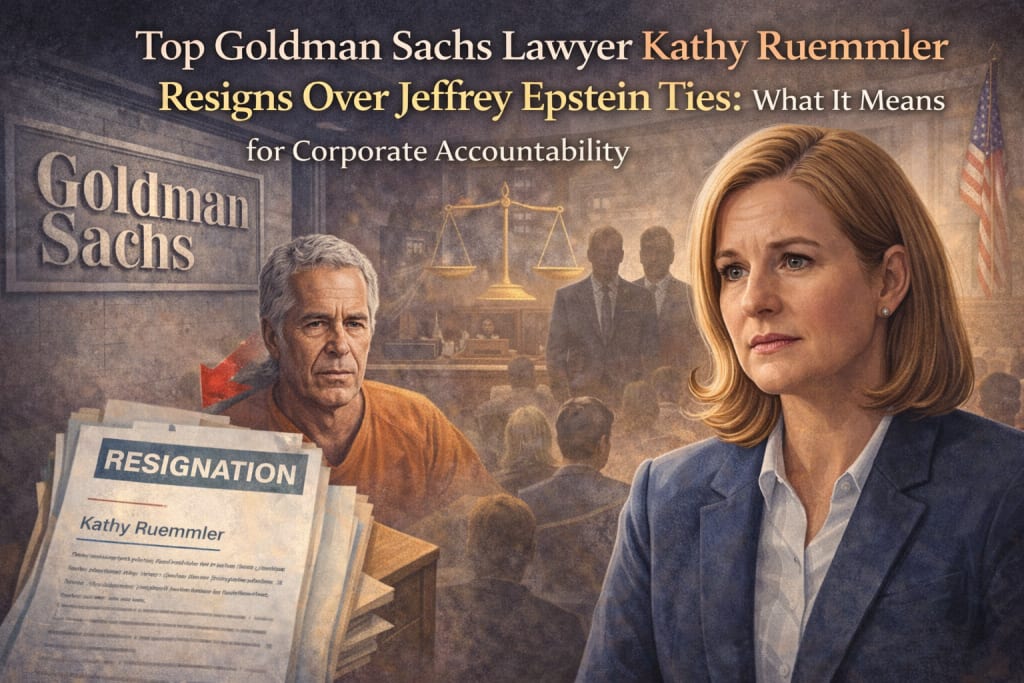
The departure of Kathy Ruemmler — one of the most powerful legal executives in global finance — has sent ripples through the corporate world. As chief legal officer of Goldman Sachs, Ruemmler occupied one of the most sensitive positions in banking, overseeing compliance, litigation strategy, and regulatory oversight for a firm managing trillions in assets.
Her resignation, linked to renewed scrutiny over past professional interactions connected to Jeffrey Epstein, underscores a hard truth for corporate America: in the post-Epstein era, reputational risk can be as damaging as legal liability.
________________________________________
Why Kathy Ruemmler’s Resignation Matters
Goldman Sachs confirmed that Ruemmler stepped down following internal discussions about reputational concerns. While the firm did not accuse her of criminal wrongdoing, executives reportedly concluded that the controversy had become an ongoing distraction.
Ruemmler, who joined Goldman in 2020, previously served as White House counsel during the Obama administration. She built a reputation as one of the most respected attorneys in Washington and on Wall Street. Her role at Goldman symbolized the close ties between elite government legal circles and major financial institutions.
That stature makes her resignation particularly significant.
It sends a clear signal that even indirect associations with Jeffrey Epstein — who died in federal custody in 2019 while awaiting trial on sex trafficking charges — remain toxic for high-profile institutions.
________________________________________
The Epstein Shadow That Won’t Fade
Years after his death, Epstein’s network continues to generate fallout across finance, academia, and politics. Investigations have revealed how deeply embedded he was among powerful elites, even after his 2008 conviction for sex crimes.
Reports indicate that Ruemmler had professional contact with Epstein during her time in private legal practice before joining Goldman Sachs. Although no criminal conduct has been alleged, critics argue that individuals serving in top compliance and ethics roles must be held to the highest standards of judgment.
In a statement released through her attorney, Ruemmler expressed regret for any association that could now be viewed negatively. She emphasized she never engaged in or supported illegal conduct but acknowledged that stepping aside was in the best interest of the firm.
The key issue was not criminal liability — it was optics, trust, and leadership credibility.
________________________________________
Goldman Sachs and Its Epstein History
Goldman Sachs has faced its own reckoning regarding Epstein. The bank previously reached a substantial settlement related to claims that it failed to properly oversee its banking relationship with him. Lawsuits alleged that the firm financially benefited from Epstein while overlooking red flags.
Although Goldman has taken steps to strengthen compliance systems since then, the resurfacing of any connection to Epstein remains a reputational flashpoint.
For a global bank operating under intense regulatory scrutiny, perception matters enormously. Investors, regulators, and clients demand assurance that ethical oversight is uncompromised.
When the chief legal officer becomes the subject of controversy, even without allegations of misconduct, the impact can ripple through boardrooms and trading floors alike.
________________________________________
Reputation vs. Legal Guilt: A New Corporate Standard
Corporate governance experts increasingly emphasize that today’s accountability environment goes beyond courtroom verdicts.
“This is about trust,” one former regulator noted. “Institutions are realizing that public confidence can erode even in the absence of legal violations.”
In the age of social media, investigative journalism, and instant global scrutiny, past professional relationships — once routine — can quickly become career-defining liabilities.
Executives are now evaluated not only on compliance with the law but also on perception, transparency, and ethical judgment.
Ruemmler’s resignation reflects this shift. It demonstrates that the cost of reputational damage may rival — or even exceed — formal legal penalties.
________________________________________
What Happens Next at Goldman Sachs?
The exit of a chief legal officer creates immediate operational challenges. The CLO role at Goldman Sachs oversees:
• Regulatory compliance across multiple jurisdictions
• Litigation risk management
• Internal ethics policies
• Government relations
• Crisis response strategy
Analysts expect the bank to appoint an interim successor while conducting a global search for a permanent replacement with strong credentials in compliance and crisis management.
An internal memo to employees reportedly reaffirmed Goldman’s commitment to integrity and oversight, signaling an effort to reassure both staff and investors.
For the bank, stability and swift leadership transition will be critical to maintaining market confidence.
________________________________________
A Broader Reckoning for Elite Networks
Ruemmler’s resignation also highlights deeper systemic questions.
How did Epstein maintain access to powerful legal, financial, and political circles for so long?
Why did institutions fail to sever ties sooner after his earlier conviction?
What due diligence standards were applied — and were they sufficient?
Advocacy groups representing Epstein’s victims argue that one resignation does not resolve a system-wide failure. They call for stronger vetting of clients and executives, enhanced transparency, and independent oversight mechanisms.
This moment, they say, should lead to structural reform — not symbolic gestures.
________________________________________
The Revolving Door Between Government and Wall Street
As a former White House counsel, Ruemmler’s career embodied the often-criticized “revolving door” between public office and corporate power.
Her appointment to Goldman Sachs had once been seen as a strategic asset, strengthening the firm’s legal expertise and government insight. Now, her departure illustrates how those same high-profile connections can magnify scrutiny.
In an environment increasingly skeptical of elite institutions, reputational expectations are shifting. Leaders must not only be legally compliant — they must be perceived as beyond reproach.
________________________________________
The Post-Epstein Era: No Safe Distance
Perhaps the most striking takeaway from this episode is how long the Epstein scandal continues to reverberate.
Years after his death, consequences are still unfolding. Careers are being reshaped. Institutions are revisiting past decisions. Associations once considered peripheral are now under renewed examination.
Financial and legal leaders across industries are watching closely.
The lesson is clear: in today’s accountability landscape, distance from wrongdoing is no longer measured solely by legality. It is measured by judgment, transparency, and public trust.
________________________________________
Why This Story Matters for Corporate America
Kathy Ruemmler’s resignation is more than a personnel change. It is a case study in modern corporate governance.
It highlights:
• The rising importance of reputational risk management
• The enduring fallout of the Epstein scandal
• The evolving standards for executive accountability
• The fragile balance between legal innocence and public perception
For Goldman Sachs, this chapter is part of a broader effort to rebuild and maintain trust after years of high-profile controversies.
For corporate America, it serves as a warning.
In the post-Epstein era, even indirect ties can become untenable. Leadership credibility is no longer judged solely in courtrooms — it is judged in headlines, shareholder meetings, and the court of public opinion.
And in that arena, reputation can be everything.
About the Creator
Adil Ali Khan
I’m a passionate writer who loves exploring trending news topics, sharing insights, and keeping readers updated on what’s happening around the world.
Keep reading
More stories from Adil Ali Khan and writers in The Swamp and other communities.
The Case for Using Your Brain — Even If AI Can Think for You
Artificial intelligence can now write your emails, draft your essays, summarize books, generate marketing strategies, solve coding problems, and even simulate emotional conversations. Within seconds, it produces answers that appear polished, structured, and confident.
By Adil Ali Khan2 days ago in The Swamp
Why Black History Matters in America?
The United States of America is celebrating their 250th anniversary in 2026. I'm proud to be an American and as someone who was born here, I wouldn't imagine myself living anywhere else. This is a country where opportunities are possible. Where anyone can be successful in anything they desire to do. Equality, community, and togetherness are the backbones of what America is and should be about. However, we have an administration who wants to erase and disregard those who have made positive, meaningful impacts in our country, specifically Black figures, such as Martin Luther King, Jr., Rosa Parks, and Maya Angelou. President Trump and his administration have been constantly complaining and fighting against what they call the "Woke agenda". They use this excuse as a distraction from other issues they refuse to address, such as the high cost of living, climate change, and inflation. That equality is dividing America, when in reality, it's bringing us together. Being woke is not tied to a specific political party. No matter where you stand on the political spectrum, you can still care about other people and their plights. Compassion and empathy for others isn't tied to a political party, either. We were taught as children to treat others the way we want to be treated and not judge others because they're different from us. Caring about others isn't a personal attack on your beliefs. It doesn't make you any less of a person. People who are easily offended over African American figures, past or present, or anything related to it, are grasping at straws. Current and future generations need to know who people like Harriet Tubman and Shirley Chisholm were, especially in the classroom. Black History is part of American History. It should be recognized, not hidden or forgotten. Besides, you can't shield children from everything, just because your feelings are easily hurt.
By Mark Wesley Pritchard 13 days ago in The Swamp
Saudi Arabia Joins Regional Effort to Tackle $7 Billion Annual Waste Crisis
Saudi Arabia has recently joined forces with countries across the Middle East and North Africa (MENA) region—including Morocco, Egypt, Iraq, Iran, and Algeria—to address a persistent and costly problem: the annual $7 billion waste crisis that threatens both environmental sustainability and tourism growth. This regional initiative reflects a broader recognition that economic development, environmental stewardship, and tourism are closely interconnected, especially as nations in the region pursue ambitious visions for 2050.
By Sadaqat Ali5 days ago in The Swamp




Comments
There are no comments for this story
Be the first to respond and start the conversation.