
The Case for Using Your Brain — Even If AI Can Think for You
Why Human Thinking Still Matters in the Age of Artificial Intelligence

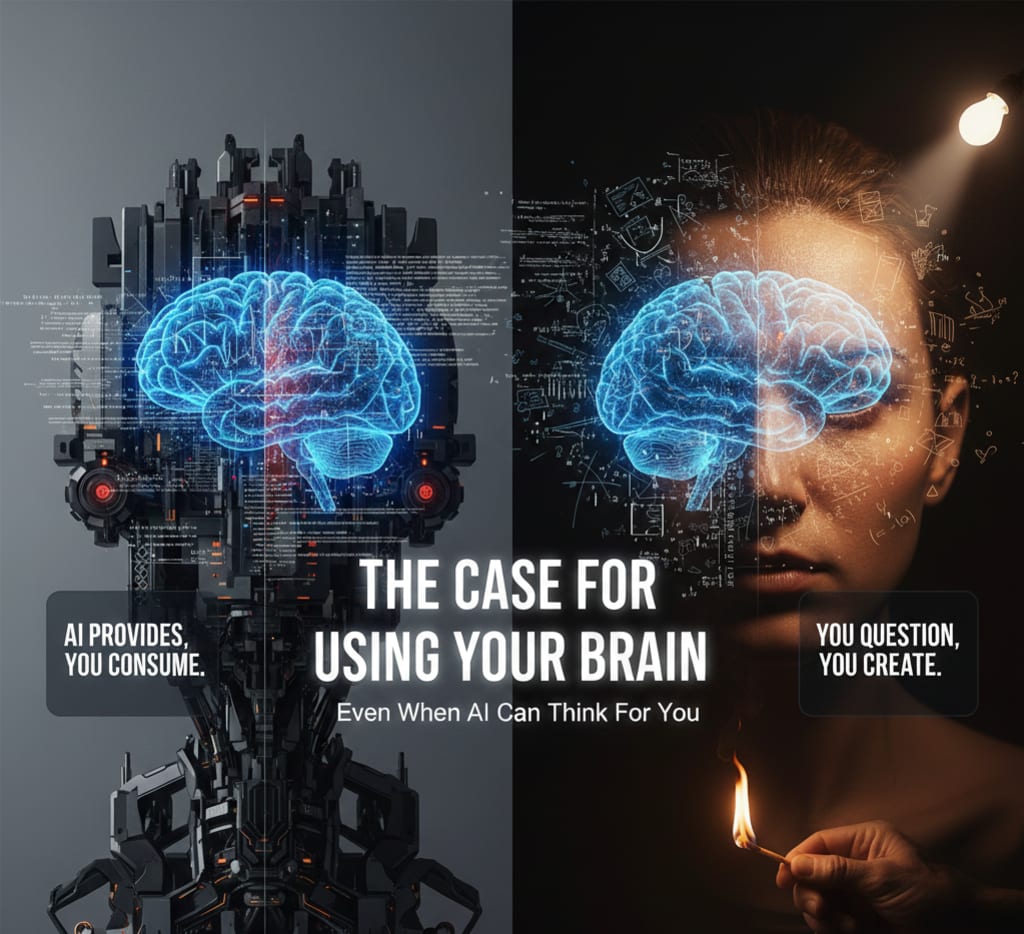
Artificial intelligence can now write your emails, draft your essays, summarize books, generate marketing strategies, solve coding problems, and even simulate emotional conversations. Within seconds, it produces answers that appear polished, structured, and confident.
So it’s fair to ask:
If AI can think for you, why bother thinking at all?
We are entering an era where mental effort feels optional. Why wrestle with complex ideas when an algorithm can generate conclusions instantly? Why struggle through uncertainty when a machine can provide clarity in seconds?
But beneath the convenience lies a deeper and more urgent question:
What happens to humanity when we stop using our own minds?
This is the case for continuing to think — even in the age of artificial intelligence.
________________________________________
AI Is Powerful — But It Does Not Truly Think
Artificial intelligence is extraordinary. But we must understand what it actually does.
AI systems do not think the way humans think. They do not:
• Experience doubt
• Feel curiosity
• Wrestle with moral conflict
• Seek meaning
Instead, AI predicts. It analyzes patterns across vast datasets and generates statistically probable responses. That predictive power can feel intelligent — sometimes eerily so — but it is not consciousness, wisdom, or lived understanding.
When humans outsource thinking entirely, they risk confusing output with insight.
An answer is not the same thing as understanding.
________________________________________
Thinking Is More Than Problem-Solving
Human thinking is not just about arriving at conclusions. It is about becoming someone in the process.
When you struggle with an idea, you:
• Strengthen neural pathways
• Develop intellectual resilience
• Refine your values
• Clarify your beliefs
The act of wrestling with uncertainty shapes identity. The discomfort of not knowing builds depth.
AI can deliver solutions instantly. But it cannot replicate the internal transformation that happens when you work through a problem yourself.
Speed is not the same as growth.
________________________________________
The Comfort Trap: When Convenience Turns Into Cognitive Dependence
Every major technological innovation has promised liberation — and quietly created dependence.
• GPS weakened our sense of direction.
• Calculators reduced mental arithmetic skills.
• Social media shortened attention spans.
Now artificial intelligence risks weakening something even more fundamental: our ability to think critically and independently.
If we consistently rely on AI to:
• Decide what to write
• Tell us what to believe
• Summarize what to understand
• Generate what to create
then our cognitive muscles begin to weaken.
Just like physical strength, mental sharpness fades when unused.
The danger is not immediate collapse. It’s gradual atrophy.
________________________________________
Critical Thinking: The First Casualty of Over-Reliance on AI
One of the greatest risks in the age of artificial intelligence is the erosion of critical thinking.
AI systems:
• Can produce confident but incorrect answers
• Reflect biases present in their training data
• Lack real-time awareness of truth or context
If users stop questioning outputs, they stop evaluating sources, examining nuance, and challenging assumptions.
In an era already saturated with misinformation, surrendering critical judgment is not harmless. It is dangerous.
Independent thought protects society from manipulation. Without it, narratives become easier to control.
________________________________________
Creativity Requires Friction — Not Just Efficiency
There is a popular belief that AI enhances creativity. And in many ways, it does. It can brainstorm, remix ideas, and inspire new directions.
But true creativity rarely emerges from ease.
It grows out of:
• Frustration
• Uncertainty
• Trial and error
• Emotional struggle
A poem generated instantly may look beautiful, but it lacks lived experience. It has no memory, no heartbreak, no longing behind it.
When humans create, they bring contradiction, emotion, vulnerability, and history. AI can imitate style — but it cannot care.
Creativity without internal friction becomes aesthetic, but not authentic.
________________________________________
Ethics Cannot Be Outsourced
Artificial intelligence can recommend actions. It cannot determine what is morally right.
Ethical decisions require:
• Empathy
• Cultural awareness
• Accountability
• Moral responsibility
If humans begin delegating major decisions — in healthcare, justice, governance, or warfare — to algorithms, they risk removing human responsibility from human consequences.
The most important question is not:
Can we automate this?
It is:
Should we?
And that question requires a human mind.
________________________________________
Thinking Builds Agency and Freedom
To think independently is to maintain agency over your life.
When you think for yourself, you:
• Choose rather than react
• Understand rather than follow
• Participate rather than consume
AI can assist decision-making. It cannot replace personal ownership.
A society that stops thinking becomes easier to manipulate, easier to divide, and easier to influence through persuasive outputs generated at scale.
Independent thinking is not just intellectual. It is civic.
________________________________________
Education in the Age of Artificial Intelligence
Schools and universities now face a defining moment.
Artificial intelligence tools are embedded in classrooms. Students can generate essays in seconds. Research can be summarized instantly.
The question is not whether students will use AI.
The question is whether they will still learn to think without it.
Education must shift from memorization toward:
• Analytical reasoning
• Ethical reflection
• Systems thinking
• Questioning assumptions
AI should be a tool for expanding perspective — not a shortcut that replaces cognitive development.
The goal of education is not polished output. It is intellectual maturity.
________________________________________
The Joy of Thinking Is Underrated
There is something profoundly satisfying about solving a difficult problem on your own.
The quiet moment when:
• A complex idea finally clicks
• You change your mind after reflection
• You articulate a belief clearly for the first time
These experiences build confidence. They cultivate self-trust.
When everything is generated for us, efficiency increases — but fulfillment may decrease.
Thinking gives life texture. It gives identity substance.
Without it, we risk becoming passive consumers of algorithmic conclusions.
________________________________________
Using AI Without Losing Yourself
This is not an argument against artificial intelligence.
AI is one of the most powerful tools humanity has ever created. Used wisely, it can:
• Accelerate research
• Expand access to knowledge
• Reduce repetitive labor
• Enhance productivity
The key is balance.
Use AI to:
• Explore perspectives
• Test ideas
• Identify blind spots
• Spark creative directions
But keep final judgment human.
Let AI assist your thinking — not replace it.
________________________________________
Thinking as an Act of Resistance
In an era of instant answers, choosing to think slowly is almost radical.
It is slower.
It is harder.
It requires effort.
But it is deeply human.
The case for using your brain — even if AI can think for you — is simple:
Because thinking is not merely about efficiency.
It is about growth.
It is about agency.
It is about meaning.
Artificial intelligence may reshape how we access knowledge. But it does not define who we are.
As machines become more capable, the responsibility to remain thoughtful becomes more important — not less.
In the age of artificial intelligence, the most powerful tool you still possess is your own mind.
And it is worth using.
About the Creator
Adil Ali Khan
I’m a passionate writer who loves exploring trending news topics, sharing insights, and keeping readers updated on what’s happening around the world.
Keep reading
More stories from Adil Ali Khan and writers in The Swamp and other communities.
Ukraine’s Strategy to Kill 50,000 Russian Soldiers a Month: Strategic Confidence or a Sign of Battlefield Constraints?
Amid the grinding reality of the Russia-Ukraine war, one striking figure has circulated among military analysts and geopolitical observers: Ukraine’s strategy aims to inflict up to 50,000 Russian casualties per month.
By Adil Ali Khan2 days ago in The Swamp
Why Black History Matters in America?
The United States of America is celebrating their 250th anniversary in 2026. I'm proud to be an American and as someone who was born here, I wouldn't imagine myself living anywhere else. This is a country where opportunities are possible. Where anyone can be successful in anything they desire to do. Equality, community, and togetherness are the backbones of what America is and should be about. However, we have an administration who wants to erase and disregard those who have made positive, meaningful impacts in our country, specifically Black figures, such as Martin Luther King, Jr., Rosa Parks, and Maya Angelou. President Trump and his administration have been constantly complaining and fighting against what they call the "Woke agenda". They use this excuse as a distraction from other issues they refuse to address, such as the high cost of living, climate change, and inflation. That equality is dividing America, when in reality, it's bringing us together. Being woke is not tied to a specific political party. No matter where you stand on the political spectrum, you can still care about other people and their plights. Compassion and empathy for others isn't tied to a political party, either. We were taught as children to treat others the way we want to be treated and not judge others because they're different from us. Caring about others isn't a personal attack on your beliefs. It doesn't make you any less of a person. People who are easily offended over African American figures, past or present, or anything related to it, are grasping at straws. Current and future generations need to know who people like Harriet Tubman and Shirley Chisholm were, especially in the classroom. Black History is part of American History. It should be recognized, not hidden or forgotten. Besides, you can't shield children from everything, just because your feelings are easily hurt.
By Mark Wesley Pritchard 13 days ago in The Swamp
Iran ready to discuss compromises to reach nuclear deal, minister tells BBC in Tehran
Iran signalled on Sunday that it is prepared to consider “compromises” in long‑running nuclear negotiations with the United States — but only on the condition that Washington engages seriously on the issue of sanctions relief, a senior Iranian official told the BBC in Tehran. The comments, made by Deputy Foreign Minister Majid Takht‑Ravanchi, come as indirect talks between Tehran and Washington are set to resume this week in Geneva, raising cautious hopes of progress after years of stalemate. “We are ready to discuss this and other issues related to our programme if they are ready to talk about sanctions,” Takht‑Ravanchi said in the BBC interview, stressing that Tehran’s willingness to compromise hinges on reciprocal engagement by the United States. “The ball is in America’s court to prove that they want to do a deal,” he added, underscoring his government’s emphasis on U.S. concessions as part of any negotiated settlement. The Business Standard Context of the Talks The comments follow a first round of indirect negotiations between U.S. and Iranian officials that took place earlier this month in Oman, under the auspices of several regional mediators. With the next round scheduled to begin in Geneva, both sides are under pressure to find common ground after years of complex diplomacy. The Business Standard Iran’s position, as outlined by Takht‑Ravanchi and other officials, combines a readiness to discuss curbs on its nuclear programme with firm insistence that sanctions relief must be part of the equation. Tehran has also reiterated that core elements of its programme, including uranium enrichment, remain non‑negotiable — although it has offered potential adjustments, such as diluting highly enriched material, if sanctions are lifted. The Business Standard That position reflects a longstanding sticking point in negotiations: the United States and its allies want strict limits on Iran’s nuclear activities to ensure the programme remains peaceful, while Tehran seeks economic relief and political leverage in return for any constraints. The negotiators hope to revive aspects of the 2015 Joint Comprehensive Plan of Action (JCPOA), which eased Western sanctions in exchange for nuclear limits, though both sides have diverged sharply over how to reconstruct a mutually acceptable framework. The Sanctions Issue at the Forefront Sanctions remain the central issue for Iranian negotiators. Decades of punitive measures — reimposed on Tehran after the United States withdrew from the JCPOA in 2018 — have crippled Iran’s economy, and officials in Tehran have insisted that any credible deal must meaningfully ease those restrictions. Takht‑Ravanchi’s comments make clear that Iran is not prepared to concede nuclear limitations in isolation from broader economic relief. For Iran, sanctions touch ordinary citizens as well as government revenue streams, and easing them could help stabilize its currency and oil exports. But U.S. policymakers — mindful of domestic political dynamics and strategic concerns — have been cautious about how much relief to offer, especially without verifiable limits on Tehran’s nuclear programme. Iran’s readiness to discuss compromises also indicates a nuanced diplomatic posture. While its leaders repeatedly deny seeking nuclear weapons, Western capitals remain sceptical about Tehran’s intentions, given its enrichment of uranium to 60 percent purity — a level close to weapons‑grade — in recent years. Tehran argues such enrichment is for peaceful purposes, but the capability has been a core concern for U.S. negotiators. The Business Standard Scope and Limitations of Negotiations Takht‑Ravanchi made clear that Iran does not intend to link nuclear discussions to other contentious issues, such as its ballistic missile programme or regional activities — areas Washington and some U.S. allies, particularly Israel, want included in broader negotiations. By limiting the talks strictly to the nuclear file and sanctions, Tehran aims to focus diplomacy on achievable goals while deflecting demands it views as outside the scope of the nuclear agreement. The scheduled Geneva talks will bring together Iranian negotiators and U.S. envoys, including special representatives from Washington, with Oman playing a continuing mediating role. Officials in both capitals have described the process as cautious but constructive, though neither side has guaranteed a breakthrough. Broader Implications The renewed talks come at a time of heightened regional tensions. Iran has faced pressure over its nuclear programme from several angles, including regional adversaries and international sanctions, while domestic political considerations shape Tehran’s negotiating strategy. For U.S. and allied policymakers, the risk of an unconstrained nuclear programme remains a top security concern. If successful, renewed diplomacy could ease one of the most persistent flashpoints in U.S.–Iran relations. But as Takht‑Ravanchi’s remarks suggest, significant gaps remain over sanctions and nuclear limits, and both sides will need to demonstrate political will and flexibility in the coming talks.
By Fiaz Ahmed 29 minutes ago in The Swamp



Comments
There are no comments for this story
Be the first to respond and start the conversation.