
Title: Machado Cannot Transfer Peace Prize to Trump, Nobel Committee Says Subtitle: After a symbolic gesture sparked international debate, the Nobel Prize’s rules on non-transferability are now front and center
A symbolic handover triggers global debate, but Nobel rules make clear the prize belongs only to its original laureate
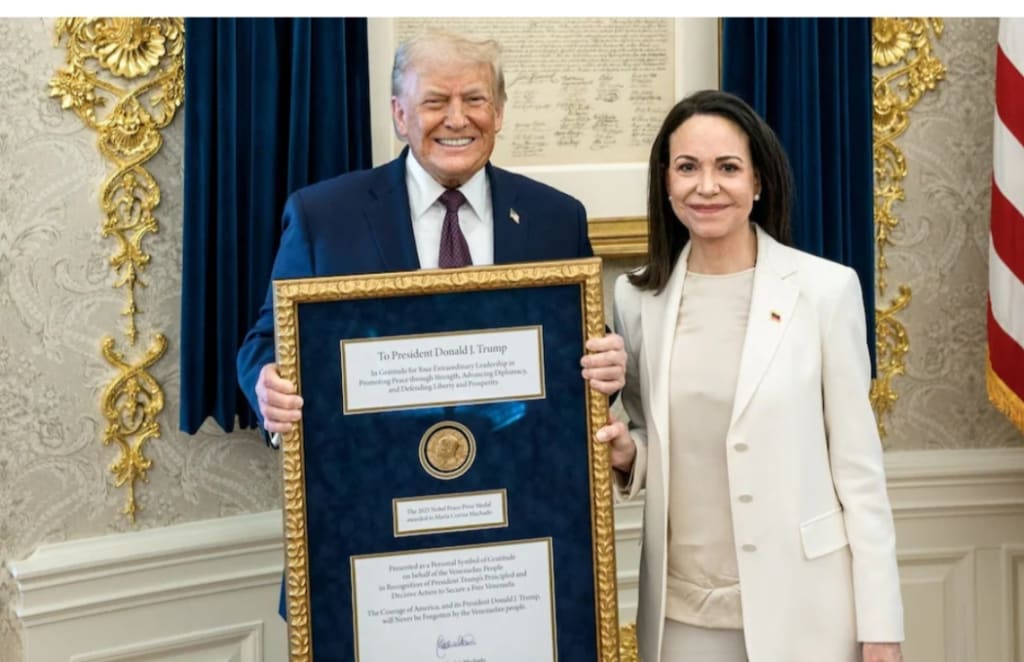
In the world of global politics, symbolism often carries as much weight as formal decisions. But when it comes to the Nobel Peace Prize, symbolism has clear limits. That reality came into sharp focus after reports emerged that Venezuelan opposition leader María Corina Machado had symbolically handed her Nobel Peace Prize medal to former U.S. President Donald Trump — a move that quickly triggered international debate and a firm response from the Nobel Committee.
The message from the Nobel authorities was swift and unambiguous: a Nobel Peace Prize cannot be transferred, shared, or reassigned — not even symbolically.
What Sparked the Controversy?
María Corina Machado, who was awarded the Nobel Peace Prize for her long-standing efforts to promote democracy and peaceful political change in Venezuela, reportedly presented her Nobel medal to Donald Trump during a high-profile meeting. The gesture was framed as a sign of appreciation for Trump’s role in international pressure campaigns and diplomatic actions related to Venezuela’s political crisis.
Images and statements surrounding the meeting quickly went viral, fueling speculation that Machado was attempting to “pass on” the prestigious honor. Supporters of Trump hailed the moment as overdue recognition, while critics described it as political theater that risked undermining the integrity of the Nobel Prize.
Nobel Committee Draws a Clear Line
Amid the growing chatter, the Norwegian Nobel Committee and the Nobel Foundation stepped in to clarify the situation. Their position was direct: the Nobel Peace Prize belongs solely and permanently to the person or organization awarded by the committee.
While Nobel laureates are free to give away, sell, or donate the physical medal, diploma, or prize money, such actions carry no legal or symbolic authority to transfer the title itself. In short, the medal may change hands, but the honor does not.
Once awarded, a Nobel Prize is final. It cannot be revoked, reassigned, or shared — regardless of intent or circumstance.
Medal vs. Laureate Status
This distinction lies at the heart of the controversy. The Nobel Committee separates physical ownership from official recognition. A medal is an object; the title of Nobel laureate is a historical designation recorded permanently in the Nobel archives.
Throughout history, Nobel medals have been sold at auction for charity, donated to museums, or gifted to institutions. Yet in every case, the official laureate remains unchanged. No precedent exists for transferring laureate status to another individual — and Nobel officials have made it clear that no such precedent will be created now.
As a result, Donald Trump is not, and will not be, a Nobel Peace Prize laureate, regardless of whether he possesses the medal.
Political Reactions and Global Debate
The episode has drawn reactions across the political spectrum. Trump supporters argue that the gesture reflects international recognition of his foreign policy efforts, particularly his role in diplomatic negotiations and pressure campaigns abroad. Critics counter that the move politicizes an award intended to rise above partisan interests.
In Norway, where the Nobel Peace Prize is awarded, several political figures and commentators criticized the episode as damaging to the prize’s credibility. Others warned that allowing symbolic reinterpretations could weaken the authority of global institutions already under strain.
Social media, unsurprisingly, amplified the debate. Some praised Machado’s gratitude, others accused her of cheapening her own achievement, and many questioned whether the Nobel Peace Prize itself has become too entangled in global politics.
Why the Nobel Rules Matter
The Nobel Peace Prize carries immense moral and historical weight. Its authority rests not only on the individuals who receive it, but on the consistency and independence of the institution that awards it. Allowing prizes to be transferred — even symbolically — would open the door to political bargaining, pressure, and retrospective rebranding.
By reinforcing its rules, the Nobel Committee is protecting the principle that peace recognition must remain independent of political influence after the fact. The prize honors specific actions, moments, and contributions — not evolving narratives or alliances.
Machado’s Legacy Remains Intact
Despite the controversy, the Nobel Committee’s statement ensures that Machado’s status as a Nobel Peace Prize laureate remains untouched. Her recognition stands on her own record of activism and advocacy, regardless of how the medal itself is used or displayed.
For Machado, the incident may have sparked criticism, but it has also reignited global attention on Venezuela’s political struggle — an issue at the heart of her Nobel recognition.
Conclusion: Symbolism Has Limits
The Machado–Trump episode serves as a reminder that while gestures can make headlines, institutions shape history. The Nobel Peace Prize is not a token to be handed over, but a permanent historical acknowledgment rooted in formal decision-making.
In the end, the message from the Nobel Committee is clear:
A medal can be gifted. A title cannot.
As global politics grow increasingly symbolic and performative, this firm stance reinforces a simple truth — some honors are meant to stand still, immune to the shifting winds of power and politics.
About the Creator
Keep reading
More stories from Aarif Lashari and writers in The Swamp and other communities.
World Stock Markets Brace for Turbulence After Trump’s Latest Tariff Shock
Global financial markets are bracing for potential turbulence following the latest tariff announcement from former U.S. President Donald Trump. Investors around the world are reacting with concern, as news of proposed tariffs threatens to disrupt supply chains, raise trade tensions, and inject uncertainty into already volatile markets.
By Aarif Lasharia day ago in The Swamp
“Escape from Siberia: A Journey of Courage and Survival”
At the beginning of the story, we see a prison in Siberia, where many German soldiers are lined up. In fact, after the end of World War II, Russia captured a large number of German soldiers and forced them to work day and night in coal mines. Although the security of this prison was quite low, no one ever tried to escape from it. The reason was that the prison was surrounded by nothing but endless snow, and it was located about 14,000 kilometers away from any human settlement. So even if a prisoner managed to escape from this prison, his death in the freezing cold of Siberia was certain. This prison was built in the middle of snow stretching thousands of kilometers in every direction, which is why no prisoner could even imagine escaping from here. However, among these prisoners, there was one man who was extremely intelligent and wanted to escape from this prison to return to his wife and daughter. This prisoner’s name was Clemens Feirl. He had been sentenced to 25 years in this prison, and Clemens did not want half of his life to pass inside these prison walls. Clemens wanted to escape from this prison at any cost. Fortunately, one day Clemens got a chance to escape, and he fled the prison by hiding inside a freight train carrying coal. When he came out of the prison and saw the stars in the open sky, he felt overwhelmed with happiness. But this happiness was short-lived. After traveling some distance, the freight train was stopped. When Clemens looked outside, he saw a Russian soldier standing in front of him with a gun aimed at him. Unfortunately, Clemens was caught, and for the crime of escaping, he was locked inside an open-air cell. The cold was extreme, and the rain during the night worsened Clemens’s condition. He was not kept in that cell for a few hours, but for a full two days. After two full days, the next morning, the prison warden came to him and took him out of the cell, but did not torture him. He only said, “Your companions are waiting for you impatiently.” When Clemens reached his fellow prisoners, they were waiting for him with sticks and clubs in their hands. They were extremely angry with Clemens because, due to his escape attempt, all of them had been kept hungry for the past two days. Now Clemens understood why the warden had said that his companions were waiting for him. As soon as the other prisoners saw Clemens, they attacked him and beat him very badly. During this beating, Clemens was injured so severely that he had to be admitted to the prison hospital. The doctor of this prison was also a German prisoner. When Clemens regained consciousness, he said to the doctor, “I want to escape from this prison once again, and I need your help.” The doctor was astonished by Clemens’s courage. Even after enduring so much suffering, he was still not ready to give up. The doctor explained to him that escaping alive from this prison was impossible, and even if he did escape, he would die in the freezing cold outside. But the truth was that even if he did not escape, his death was still certain. The coal mines where they worked had extremely high levels of carbon, which entered their bodies through the air and caused deadly diseases like cancer. That is why the doctor said to Clemens, “You must try to escape from this prison one last time.”
By Filmon Ke Raaz | Movie Mysteries Explained3 days ago in The Swamp



Comments
There are no comments for this story
Be the first to respond and start the conversation.