
Thomas Jefferson
America’s First Liberal President

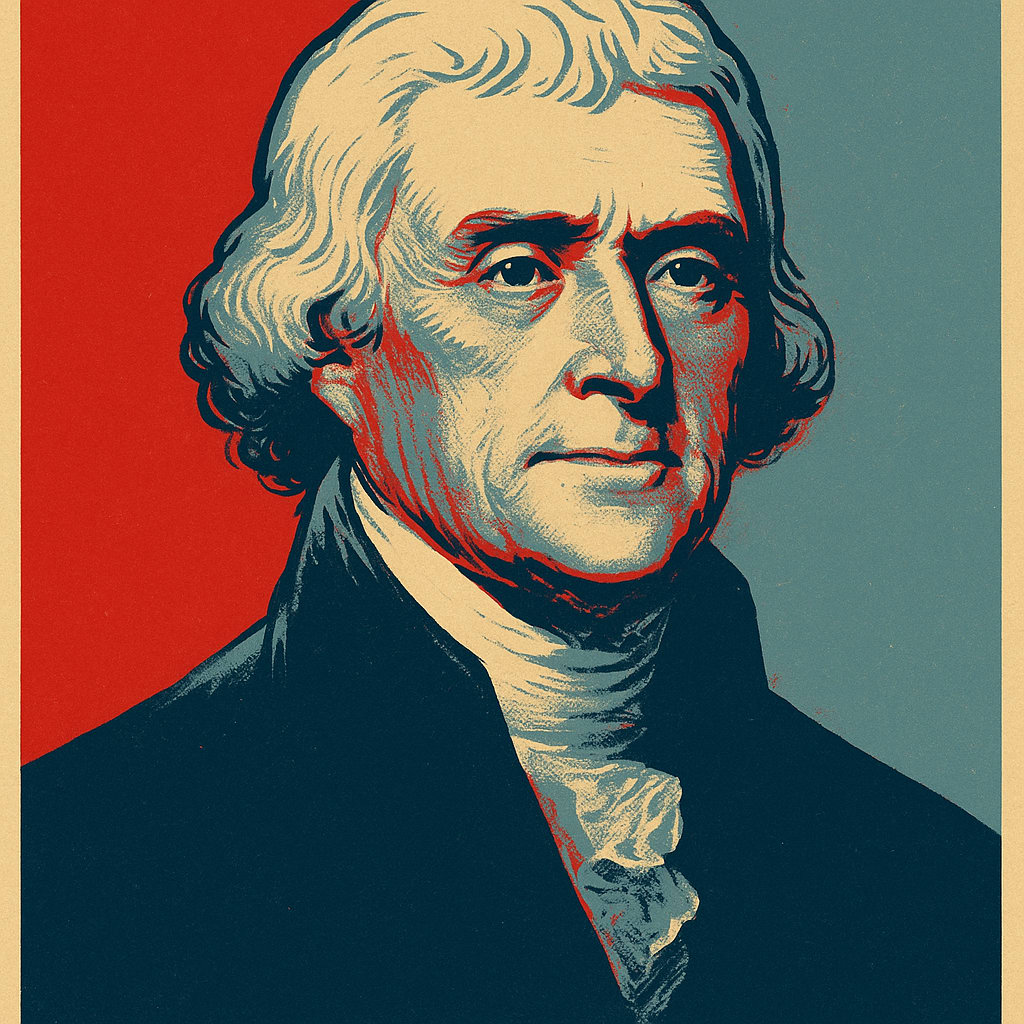
Thomas Jefferson's life was a pivotal chapter in the shaping of the United States, marked by profound intellectual contributions, complex personal relationships, and enduring political legacies. His journey to penning the Declaration of Independence was rooted in the growing discontent with British rule and a burgeoning belief in self-governance and natural rights. As a brilliant young Virginian lawyer and statesman, Jefferson emerged as a powerful voice for colonial rights. The Declaration of Independence primarily his work, was a revolutionary document that articulated the philosophy of natural rights—life, liberty, and the pursuit of happiness—and the right of the people to reject governments that violate these rights; and to this very day, those are the things society most debate as to who and how those rights apply. It laid the philosophical groundwork for American independence and deeply influenced democratic movements worldwide.
Jefferson's relationships with other prominent Founding Fathers were dynamic and often fraught with political tension.
John Adams: Initially close collaborators and friends during the Revolution, their relationship soured significantly during the partisan struggles of the late 18th and early 19th centuries, becoming bitter political rivals. However, in their twilight years, they reconciled, exchanging a remarkable series of letters that explored their shared history and political philosophies. These letters are a remarkable collection of correspondence, that began in 1812 and continued until their mutual death on July 4, 1826. Proving that it's possible to mend serious political divides and renew a shared patriotic view of the nation they both formed and loved.
Benjamin Franklin: Jefferson deeply respected Franklin's intellect and diplomatic prowess. They served together on the Committee of Five to draft the Declaration of Independence, and Franklin at 70 was a mentor figure to the younger Jefferson at 33. After Benjamin's 8 years as America's chief diplomat to France, during the Revolutionary War, it was Thomas that relieved him to become the United State's first official ambassador to France, where he inherited Franklin's love for the french and their liberal attitude.
Alexander Hamilton: Hamilton and Jefferson stood at opposite ends of the nascent American political spectrum. Their rivalry was intense and ideological, defining the early years of the republic. Hamilton, a Federalist and the Conservative in those days, advocated for a strong central government, a national bank, and industrial development, while Jefferson, a Democratic-Republican which were considered the liberal position, championed states' rights, agrarianism, and limited government. This profound disagreement shaped the nation's political discourse for decades; which still rages on today, even if the political terms and labels of conservative and liberal have jumped around the social political spectrum throughout history.
Their basic disagreement stemmed from Hamilton's belief that the Federal government should hold all State's debts and hold all the power to promote a strong united republic, which would project international strength, and protect the Union from outside enemies. Jefferson believed the States should hold the power to govern liberally govern themselves, as the people democratically decided amongst themselves. In 1800 it was Hamilton's vote for Jefferson over Arron Burr, that gave him the Presidency; proving that even though they were bitter political rivalries they understood when cooperation was needed and putting the nation above political party affiliation was necessary.
George Washington: Washington held Jefferson in high regard, appointing him as the first Secretary of State. Despite their shared commitment to the new nation, their relationship was strained by Jefferson's growing opposition to Hamilton's financial policies, which Washington generally supported. While Washington valued Jefferson's abilities, he was deeply troubled by the partisan divisions that emerged.
The intense ideological differences with Hamilton led Jefferson, along with James Madison, to form the Democratic-Republican Party. This was America's first organized political opposition, advocating for agrarian interests, individual liberties, and a strict interpretation of the Constitution, again this being the liberal position of Jefferson's day. George Washington, however, was deeply wary of political parties, fearing they would divide the nation and lead to factionalism and instability. In his Farewell Address, he famously warned against "the baneful effects of the spirit of party."
The biggest political riff between these two Founding Fathers, stemmed from Jefferson's belief that the Untied States should support France during their revolution, while Washington believed doing trade with England was more prudent, do to the fact they were not under the economic duress and uncertainties of war. Jefferson felt the U.S. betrayed France for their help during the Revolutionary War, while Washington asserted that America's deal was with King Louis the XVI, who lost his head on January 21, 1793.
Jefferson's presidency (1801-1809) was transformative. His most significant contribution was the Louisiana Purchase in 1803, which doubled the size of the United States and opened vast new territories for westward expansion, despite his initial constitutional reservations about the executive power to acquire land. He also championed the concept of an "empire of liberty," believing that the new territories would allow for an expansion of republican ideals. His administration reduced the national debt, limited the size of the federal government, and established the U.S. Military Academy at West Point. Jefferson had an open door policy to the public, and frequently allowed and encouraged the people to visit him while in office. What Jefferson began, as his relationship with the public, in the early 19th Century, may now be seen in how politicians interact with their constituents via Social Media.
Among his many intellectual pursuits, Jefferson created what is famously known as "The Jefferson Bible," or The Life and Morals of Jesus of Nazareth. He meticulously cut and pasted sections from the New Testament, removing all supernatural elements, miracles, and references to Jesus's divinity. His goal was to present Jesus as a great moral teacher, focusing on his ethical principles rather than theological dogma. This work was a personal endeavor and was not published during his lifetime. Its reception by Christians has been varied: some view it as a radical attempt to strip Christianity of its core tenets, while others see it as an intellectual exercise aimed at understanding Jesus's moral philosophy. Generally, orthodox Christians do not accept it as a legitimate version of the Bible due to its deliberate exclusion of foundational theological doctrines, while others believe it's the essence of what Christianity is, since it follows only the word and actions of Jesus, which the religion is actually predicated upon.
Jefferson's personal life was complex and fraught with contradictions, particularly concerning his ownership of slaves. His relationship with Sally Hemings, an enslaved woman at Monticello, has been a subject of intense historical debate and research. DNA evidence and extensive historical scholarship now widely confirm that Jefferson fathered at least six children with Hemings: Harriet (born 1795, died in infancy), Beverly (born 1798), Harriet (born 1801), Madison (born 1805), and Eston (born 1808).
Beverly and the younger Harriet were allowed to leave Monticello and live as free white individuals, while Madison and Eston were emancipated in Jefferson's will. Despite his eloquent words on liberty, Jefferson remained a lifelong slave owner and died deeply in debt, primarily due to agricultural losses, investments, and the financial burden of maintaining Monticello. His estate, including his slaves, had to be sold after his death to cover his obligations.
Thomas Jefferson, should be viewed as America's first Liberal President. His beliefs in limited federal government, freedom from religion, individual liberty, public education, and strict adherence to the Constitution as it's written, while also believing the Constitution should be completely overhauled every generation, proves he championed liberal ideas, which where opposed by those in government who wished to conserve the Union and use strong federal powers to do so. His vision emphasized the importance of an educated citizenry, individual autonomy, and the pursuit of happiness, laying a philosophical groundwork that continues to resonate with liberal thought today. Despite the profound paradoxes of his personal life, Jefferson stands tall till this day as one of the United States most accomplished and beloved Founding Fathers.
About the Creator
Meko James
"We praise our leaders through echo chambers"
Keep reading
More stories from Meko James and writers in The Swamp and other communities.
The Great Depression:
Introduction The Great Depression was a significant and harrowing chapter in American history, reshaping the economy, society, and government. It serves as a stark reminder of how interconnected our financial systems are and how the decisions we make today can echo through time. Alarmingly, many of the factors that contributed to the Great Depression are resurfacing in our current climate. This essay will highlight the causes of the Great Depression and draw parallels to contemporary issues, including government deregulation, corruption, the glorification of wealth, and the rise of exclusionary purity movements. With only 4 years away from the 100th anniversary of the beginning of the Great Depression, it behoves us to take a serious sociopolitical look at the parallels of today that have us headed unavoidably to our next one.
By Meko James 9 months ago in The Swamp
A Gathering of Evil Bosses
“I’m the queen of chin jutting while I smooth my hair, attacking, insulting, and deflecting to protect my appointer.” “Oh, please, Blondi, my hair is curled, highlighted, and longer than yours. I feature television commercials telling immigrants that we will give them a free plane ride home, and if they voluntarily turn themselves in, they will be allowed to legally apply for re-entry. It runs everywhere, and I look good in it! You can’t compete because of your blond hair. Mine is nicer, and my lips are prettier than yours.”
By Andrea Corwin 11 days ago in The Swamp




Comments
There are no comments for this story
Be the first to respond and start the conversation.