


Where were you on September 11, 2001? For many, the memory of that day remains etched in vivid detail—the shock, the grief, and the sense that the world as we knew it had changed forever. Beyond the immediate tragedy, 9/11 reshaped global politics, security, culture, and even personal freedoms in ways that continue to affect us today. Two decades later, the ripple effects are still unfolding.
A New Era of Security
Before 9/11, traveling by plane felt relatively relaxed. Passengers could walk to the gate with loved ones, and security checks were brief. After that day, airports transformed into fortresses of vigilance. The creation of the Transportation Security Administration (TSA) in the U.S. was just one step in a broader global shift toward stricter travel regulations.
Today, scanning shoes, removing laptops, and undergoing body checks are standard practices. While many travelers see it as a minor inconvenience, these changes highlight a world where security is prioritized over speed. The phrase “the new normal” was born out of these very shifts.
The War on Terror and Global Politics
The attacks launched what came to be known as the “War on Terror.” The U.S. invaded Afghanistan in 2001 and Iraq in 2003, with far-reaching consequences. These wars not only toppled regimes but also reshaped geopolitics, influenced energy markets, and altered relationships between nations.
For instance, NATO allies were drawn closer, but divisions also deepened in other regions. The Middle East became a stage for prolonged conflicts that created humanitarian crises and refugee movements, which continue to shape global debates on immigration and security.
Technology and Surveillance in Daily Life
One of the less obvious but deeply impactful consequences of 9/11 was the expansion of surveillance. Governments around the world adopted new powers to monitor communications, financial transactions, and online activity. The USA PATRIOT Act in America became a symbol of this new age of monitoring.
On the one hand, these tools aimed to prevent future attacks. On the other, they sparked debates about privacy and freedom. Today, the idea that our digital footprints are constantly tracked feels normal, but it’s a reality that accelerated because of post-9/11 policies.
Social and Cultural Shifts
Beyond politics and technology, 9/11 also changed how people viewed each other. Communities of Middle Eastern and Muslim backgrounds often found themselves unfairly targeted with suspicion or prejudice. Islamophobia rose sharply, leaving scars that still affect social harmony today.
At the same time, there was also an outpouring of solidarity. In New York and around the world, people came together in vigils, charities, and support networks. That dual reality—fear and unity—has continued to define much of the world’s cultural response to tragedy since then.
The Economy and Global Markets
The immediate aftermath of 9/11 saw global markets plunge. The airline industry nearly collapsed, tourism slowed dramatically, and insurance companies faced massive payouts. Yet, in the long run, it sparked resilience. Businesses adapted, governments supported recovery, and new industries in security and technology began to thrive.
Think about how biometric identification, cybersecurity, and even drone technology gained traction after 9/11. These innovations, while rooted in safety concerns, now have applications in everything from smartphones to delivery services.
The Legacy of Resilience
Perhaps the most enduring legacy of 9/11 is the resilience of people. In New York, the rebuilding of the World Trade Center and the creation of the 9/11 Memorial serve as symbols of strength and remembrance. Globally, the tragedy reminded people of the fragility of life and the importance of unity.
For many young people who were children at the time, 9/11 shaped how they view the world—instilling an awareness of global conflict, empathy for others, and a desire to create a more peaceful future.
Moving Forward: Lessons for Today
So, what does the world after 9/11 teach us today? It reminds us that fear can change policies, but hope can rebuild nations. It teaches us that while security is necessary, it must balance with freedom. And above all, it shows us that human resilience is stronger than any tragedy.
The world has undoubtedly changed since 2001, but how we respond to those changes defines who we are today.
Now it’s your turn—how do you think the world after 9/11 shaped your life or perspective? Did it alter how you view safety, freedom, or community? Share your thoughts in the comments and join the conversation. Your story could inspire others to reflect on their own journey through a world forever changed by that day.
About the Creator
John Smith
Man is mortal.
Keep reading
More stories from John Smith and writers in The Swamp and other communities.
The Death of the Dollar
Have you ever wondered what it would mean if the U.S. dollar—the currency that has dominated global trade for decades—suddenly lost its power? It may sound like a distant possibility, but growing signs suggest that the dollar’s unshakable grip on the world economy may be loosening. And if history teaches us anything, no empire, not even one built on green paper, lasts forever.
By John Smith6 months ago in The Swamp
A Gathering of Evil Bosses
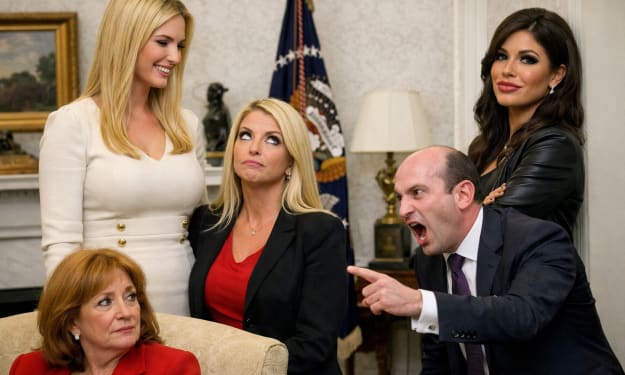
“I’m the queen of chin jutting while I smooth my hair, attacking, insulting, and deflecting to protect my appointer.” “Oh, please, Blondi, my hair is curled, highlighted, and longer than yours. I feature television commercials telling immigrants that we will give them a free plane ride home, and if they voluntarily turn themselves in, they will be allowed to legally apply for re-entry. It runs everywhere, and I look good in it! You can’t compete because of your blond hair. Mine is nicer, and my lips are prettier than yours.”
By Andrea Corwin 12 days ago in The Swamp
Iran’s Supreme Leader Ayatollah Ali Khamenei, Who Led the Islamic Republic Since 1989, Is Dead at 86
Ayatollah Ali Khamenei, the supreme leader of the Iran for more than three decades, has died at age 86, Iranian state media confirmed, marking a historic turning point for Tehran and a potential reshaping of Middle East geopolitics. His death was announced Sunday following a major joint military operation by the United States and Israel that reportedly struck his compound in Tehran over the weekend. Iran’s official broadcaster described Khamenei’s death in solemn terms, saying the supreme leader “has reached martyrdom” and announcing 40 days of public mourning across the country. Authorities declared a week-long holiday to honour him, a signal of his central role in Iran’s state identity. A Leader Who Dominated Iranian Politics Khamenei assumed the post of supreme leader in 1989 after the death of Ayatollah Ruhollah Khomeini, the founder of the Islamic Republic. Although originally seen by some as a compromise successor with weaker religious credentials, Khamenei consolidated power over time and became one of the most influential figures in Iran’s modern history. As supreme leader, he held ultimate control over the government, military, judiciary, and state media — outranking elected officials such as the president and parliament. He was the commander-in-chief of the armed forces and the final authority on foreign policy, security, and national ideology, shaping Iran’s path through repeated domestic and international crises. Domestic Hardline Rule and Crises Domestically, Khamenei’s tenure was marked by repeated unrest and government crackdowns. Major waves of protest erupted under his watch, including large-scale demonstrations in 2022 over the death of Mahsa Amini, an Iranian Kurdish woman who died in morality police custody, sparking widespread outrage. Security forces were accused of lethal force against demonstrators, intensifying international criticism of Tehran. Through periods of economic hardship, unemployment, inflation, and social restrictions, opposition to the clerical establishment grew among younger Iranians who chafed under political and cultural repression. Yet, the regime maintained control through a network of loyal institutions, including the powerful Islamic Revolutionary Guard Corps (IRGC), which became a dominant force in both security and economic spheres. Foreign Policy and Regional Influence Khamenei’s foreign policy was defined by opposition to Western powers, particularly the U.S. and Israel, and by expanding Iran’s influence across the Middle East. Tehran supported allied militias and political groups in countries such as Iraq, Syria, Lebanon, and Yemen, viewing them as part of an “Axis of Resistance” against Western influence. His resistance to U.S. pressure over Iran’s nuclear ambitions was a defining feature of his leadership. Although he issued a religious ruling that nuclear weapons were forbidden under Islam, Tehran advanced its nuclear program significantly, drawing intense scrutiny and sanctions from the West. In 2015, Iran agreed to an international nuclear deal, but the U.S. withdrawal from the pact in 2018 led to renewed escalation and reciprocal violations. The Strike and Its Aftermath According to multiple reports, Khamenei was killed on February 28, 2026, after a coordinated military operation by U.S. and Israeli forces targeting key locations in Tehran, including his residence and other strategic sites. President Donald Trump publicly confirmed the death on social media platforms, framing it as justice for the victims of the Iranian regime and a potential catalyst for change in Iran’s governance. Before Iranian state confirmation, there was confusion about his status, with semi-official outlets initially reporting that he remained “steadfast and firm.” However, the state broadcaster’s confirmation has now ended that uncertainty. Business Standard Uncertain Succession and Power Struggles Khamenei’s death leaves a significant power vacuum. Iran’s constitution empowers the Assembly of Experts, a body of senior clerics, to select his successor, but no clear front-runner has emerged. Analysts warn that factional infighting among hard-liners, conservatives, and pragmatic elements could intensify as various interests seek to shape the next era of Iranian leadership. The role of the IRGC is also critical; the powerful military institution has played a central role in maintaining internal order and executing foreign policy goals. Its influence may be decisive in determining Iran’s political direction and stability in the coming months. Regional and Global Repercussions The death of such a pivotal figure is bound to send shockwaves beyond Iran’s borders. Middle Eastern governments, global powers, and international markets are all closely watching the developments. Security measures have been heightened across the region amid fears of retaliation or escalation, while diplomatic efforts to manage tensions are likely to intensify. Oil markets, already sensitive to geopolitical risk, may also react to the leadership transition and potential instability, given Iran’s strategic position in global energy corridors. End of an Era Ayatollah Ali Khamenei’s death marks the end of an era that saw Iran transform from a revolutionary state into a formidable regional power, albeit one fraught with internal repression and international isolation. His legacy is deeply polarizing — venerated by loyalists and reviled by critics who accuse him of authoritarianism and human rights abuses. As Iran enters a period of uncertainty, questions loom about its future direction, leadership dynamics, and the broader implications for Middle East stability in an already volatile geopolitical landscape.
By Fiaz Ahmed a day ago in The Swamp



Comments (1)
WELL DONE