
The United States' Democratic Backslide
Don't give up now.


On January 21st, 2025, Donald Trump began his second term as president.
It was a day of mixed emotions throughout the nation. Some were elated, believing that problems would finally be fixed. For others, it was somber, their biggest fears a reality.
For everyone in D.C., it was a chilling day – literally. The wind whipped through the streets, and the National Mall was covered in a layer of ice. The mixed crowd gathered before the Capitol to watch the inauguration. Though, due to the weather the celebration had been moved indoors. This meant that those who traveled, some hundreds of miles, could only wait with baited breath for the ceremony to end and the president to (hopefully) step out and greet the crowd.
Those inside were a wealthy and influential group. They were not the masses that got Trump elected, though they certainly helped to push his agenda and spread his message to a slew of young voters. Individuals like Elon Musk, TikTok CEO Shou Zi Chew, the Paul brothers, and podcaster Joe Rogan got prime seats for the event. Tech giants and media personnel were the key figures, ahead of some of the more expected names such as former presidents Barack Obama and Bill Clinton.
As promised, Trump began his work on day one, signing 26 Executive orders. Many of the orders were primarily symbolic, though that doesn’t mean they had no impact. Tensions rose with orders calling for the removal of DEI institutions, the demarcation of only two federally recognized genders, and the renaming of landmarks such as the Gulf of Mexico and Mt. Denali.
The most controversial actions stem from Trump’s past and current stance on immigration. Immigration at the southern border was called an invasion. The detention of undocumented immigrants was called for. The Secretary of Defense and Secretary of Homeland Security were told they could take action and deploy personnel as they saw fit.
Day one was a sign of what was to come, a sign that the United State’s slow descent was picking up pace like none of us could have imagined. Well, perhaps not all of us. Scholars have been warning us for years that the country is facing a democratic backslide, but many don’t know what this term means or how to prevent it.
Democratic backsliding is a term used to describe countries whose democratic values and ideals decline.
Culturally, the U.S. has been in a slow decline to conservatism since the first Trump presidency in 2016. There was a great amount of backlash to a woman, Hillary Clinton, running for office. Additionally, the rhetoric displayed by Trump and his supporters – especially regarding immigration – was appalling.
Thus began the right-ward shift of the populace, something seen throughout the world today in other democracies such as Germany. The people elect more far right politicians, these politicians work to shape the institutions in their favor, and the people are left wondering where it all went wrong later down the line.
It’s a vicious cycle that’s eating away at democracy.
There’s even more trouble when democratic practices are called into question. Take the 2020 election. Trump questioned the legitimacy of the election results all the way to the day Biden was sworn into office. With a mass of supporters at the Capitol on January 6th, Trump held a rally that inflamed the crowd.
Of course, there’s the discussion as to if Trump is truly at fault for the actions of the protestors on January 6th, but it’s no question that his words certainly didn’t help de-escalate the situation. Those in Congress were at risk of serious harm as swarms of protestors flooded in through the doors, jumping barricades and bringing down officers.
This day should have been a wake up call for the millions of Americans at home. A Democratic president may have taken office, but that didn’t mean tensions were going to settle. In fact, they swelled.
The Black Lives Matter protests later that year was another example of rising partisanship.
Right wing individuals described the groups as nothing but looters and rioters. The crux of the problem was ignored – the institutionalized racism in America, especially in the police force. To the right, the police were the ones facing victimization which led to the rise of Blue Lives Matter flag sales and pointed Facebook posts.
The left isn’t safe from criticism either. Some of these individuals argued that the protestors were protesting incorrectly. Instead of “riots” there should have been peaceful demonstrations. The demonstrations should not have greatly affected everyday life.
But when has the U.S. ever taken the chill route?
Looking through history, America has done far more for far less. We started an entire revolution and threw English tea into the Boston harbor over some taxes. For decades, centuries even, we’ve been known to escalate matters better than anyone else. However, when citizens march in the streets for valid reasons, for the protection of their neighbors and the end of unjust practices, we’re said to have taken it too far.
A similar display of partisanship and rhetoric was displayed in the more recent Palestinian solidarity encampments across college campuses. Students faced the militarization of police as teargas and rubber bullets were utilized to break up crowds. The right to assembly is found in the First Amendment, one that politicians love to reference due to the freedom of speech found there as well. However, this right isn’t given to the people when their protests are shut down, and they are imprisoned for petitioning the government.
With these current news cycles, it can be easy to give up hope. It takes less effort to sit back and watch the world fall around you than to step up and do something about it. What can one person do to stop the modern day gestapo in LA? What can one person do to combat the rise in partisan divide?
To that I say this: it doesn’t take one person. Okay. There might be one person who’s the spark, fine, but a battle isn’t won by individuals alone. Movements aren’t continued by a sole survivor. Revolutions aren’t the act of a single player. Change relies on the actions of the many, on the cooperation of hundreds, thousands, of people all across the U.S.
Change isn’t just about the big cities like New York or Los Angeles or Chicago. It’s also about the small towns banding together and showing up. Change isn’t about the one influencer that made a post with millions of likes. It’s about the hundreds that follow in their footsteps and share the message across the globe.
While hope is important to have, and without it all else fails, there’s another critical factor that cannot be forgotten.
Education.
Don’t stop learning, never stop learning.
Fascism relies on the citizenry being uninformed about what’s happening around them. In some cases, that be an individual not knowing the history of a conflict or the factors that lead to a protest. Even more problematic is when people don’t know their rights and how the governmental systems work.
Because sometimes, knowing the system works in your favor.
Despite how challenging it can be to see the tragedies in the news, never stop reading up on current events. Better yet, check out the story from both sides, left and right, to see how parties are spinning the narrative. Don’t allow yourself to be sucked into a single narrative.
Know your constitutional rights front and back, the rights given to you by Supreme Court cases, and additional protections that your state may allow you. It’s a lot to learn, but there are plenty of fact sheets and Quizlets out there to utilize – I would know, I took Constitutional Law.
Once you’re ready to step out into the world: get involved.
This doesn’t always involve walking down city streets with signs and protesting though. For some, this is impossible. So, call your local representative – House or Senate. This is particularly important in states where questionable bills may be on the docket. You can also write to your local civic organizations such as city councils and chambers of commerce as well as local branches of national organizations.
Get involved and keep moving forward.
Those that strip the people of power rely on the idea that there will come a day where the people give up their fight and back down. If that day comes, we all lose. When one person is stripped of their rights, we all have that risk.
The right to habeas corpus is a great example. This right is a key aspect of the Constitution and prevents the unlawful detention of individuals. At this moment, this right is being chipped away with the detention of U.S. citizens like Juan Carlos Lopez-Gomez. It’s important, now more than ever, that we stand up to protect these rights. Not only will you protect those around you, you end up protecting yourself too.
All empires fall – the Romans, Ottomans, and Soviets – and the mighty do too. To some this is a grim statement, but to others it’s a reminder that change will come. We will rise together, but that only happens if we work together. So look to your neighbor, your classmate, your coworker, and remember that we’re all fighting for a better world.
About the Creator
caito
The soul of a creative writer but the mind of a polisci student who's currently making it through undergrad.
Parallel Protests
I haven't written for quite some time, but I have A LOT of thoughts about yesterday's protest rally against our government's involvement and complicity in America's war on Iran, on the harbourside of my home city Bristol, and I need to put them somewhere. My gorgeous girlfriend is always a loving and listening ear and sharing it all with her will always be a healthy and happy way of processing the mental and emotional weight, but getting it straight in my brain to share means writing it all down in straight lines, so, here we are and thanks for being here.
By Steph Cole7 days ago in The Swamp
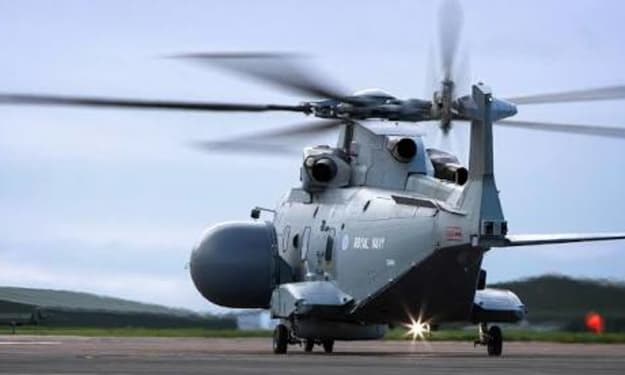
Royal Navy Crowsnest airborne surveillance helicopters deployed to Cyprus
Deployment strengthens British monitoring capability in the Eastern Mediterranean amid regional tensions. The United Kingdom has deployed a number of airborne surveillance helicopters equipped with the advanced Crowsnest radar system to Cyprus, strengthening its ability to monitor activity across the Eastern Mediterranean. The move comes as regional tensions continue to rise and the UK enhances its military readiness to support allies and protect strategic interests. The helicopters, operated by the Royal Navy, are part of Britain’s airborne early-warning capability designed to detect aircraft, ships and potential threats over long distances. Mounted on AgustaWestland Merlin HM2 helicopters, the Crowsnest system provides radar coverage that significantly extends the situational awareness of naval forces operating at sea. Strategic Deployment to Cyprus The aircraft have been deployed to the UK’s sovereign base areas in Cyprus, which serve as a critical hub for British military operations in the Middle East and Mediterranean region. From these bases, the helicopters can monitor wide swathes of airspace and maritime routes stretching across the eastern Mediterranean. Military officials say the deployment is designed to enhance intelligence gathering and early warning capabilities during a period of heightened regional uncertainty. The Eastern Mediterranean has become an increasingly important strategic area due to ongoing conflicts, shipping routes and the presence of multiple international military forces. The move also supports broader British defence efforts in the region, particularly as the UK positions naval assets to respond quickly to potential crises. What the Crowsnest System Does The Crowsnest system represents the Royal Navy’s latest generation of airborne surveillance technology. It is designed to provide airborne early warning and control, enabling naval commanders to detect and track aircraft, missiles and ships far beyond the radar horizon of surface vessels. Unlike traditional ship-based radar systems, airborne platforms can scan a much larger area because of their higher altitude. This allows the radar to identify potential threats earlier and provide commanders with more time to respond. Mounted beneath the Merlin helicopter’s fuselage, the Crowsnest radar can rotate and scan the surrounding airspace while transmitting data back to ships, command centers and allied forces. Military analysts say this capability is especially important for protecting high-value naval assets such as aircraft carriers and amphibious ships. Support for Carrier Operations The helicopters are closely linked with the operations of the HMS Prince of Wales, one of the UK’s two large aircraft carriers. Crowsnest-equipped helicopters typically operate as part of a carrier strike group, providing the airborne surveillance necessary to detect incoming threats before they reach the fleet. By deploying the helicopters to Cyprus, the Royal Navy can maintain surveillance coverage even when the carrier itself is not immediately present in the region. The move also ensures that trained crews and equipment are positioned close to potential operational areas. Defence officials have stressed that such deployments are routine components of the UK’s global military posture, though they often become more visible during periods of geopolitical tension. Importance of the Cyprus Bases The United Kingdom maintains two sovereign base areas on Cyprus — RAF Akrotiri and Dhekelia — which have long served as forward operating locations for British and allied forces. Their proximity to the Middle East allows rapid response to developments in several strategically sensitive regions. These bases have been used for surveillance missions, humanitarian operations, evacuation efforts and coalition military campaigns over the years. Aircraft operating from Cyprus can monitor maritime traffic in the Mediterranean and provide support to naval forces operating further south or east. With tensions in the Middle East continuing to fluctuate, the bases remain one of Britain’s most important overseas defence installations. Enhancing Regional Monitoring The deployment of the Crowsnest helicopters reflects the increasing importance of surveillance and early warning in modern military operations. Detecting threats early allows commanders to coordinate defensive measures, deploy intercepting aircraft, or adjust naval formations before hostile forces approach. For the Royal Navy, maintaining a robust surveillance network is essential for safeguarding both British forces and allied vessels operating in the region. Preparedness in an Uncertain Environment While British officials have not indicated that the helicopters are preparing for immediate combat operations, the deployment highlights the UK’s readiness to respond to evolving security challenges. By positioning airborne surveillance assets close to potential areas of instability, the UK ensures it can monitor developments in real time and support allied forces if required. As geopolitical tensions persist across several parts of the Middle East and Eastern Mediterranean, the presence of advanced systems like Crowsnest underscores the role of technology and preparedness in maintaining maritime security.
By Fiaz Ahmed 3 days ago in The Swamp



Comments
There are no comments for this story
Be the first to respond and start the conversation.