
The Shadow Recession and AI
When the bubble pops we're all doomed... or maybe not


There are a few things within conventional economics that I believe we rely on too much as an indicator of how well… or how shit an economy is actually doing. And GDP, and GDP per capita are probably top of the list of things that Economists like me rely on far too much, because if you believe the conventional wisdom, the GDP of America going up is a sign that the Tariffs are working and the economy is doing well. But if you ask everyday Americans, the picture is not sunshine or rainbows, it is quite the opposite. The sticker price at the store is more now than it ever has been, and their wages are not really growing to meet the cost of living at all. The economy has functionally been stagnant long before Trump and likely started during Biden’s tenure. But Trump is absolutely making it worse on the lowest strata of Americans.
So, if the average joe is suffering, why is GDP seemingly increasing, why is the quantitative data so wrong? Well, GDP is a measure of the output of an economy, for the nerds its measured as.
GDP = C+I+G+(X- M)
Let’s break that down for you, C is for household consumption, in essence how much you as a household are spending on goods, services, etc, this makes up a significant chunk of GDP in most models, and in regard to what I’m talking about, it is the core of my argument. I is the gross investment over the economy, this doesn’t always include government investment, it usually represents private investment, this is relevant to the AI investments that have been happening for at least the past 4 years. G represents government spending, it’s inclusive of deficits, and military spending. And then there is X (Exports) and M (Imports), countries naturally need to import what they can’t produce on their own and export the excess of what they can’t consume to other countries, this is part of what “free trade” is, the free movement of goods and services into and out of a given country.
Now that you understand what GDP is, why is it wrong (in this case). Well first we have to talk about the AI market, and how that plays into everything
Artificial intelligence – The Kingmaker and the Kingslayer
So, the current wave of AI has been around since at least 2020, and I’m including private use of ChatGPT 3, but it wasn’t released to the public until 2022. Once the private market caught wind that OpenAI had developed a plausibly profitable Large Language model, the investments into it began to trickle in, and once ChatGPT became public and everyone got to experience it first-hand, investments began to surge it and other models into the mainstream. This means around $800 Billion to $1.2 Trillion has been invested into AI since 2020 (Globally), which equates to around 1.4% of America’s GDP. That is actually quite a lot of money to be tied up in a new market that hasn’t yet proven itself to be profitable in anyway. Additionally, AI is likely to be the epitome of “short term gain” if it does end up being profitable.
This is because AI unlike the revolutionary technology that came before it (like the steam engine) actually creates more liability than it decreases. We’ve already started to see manual labour jobs decrease, and middle class (clerical) jobs tank in employment numbers as AI, especially ChatGPT agents take over those roles or water down the wages related to those roles. Based on the United States Bureau of Labor Statistics, between 12-30% of the United States workforce are in jobs vulnerable to AI replacement or AI-related wage dilution, that is around 18.5-28 million Americans.
If we are being middle of the road about it, and 22 million American’s face wage dilution and/or replacement from AI, then that will reduce their spending power, and ironically, will reduce any kind of profitability that AI may have because AI hasn’t just replaced them, but has also reduced its customer base at the same time. What I am about to say is the most speculative part of this whole piece, The administration’s decision to delay labour statistics coincides suspiciously with rising automation risks… and politically, it would be convenient to suppress evidence of large-scale displacement.
So, the long story short is, the investment of AI is propping up the economy, because spending power for households has plummeted and will likely continue to plummet. While AI as an unproven product will continue to absorb much of the loss households are facing. But we’re already seeing investments in AI slow down and we’re approaching a well-proven phenomenon in Economics called a Minsky Moment.
When the sky falls on our heads
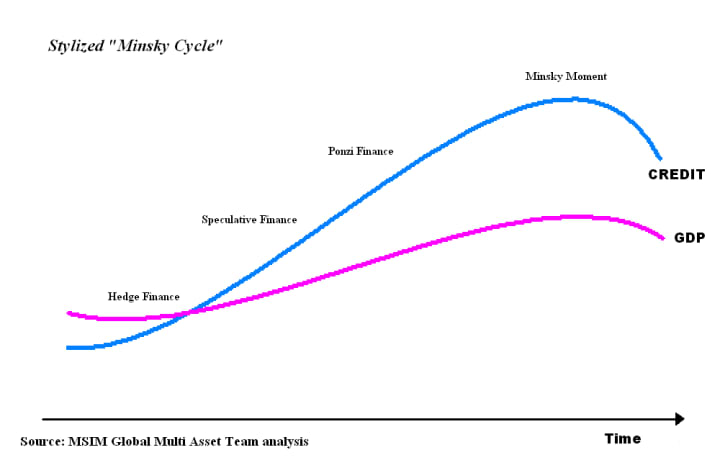
Back in 2008, during the Global Recession, there was talk from the layman of “the crash was unpredictable, who could have predicted this” and well funny you say that Hyman Minsky did at least 30 years earlier. Post-Keynesian Economist, Hyman Minsky described what would later be referred to as a “Minsky Moment” wherein investors, governments, etc all realise that the borrowing they’ve been doing in order to invest in a market or asset isn’t actually going to result in any tangible gain. Resulting in investments being pulled, interest on loans spiking and asset values crashing often resulting in a “credit crunch” wherein the borrowers are unable to pay back the loans they’ve taken out, because the money is gone, and their investment vehicle (the thing they were investing in) has disappeared.
What we are seeing with the slow down of AI investments is the lead up to the Minsky moment we saw in late 2007, wherein house prices started to shrink slightly before they crashed “out of nowhere”. So, what does this mean for after the AI bubble bursting?
The morning after pill
So, it’s clear that the average joe in the United States has been experiencing a recession that the data hasn’t shown for at least the past 2 years. If the thing keeping the economy just above recession level crashes, what does that ultimately mean for the economy as a whole. Well, there’s an optimistic view, and then there’s the pessimistic one. Fortunately for you, I lean far more optimistically than some people on the internet or in the halls of academia.
If AI crashes, the US economy will likely fall into a depression (one it’s technically been in for at least 6 months to a year), meaning that the United States will have been in a recession that has lasted for at least 2 full quarters. A recession is when there is at least 2 quarters of negative GDP growth consecutively, a depression is a recession that lasts usually more than 2 years. That’s usually accompanied by massive layoffs, bread lines and increase in criminality as people try to make ends meet when jobs are scarce.
And for those who may take issue with me referring to this moment as a depression. I will put your mind at ease, by stating the obvious; this will result in Corporate Expenditure drying up, and owing to how incestuous the American economy is, wherein every business and bank borrows and trades with each other, if one investment bank dries up, every business will be left on the hook for their debts, causing them to crash or fall into liquidation, and millions will lose their jobs, not to AI but the failed promises of it. This will be the second depression America has ever had since the great depression of 1929, and if all of this does not make a depression, you need to take your econ class again.
An optimistic conclusion
So, this is where it gets butterflies and rainbows, the government has two options if either a recession or depression happens. The debt hawks are going to hate this, but the Government will either have to borrow a sh*t ton of money and funnel it into every single stratum of the economy OR print the money, devalue the currency and increase sales taxes to try and get the economy producing hard goods again. As far as the United States is concerned, I suspect that Trump is likely to do the latter.
Before someone says “TAXES” yes, you could also tax the rich, but I don’t think Trump is about to do that. He’s a Populist, not a Rockefeller Republican.
About the Creator
Ashyr H.
My name is Ash, I'm a 3rd year Business Economics student mainly specialising in Alternative Business structures like Co-operatives and Accessibility. I mainly write about Business, Politics, Sociology and some personal stuff.
They/them
Iran Acknowledges Mass Protest Deaths, But Claims Situation Under Control as Trump Mulls Response
Iran is facing one of the most intense and deadly waves of civil unrest in years, with nationwide protests pushing the clerical regime into a precarious position. While Tehran has publicly acknowledged that demonstrators have died, Iranian officials maintain that the situation is now under control — a claim sharply contrasted by mounting reports of deaths, widespread arrests, and international pressure. Meanwhile, U.S. President Donald Trump has made clear that Washington is weighing a range of responses, including possible military action, in reaction to Tehran’s violent crackdown.
By Aadil shanawarabout 22 hours ago in The Swamp
Standing While Falling
Quotation from Friedrich Nietzsche "He who wrestles long with monsters should beware lest he himself become a monster. And if you gaze long into an abyss, the abyss also gazes into you. Man is not destroyed by suffering, but by the meaning he makes of it."
By LUCCIAN LAYTH6 days ago in Critique


Comments
There are no comments for this story
Be the first to respond and start the conversation.