
The Rise and Fall of saddam Hussein
Power, Fear, and the Inevitable Fall — Humble Beginnings: A Boy from Tikrit with a Dangerous Dream — The Ba’ath Party and the Seizure of Power — A Reign of Terror: Saddam’s Grip Over Iraq

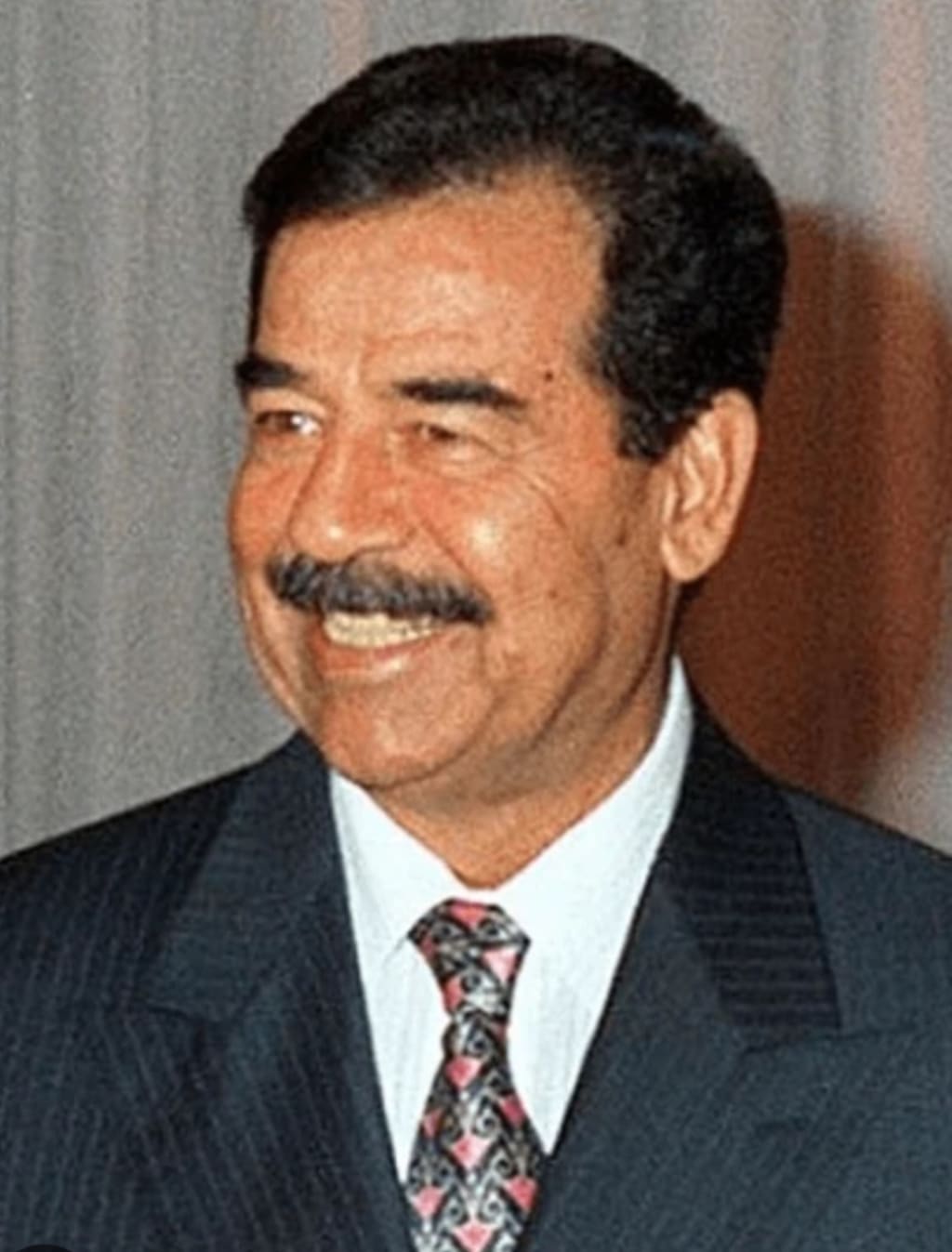
He was once one of the most feared men on earth — his name whispered in terror, his portrait plastered across buildings, schools, and even currency. Saddam Hussein ruled Iraq not as a leader, but as a tyrant whose grip on power was enforced through violence, fear, and total control.
Born in 1937 in a poor village near Tikrit, Iraq, Saddam’s early life was marked by hardship and abuse. Raised by a brutal stepfather, his childhood experiences likely carved the ruthless mindset he would later unleash on an entire nation. As a young man, he joined the Ba'ath Party, drawn by its promises of Arab nationalism and socialism. But Saddam didn't just want to follow the party — he wanted to own it.
In 1968, through a coup, the Ba’ath Party seized power in Iraq, and over the next decade, Saddam maneuvered himself to the top. By 1979, he declared himself president. His rise was swift, but the fear he instilled spread even faster. During his first official speech as president, Saddam read a list of names of so-called “traitors” — many of whom were present in the room — and they were dragged out and executed immediately. That moment became symbolic of his rule: absolute, brutal, and terrifying.
Once in power, Saddam began to rebuild Iraq’s economy using oil revenue, constructing roads, schools, and infrastructure. On the surface, it looked like progress — but beneath it all, a dark shadow grew. Saddam’s regime was infamous for its secret police, torture chambers, and sudden disappearances. Entire families vanished overnight. Political opponents were executed. Even suspected critics were silenced forever. No one was safe — not even his own relatives.
In 1980, Saddam made a decision that would define his rule: he invaded neighboring Iran. What he expected to be a quick victory turned into an eight-year war that killed over a million people. The conflict drained Iraq’s economy and left the region devastated. Saddam didn’t hesitate to use chemical weapons, not only on the battlefield but also against civilians — including the horrific massacre of thousands of Kurdish people in Halabja in 1988. He justified it as protection of Iraq’s unity. The world called it genocide.
Two years after the Iran-Iraq war, Saddam again shocked the world by invading Kuwait in 1990. Bold and arrogant, he claimed Kuwait was historically a part of Iraq. But this time, the global powers responded swiftly. The United States led a coalition to launch Operation Desert Storm in 1991. Iraq’s military crumbled under the weight of modern warfare. Saddam was forced to retreat, but his grip on Iraq remained. Inside the country, he crushed uprisings with full force, killing tens of thousands. The people were terrified, but powerless.
By the early 2000s, Saddam’s Iraq was isolated, sanctioned, and struggling. His regime still ruled with an iron fist, but the outside world was watching. Then came the fatal turning point: the accusation that Iraq was hiding weapons of mass destruction. The U.S., under President George W. Bush, used this claim to justify a full-scale invasion in 2003. Whether those weapons ever existed or not remains a debated mystery — but for Saddam, it didn’t matter anymore.
Within weeks, Baghdad fell. Statues of Saddam were pulled down in the streets by cheering crowds. His palaces were looted, his ministers fled. But Saddam himself had vanished. A man once omnipresent was now hiding like a fugitive.
For months, the world hunted him. Then, on December 13, 2003, U.S. forces discovered him in a small underground bunker near Tikrit. Disheveled, bearded, and powerless — he was no longer the feared dictator but a captured man clinging to survival. The news sent shockwaves around the globe. The man who once terrified a nation was now in chains.
Saddam was put on trial for crimes against humanity, including murder, torture, and genocide. It was a long, tense legal process, watched by millions. His demeanor in court was defiant at times, silent at others. In the end, he was sentenced to death. On December 30, 2006, Saddam Hussein was hanged. The video of his execution leaked, showing a once-mighty figure meeting a brutal end.
Even in death, Saddam left behind a divided legacy. Some in Iraq mourned him, remembering the days of strong rule and national pride. Others celebrated, having lived through his years of oppression. The country itself spiraled into chaos after his fall — civil war, sectarian violence, and terrorism took root. His absence didn’t bring peace. Instead, it opened the door to deeper wounds that remain unhealed.
Saddam Hussein’s life is a dark chapter in modern history. It is a story of how power can corrupt, how fear can rule a nation, and how one man’s ambition can destroy millions of lives. His rise was built on blood; his fall echoed with betrayal, war, and broken dreams. And though he is gone, Iraq still lives in the shadow of what he left behind.
About the Creator
Misbah
Collector of whispers, weaver of shadows. I write for those who feel unseen, for moments that vanish like smoke. My words are maps to places you can’t return from
A Gathering of Evil Bosses
“I’m the queen of chin jutting while I smooth my hair, attacking, insulting, and deflecting to protect my appointer.” “Oh, please, Blondi, my hair is curled, highlighted, and longer than yours. I feature television commercials telling immigrants that we will give them a free plane ride home, and if they voluntarily turn themselves in, they will be allowed to legally apply for re-entry. It runs everywhere, and I look good in it! You can’t compete because of your blond hair. Mine is nicer, and my lips are prettier than yours.”
By Andrea Corwin 23 days ago in The Swamp




Comments
There are no comments for this story
Be the first to respond and start the conversation.