
The Man Who Shook the World: The Untold Story of Julian Assange
From secret war files to global headlines — how one man challenged power and redefined truth

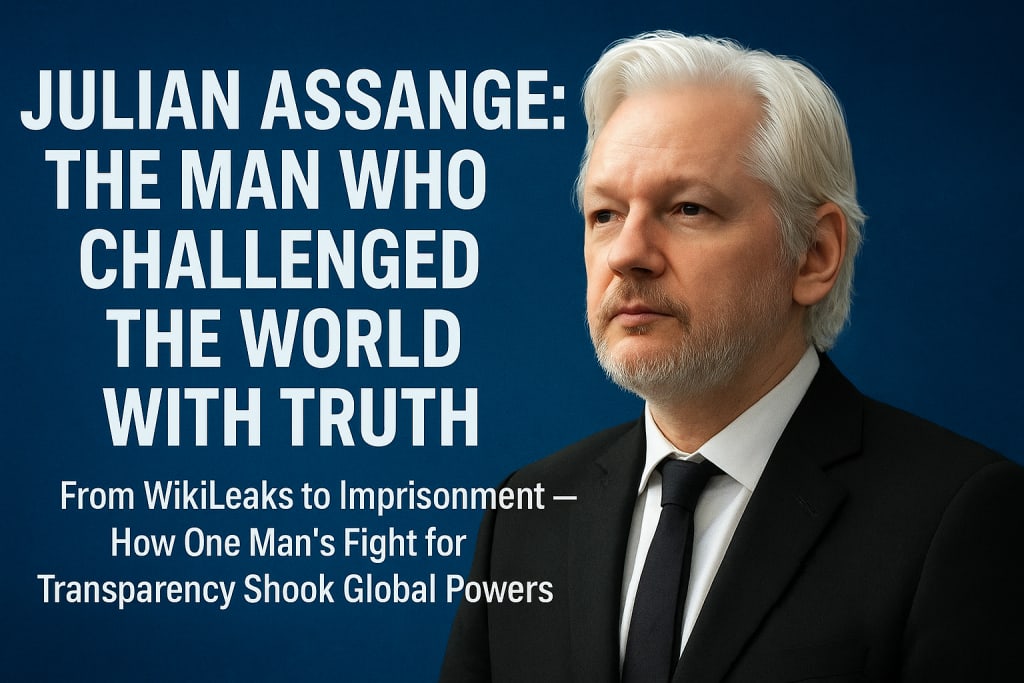
When history is written about the digital age, the name Julian Assange will not be forgotten. Whether hailed as a hero of transparency or criticized as a reckless agitator, Assange remains one of the most controversial figures of the 21st century. His story is not just about one man — it is about power, secrecy, freedom, and the cost of truth.
The Beginning of a Rebel Mind
Born in Townsville, Australia in 1971, Julian Assange was not destined for an ordinary life. By his teenage years, he was already drawn to the hidden world of computers. Known under the hacker alias “Mendax,” Assange explored networks and systems at a time when the internet was still young and unregulated.
This rebellious curiosity laid the foundation for something larger: a belief that governments and powerful institutions should not operate in secrecy while citizens remain in the dark.
The Birth of WikiLeaks
In 2006, Assange co-founded WikiLeaks, a platform designed to receive, protect, and publish leaked documents from whistleblowers worldwide. Its mission was simple yet radical: reveal hidden truths to the public, regardless of how powerful the subject might be.
At first, WikiLeaks published smaller stories. But in 2010, everything changed.
The Year That Changed Everything
In April 2010, WikiLeaks released the now infamous video titled “Collateral Murder.” The footage, leaked by U.S. Army intelligence analyst Chelsea Manning, showed a U.S. military helicopter attack in Baghdad that killed civilians, including journalists.
Soon after, WikiLeaks published hundreds of thousands of classified U.S. documents related to the wars in Iraq and Afghanistan, followed by a massive dump of U.S. diplomatic cables.
For some, this was an extraordinary act of transparency, exposing the realities of war and government hypocrisy. For others, it was reckless, endangering lives and national security.
But one thing was clear: Julian Assange had shaken the world.
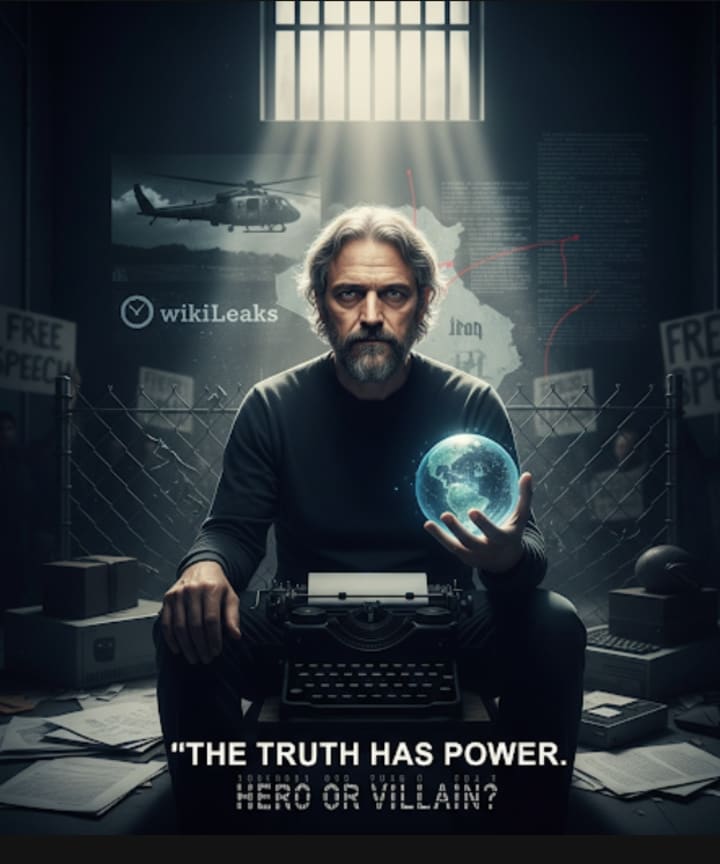
Hero or Villain?
Assange’s supporters call him a champion of truth and free speech. They argue that citizens have the right to know what their governments are doing in their name.
Critics, however, see him as irresponsible. They claim that releasing sensitive documents without redaction put soldiers, informants, and ordinary people at risk.
This tension — between freedom of information and national security — is at the heart of Assange’s story.
The Asylum Years
In 2012, facing extradition to Sweden over unrelated allegations (which were later dropped), Assange sought asylum in the Ecuadorian Embassy in London. For nearly seven years, he lived inside that building, cut off from the outside world.
Outside, British police waited constantly. Inside, Assange fought legal battles and continued his work online. His unusual life turned him into a symbol — of resistance, secrecy, and political controversy.
Arrest and Imprisonment
In April 2019, Ecuador withdrew his asylum. British police entered the embassy and arrested Assange. Since then, he has been held in Belmarsh Prison in London, often described as the UK’s “Guantanamo Bay.”
The United States has charged him under the Espionage Act, seeking extradition for his role in publishing classified materials. If convicted, he could face decades in prison.
A Global Debate
Assange’s case is no longer just about one man. It is about questions that affect everyone in the digital age:
Should governments have the right to keep secrets at any cost?
Do citizens have a right to know uncomfortable truths?
Is publishing leaked information journalism — or espionage?
For journalists, human rights activists, and ordinary citizens, these questions strike at the very core of democracy.
The Legacy of Assange
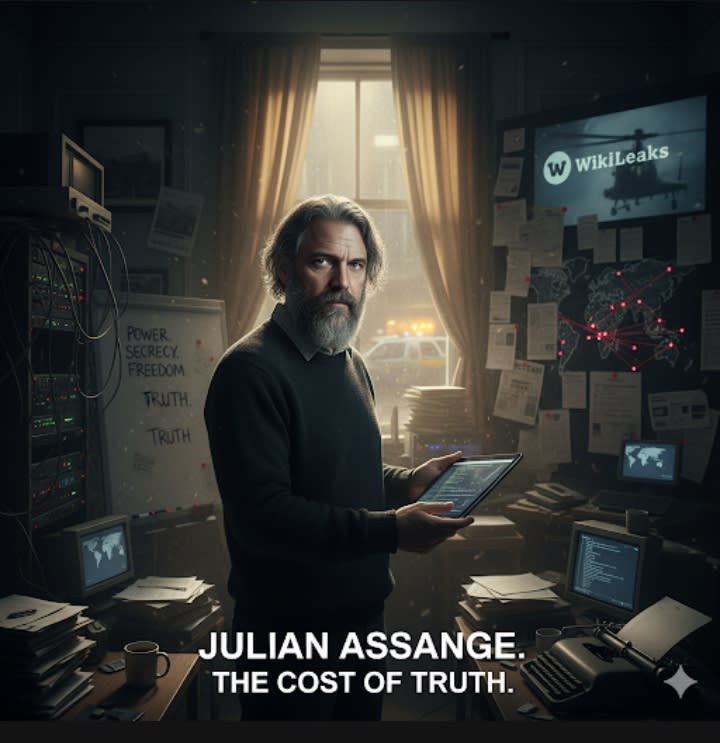
Regardless of how his legal battle ends, Julian Assange has already left an indelible mark on history. He forced the world to confront the uncomfortable balance between transparency and security. He showed that one determined individual — armed with technology, belief, and courage — can challenge the most powerful nations on Earth.
Assange is not a simple hero or villain. He is a mirror, reflecting both the light and darkness of our modern world.
Final Thoughts
The story of Julian Assange is unfinished. Even as you read this, courts and governments are deciding his fate. But his impact has already been written into history.
In the end, whether you agree with him or not, Assange has proven one thing beyond doubt: the truth has power.
✨ If you found this article thought-provoking, don’t forget to hit “Subscribe.” More stories on human rights, politics, and the future of freedom are on the way — and your support helps keep these discussions alive.
About the Creator
AngelFace
✨ “I share mysteries 🔍, stories 📖, and the wonders of the modern world 🌍 — all in a way that keeps you hooked!”
The Forsyth House Fire
Since 1851, Forsyth House has stood on the corner of Union Street and Gordon Street in the heart of Glasgow. Its iconic, or was... because on Sunday 8th of March, 2026, a fire broke out in a small, seemingly un-named shop in the building and tore all that history down. As I write, the rubble is still unsettled and the street is still blocked off. Central Station is quiet on the upper level, and around 30 small businesses have quite literally gone up in smoke.
By S. A. Crawford3 days ago in The Swamp
U.S. Refueling Plane Crashes in Iraq, Military Says
A U.S. military KC‑135 Stratotanker refueling aircraft crashed in western Iraq on March 12, 2026, the U.S. Central Command (CENTCOM) confirmed, prompting urgent rescue operations as the fate of the crew remains unknown. The incident occurred amid ongoing U.S. military operations linked to the conflict with Iran, with officials stressing that the crash was not the result of hostile fire or friendly fire. The KC‑135, a mainstay of the U.S. Air Force’s aerial refueling fleet for more than six decades, was operating in “friendly airspace” over western Iraq when the mishap occurred. CENTCOM’s initial statement confirmed that two aircraft were involved in the incident — one that went down and a second that was able to land safely despite sustaining damage. Rescue teams, including U.S. military personnel and coalition partners in the region, were deployed quickly to locate the site of the crash and extract any survivors. Officials have not yet provided details on the number of personnel aboard or their condition, citing the developing nature of the situation. The Stratotanker plays a critical support role in extended air operations by refueling combat aircraft mid‑air, enabling missions to cover great distances without returning to base for fuel. Given the operational tempo of U.S. forces during the current Middle East conflict, KC‑135 tankers have been in heavy use supporting fighter jets, bombers, reconnaissance aircraft, and other assets. CENTCOM emphasized that the aircraft’s loss was not caused by hostile action, clarifying that no hostile fire or friendly fire was involved. The circumstances point toward an accident or operational mishap while two tankers were flying in close proximity, though investigators will need time to reconstruct the events leading up to the crash. The identity of the downed tanker, as well as its mission specifics, have not been publicly disclosed. However, multiple U.S. officials familiar with the matter told reporters that the flight was part of a refueling mission supporting American and allied aircraft conducting operations under the banner of Operation Epic Fury, a campaign linked to the broader hostilities involving Iran. Officials noted that the second aircraft involved issued an emergency declaration and later landed safely at an airfield outside Iraq after the mid‑air incident. The relationship between the two tankers during the crash has not been fully explained, and CENTCOM said it would release more information as it becomes available. The current incident marks one of several aviation losses the U.S. military has acknowledged in recent weeks connected to the conflict. Earlier episodes included aircraft damaged during friendly fire incidents or other unforeseen circumstances, though in many cases crew members survived or were successfully recovered. Officials in Washington stressed that the KC‑135’s age and the inherent risks of aerial refueling, a complex and tightly coordinated maneuver, can contribute to accidents even in the absence of enemy engagement. With more than 300 tankers still in service across active duty units and the Air National Guard, the aircraft remains vital to sustained air operations but also faces maintenance and operational challenges given its decades‑old design. As of the latest updates, military search and rescue teams are focusing on locating the crash site in the remote desert region of western Iraq. U.S. officials have said they are coordinating with Iraqi authorities to facilitate access and ensure safety for recovery teams. Family members of the crew were being notified privately as part of standard military protocol prior to any public details regarding casualties. The Pentagon has not released a formal count of personnel aboard the aircraft, but typical KC‑135 missions involve at least five to six crew members, including pilots, navigators, flight engineers, and boom operators tasked with conducting the refueling. President Donald Trump and other senior U.S. defense officials have acknowledged that the conflict involving Iran and allied militias will likely continue to strain American and coalition forces in the region. They have also warned that air and ground operations in hostile environments inherently carry risks to both personnel and equipment. At this stage, no timeline has been provided for when investigators expect to release a preliminary report on the cause of the crash. Military aviation incidents, especially involving mid‑air events, typically involve detailed analysis of flight data recorders, radar tracks, communications logs, and eyewitness accounts. The loss of a tanker aircraft and its potential human toll underscores the broader challenges faced by U.S. forces operating in a high‑tempo conflict environment. As rescue and recovery efforts continue in Iraq, U.S. Central Command pledged to keep the public informed with verified facts and to support the affected families throughout this difficult process.
By Fiaz Ahmed 3 days ago in The Swamp


Comments (2)
Wow 👌 so nice this article and Information
"Powerful read ✍️🔥 Assange’s case really shows how press freedom and corruption are connected. Much needed perspective 👏🌍"