
The Limits of Saudi Power in Southern Yemen: A Struggle for Control in a Divided Nation
Subtle Shifts in Saudi Influence: The Struggles for Control in Southern Yemen

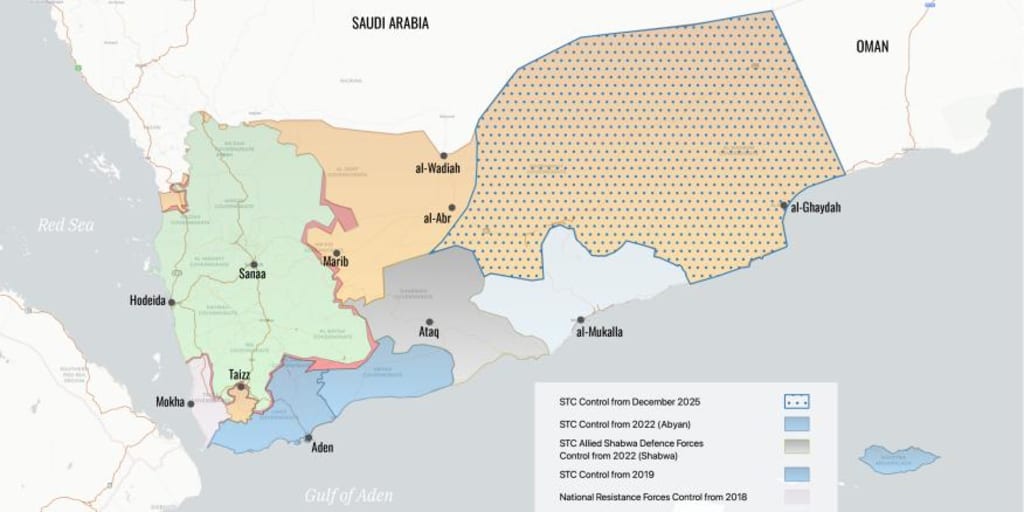
The conflict in Yemen, now in its ninth year, has involved multiple actors with competing interests. One of the most significant powers involved in the Yemen conflict is Saudi Arabia, which has supported the Yemeni government against the Houthi rebels since 2015. However, despite the kingdom's military dominance and substantial financial investments, Saudi Arabia's power in southern Yemen has encountered serious limits. The Southern Transitional Council (STC) and other local factions, once aligned with Riyadh, now challenge Saudi influence in the region, underscoring the complexity of Yemen's ongoing civil war.
The Southern Transition and Saudi Interests
Historically, the southern part of Yemen had its own independent government until its unification with the north in 1990. The unification did not last long, as tensions between the two regions culminated in a civil war in 1994. While the North emerged victorious, the deep divide between the northern and southern regions persisted. The region's desire for autonomy resurfaced after the conflict began in 2015, and the STC, a group primarily based in the south, emerged as a significant player.
Saudi Arabia’s involvement in Yemen's war was initially framed as a campaign against the Iran-backed Houthi rebels, but over time, the dynamics became far more complex. With the STC’s growing influence and its desire for greater autonomy for southern Yemen, Riyadh found itself supporting a fractured coalition, one that struggled with competing local interests.
Saudi Arabia’s primary goal in Yemen has been to contain the rise of the Houthi rebels, who control northern Yemen and have ties to Iran. However, its military campaign has failed to defeat the Houthis, and the southern region's instability, fueled by the STC and other local groups, has become another challenge to Riyadh's authority.
The Rise of the Southern Transitional Council (STC)
In recent years, the STC has become one of the most prominent and well-equipped military forces in southern Yemen, despite initially being a Saudi-backed entity. The STC, which seeks greater autonomy for the south, has increasingly challenged Saudi Arabia's authority in the region. The group has been supported by the United Arab Emirates (UAE), which has its own interests in the south. As a result, Saudi Arabia has faced growing opposition from a faction it once considered an ally.
The STC's demands for autonomy have led to tensions with the Yemeni government, which is also supported by Saudi Arabia. The STC wants to establish a federal system of government, granting the south significant control over its resources and governance. This vision conflicts with Saudi Arabia's broader goal of preserving Yemen as a unified state under the current internationally recognized government.
The UAE, which has supported the STC, withdrew many of its forces from Yemen in 2019, leaving Saudi Arabia to continue its military involvement. Despite this, the UAE has continued to provide political and financial backing to the STC, which has become a formidable political and military force in southern Yemen.
Saudi Arabia’s Struggle for Influence
Saudi Arabia’s involvement in southern Yemen has become a complex balancing act. On the one hand, the kingdom supports the internationally recognized Yemeni government, which it sees as a counterweight to the Houthi rebels. On the other hand, it needs the support of the STC, which controls significant portions of the south and has become a key player in the conflict.
While Saudi Arabia has tried to maintain influence over the STC, tensions have emerged between the two. The STC has increasingly acted independently of Saudi Arabia and has fought against Yemeni government forces in the south. The group’s push for autonomy has further complicated Saudi Arabia’s position.
The difficulty for Saudi Arabia lies in its inability to fully control the situation in southern Yemen. Despite its military power and financial resources, Saudi Arabia has found it challenging to bring about a resolution to the conflict or ensure stability in the south. The STC’s growing autonomy and the division between Riyadh and its allies in Yemen have limited Saudi Arabia’s ability to assert control over the region.
The Role of External Actors: The UAE and Iran
While Saudi Arabia has tried to maintain influence over southern Yemen, other external actors have played significant roles in shaping the region’s dynamics. The UAE, in particular, has had a strong presence in the south, supporting the STC and providing military backing. The UAE's backing of the STC is rooted in its broader geopolitical interests, including limiting Iranian influence in the region and securing access to the strategic ports in southern Yemen.
The involvement of Iran, through its support of the Houthi rebels, has also complicated the situation. Iran's involvement has added a sectarian element to the conflict, with the Houthis, a Shia Muslim group, facing off against Saudi Arabia, a predominantly Sunni power. Saudi Arabia’s concern about Iran's growing influence in Yemen has been a major driver of its involvement in the war.
The Way Forward: A Fragmented South and a Fragile Peace
As the conflict in Yemen drags on, it remains unclear whether Saudi Arabia will be able to exert control over southern Yemen. While the kingdom has worked to secure a political settlement through the Riyadh Agreement (2019), which was intended to bring the Yemeni government and the STC together, the agreement has largely failed to produce meaningful results. The STC continues to push for autonomy, and the central government remains fragmented, with the war showing few signs of ending.
Saudi Arabia's influence in Yemen is likely to remain limited as long as local actors like the STC continue to challenge the government’s authority. The conflict in Yemen, once seen as a straightforward confrontation with the Houthis, has become far more complex, with competing regional powers and local factions complicating the path to peace.
Conclusion: A Shifting Geopolitical Landscape
The limits of Saudi power in southern Yemen underscore the changing geopolitical dynamics in the region. Saudi Arabia's strategic interests in Yemen have become increasingly difficult to navigate, as its influence is challenged by local actors and rival powers such as the UAE and Iran. The southern region, with its growing autonomy and division between various factions, poses a serious challenge to Saudi Arabia’s regional influence.
As Yemen's civil war continues, the future of Saudi Arabia's role in the country remains uncertain. However, it is clear that the kingdom’s efforts to shape the future of southern Yemen will face increasing challenges as the region becomes more fragmented and complicated by shifting alliances.
About the Creator
Fiaz Ahmed Brohi
I am a passionate writer with a love for exploring and creating content on trending topics. Always curious, always sharing stories that engage and inspire.
Keep reading
More stories from Fiaz Ahmed Brohi and writers in The Swamp and other communities.
Why Does Canada Have Such High Rates of Forced Psychiatric Hospitalizations?
Mental health care is a crucial component of any healthcare system, and in recent years, many countries, including Canada, have made significant strides in addressing mental health challenges. However, despite efforts to improve mental health care and reduce stigma, Canada is facing a concerning trend: high rates of forced psychiatric hospitalizations. This issue has raised numerous questions about the country’s mental health care system, its legal framework, and the ethical implications of involuntary treatment. Understanding Forced Psychiatric Hospitalizations Involuntary or forced psychiatric hospitalization refers to the practice of admitting individuals to a psychiatric facility without their consent due to concerns about their mental health and safety. In Canada, this can happen under specific conditions, usually when an individual is deemed to be a danger to themselves or others due to a mental illness. Forced hospitalizations typically occur in cases of severe mental illness, such as schizophrenia, bipolar disorder, or severe depression, where the individual’s judgment may be impaired. Canada’s legal framework, which includes provincial and territorial mental health acts, outlines the criteria under which an individual can be involuntarily hospitalized. These acts are designed to balance individual rights with the need to protect those who may pose a risk to themselves or others due to mental illness. The High Rates of Involuntary Hospitalizations in Canada One of the most concerning aspects of this issue is the disproportionately high rate of involuntary hospitalizations in Canada compared to other countries. According to recent studies and reports, Canada has one of the highest rates of forced psychiatric admissions among Western nations. For example, a study published in the Canadian Journal of Psychiatry revealed that more than one-third of psychiatric hospitalizations in Canada were involuntary, which is significantly higher than the rates seen in other developed countries. Several factors contribute to this high rate, and they range from systemic issues within the healthcare system to societal and legal challenges. 1. Overburdened Mental Health System Canada’s mental health care system is often criticized for being underfunded and overburdened. While the country has made substantial investments in healthcare, mental health care remains a low priority in many provinces. This lack of resources leads to long wait times for treatment, limited access to mental health professionals, and an insufficient number of inpatient psychiatric beds. As a result, individuals with serious mental health issues may be placed in psychiatric facilities as a last resort when outpatient care and community-based services are unavailable or inadequate. The lack of resources also means that mental health professionals are often forced to make difficult decisions. In some cases, patients who could benefit from outpatient care are admitted involuntarily to ensure they receive the care they need, even if this leads to ethical and human rights concerns. 2. Legal Framework and Involuntary Hospitalization Laws The legal framework governing involuntary psychiatric hospitalizations varies across provinces and territories in Canada. However, the criteria for forced hospitalization generally remain consistent: a person must pose a risk to themselves or others due to mental illness, and their treatment cannot be provided effectively in a less restrictive environment. While the legal framework aims to protect individuals from harm, some argue that the criteria for involuntary hospitalization are too broad and are being applied too frequently. Critics contend that the threshold for what constitutes a danger to oneself or others can be subjective, and the decision to admit someone involuntarily is often made without sufficient safeguards to protect their rights. For example, some individuals may be hospitalized against their will simply for behaviors associated with their mental illness, such as refusing treatment or expressing suicidal thoughts, even if they do not pose an imminent danger to themselves or others. This raises concerns about the potential for overuse of involuntary hospitalization, especially for marginalized populations. 3. Stigma and Discrimination Against Mental Illness Another factor contributing to high rates of forced psychiatric hospitalizations in Canada is the stigma surrounding mental illness. People living with mental health conditions are often treated as dangerous or unpredictable, which can lead to overprotective responses from healthcare providers, families, and the general public. This stigma may contribute to a culture of over-medicalization, where individuals with mental health issues are more likely to be hospitalized involuntarily instead of being offered community-based support or treatment options. Additionally, systemic discrimination, particularly against Indigenous peoples and racial minorities, can exacerbate the issue. Indigenous individuals in Canada, for example, are overrepresented in the psychiatric system and are more likely to experience forced hospitalizations. This disparity can be attributed to various social determinants of health, including poverty, historical trauma, and discrimination. 4. Lack of Community-Based Mental Health Support A major barrier to reducing involuntary hospitalizations is the lack of community-based mental health services. In many parts of Canada, mental health care is still heavily focused on institutionalized settings, rather than on outpatient services or community-based support networks. This gap in services leaves people with few options when they need help but do not require hospitalization. Consequently, many individuals are admitted to psychiatric hospitals as a way to ensure they receive care, even if it may not be the most appropriate option for their long-term well-being. 5. The Need for Reform Addressing the issue of high rates of forced psychiatric hospitalizations in Canada requires comprehensive reforms. This includes investing in community-based mental health services, increasing the availability of outpatient care, improving access to early intervention programs, and reducing the stigma surrounding mental illness. Additionally, it is crucial to ensure that the legal framework for involuntary hospitalization is clear, transparent, and consistently applied, with sufficient safeguards in place to protect individuals' rights. Conclusion: Moving Toward a More Compassionate Mental Health System The high rates of forced psychiatric hospitalizations in Canada are a complex issue that reflects deeper systemic problems within the country’s mental health care system. While involuntary hospitalization may be necessary in some cases to protect individuals, the overuse of this practice can have serious consequences for patients' dignity and autonomy. To address this issue, Canada must prioritize mental health reform, focusing on creating a more compassionate, inclusive, and accessible system that emphasizes early intervention, community support, and the reduction of stigma. Only through comprehensive reform can the country ensure that individuals living with mental health conditions receive the care they deserve in the least restrictive and most supportive environment possible.
By Fiaz Ahmed Brohi18 days ago in The Swamp
Microwave Oven Market Size & Forecast 2025–2033: Convenience Meets Innovation in the Modern Kitchen
The microwave oven, once regarded as a simple reheating device, has evolved into a sophisticated, multi-functional kitchen essential. According to Renub Research, the global microwave oven market is projected to grow from US$11.34 billion in 2024 to US$16.13 billion by 2033, registering a compound annual growth rate (CAGR) of 3.98% during 2025–2033. This steady expansion reflects changing consumer lifestyles, rapid urbanization, the proliferation of smart homes, and continuous innovation in appliance technology.
By Renub Research7 days ago in The Swamp
Dollar Slips to One-Week Low as US-EU Tensions Rattle Market
The U.S. dollar tumbled to a one-week low on Monday, as heightened tensions between the United States and the European Union rattled investor confidence and pushed global markets into a cautious stance. The currency’s weakness reflected a growing risk-off sentiment among traders, who are reevaluating the dollar’s safe-haven status amid escalating geopolitical and trade uncertainties.
By Salaar Jamalia day ago in The Swamp




Comments
There are no comments for this story
Be the first to respond and start the conversation.