
The High Cost of Survival: Life on $4,200 in California
Inside the daily struggle of American families battling inflation, rent spikes, and a broken cost-of-living system.

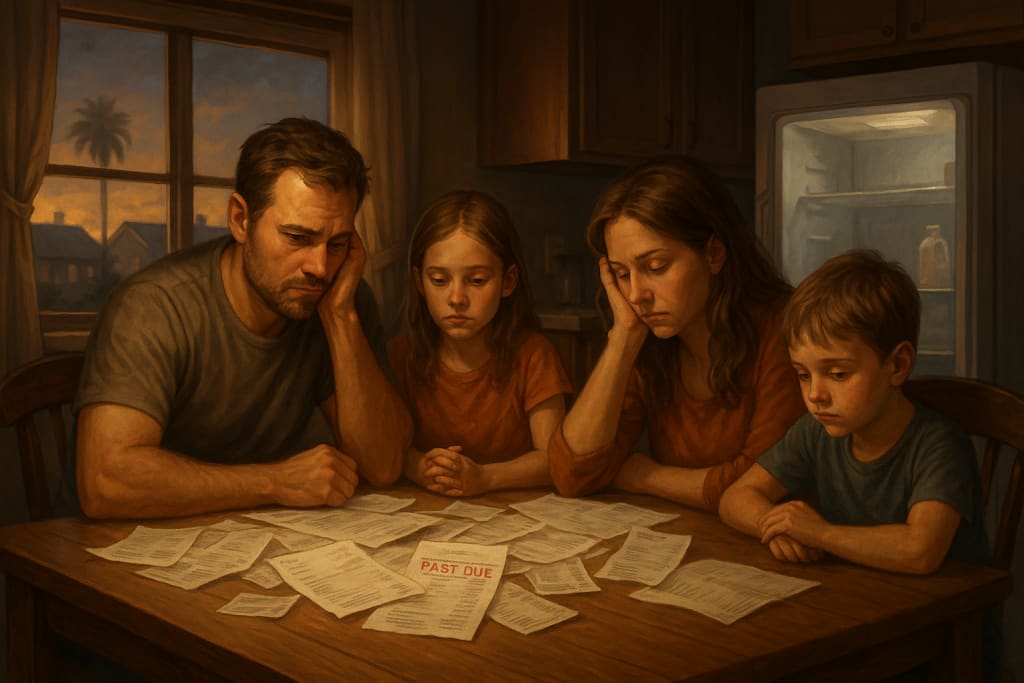
Introduction: Michael’s Daily Treadmill
In a sunlit suburb of California, where palm trees sway and tech fortunes flourish, lives Michael—a father, husband, and worker whose life has become a monthly balancing act. With a total household income of $4,200 per month, he supports his wife and two children. Every day brings a painful question: groceries or rent? healthcare or savings? dignity or despair?
Just two years ago, life was more manageable. Rent was within reach, grocery runs didn’t cause anxiety. But now, in 2025, everything has shifted:
• Rent jumped by $400 per month in just one year.
• Basic staples—eggs, milk, bread, rice—have nearly doubled in price.
“We notice it every week,” Michael whispers. “The money just doesn’t stretch like it used to.”
Michael’s struggle isn’t isolated—it reflects a sweeping American crisis where working-class families across the nation face impossible tradeoffs. From the East Coast to the West, the phrase “cost of living” has lost all softness; it’s become a rope tightening around their throats.
⸻
1. Inflation vs. Wages: A Widening Canyon
1.1 Rising Prices, Slow Earners
The official U.S. Consumer Price Index shows prices rose about 2.4 % year-over-year in May 2025, with food expected to grow even more—some forecasts near 5.5 % . But incomes haven’t kept pace:
• Median household income has only risen approximately 5 % since 2020, while consumer prices surged over 20 % .
• The USDA predicts grocery prices will increase by around 1.9 % in 2025, with food-at-home costs up 0.8 %, and restaurant prices rising 3.5 % .
Even if food inflation is slowing, essential items like eggs are volatile—forecast to grow over 40 % this year .
1.2 Paycheck-to-Paycheck: The New Normal
• 70 % of American households now live paycheck-to-paycheck—even among six-figure earners, 21 % limit spending to necessities .
• 62 % report needing their next paycheck to cover just one month of expenses .
For Michael’s family, this financial tightrope snapped long ago. A $150 utility bill, a minor car repair—any unexpected cost tips them into crisis.
⸻
2. The Housing Trap in California
2.1 Rent Prices Soaring
Nationwide, rent is on the rise:
• A two-bedroom unit now costs around $1,905, up 3 % annually .
• In California, average rent for two bedrooms exceeds $2,000, with metro rates nearing $4,000 .
California’s rental-inflation index recently hit a record 157.8 vs. national averages . A combinatzion of limited construction, zoning restrictions, and high demand keep prices sky-high .
2.2 Policy & Proposition 33
In November 2024, California voters rejected Proposition 33, which would have repealed Costa‑Hawkins and allowed stricter, local rent controls . The failure left cities unable to implement tougher rules, leaving tenants like Michael without recourse.
⸻
3. Food, Fuel, and Fundamentals
3.1 The Shrinking Grocery Basket
Since early 2020:
• Grocery prices soared nearly 22 %, food-away-from-home jumped 28 % .
• In 2024 alone, food-at-home rose 1.9 %, food-away-from-home 3.4 %, with eggs up 37 %—driven by avian flu culls .
• In 2025, if new tariffs take full effect, household grocery bills could jump another $2,600–$4,900 annually .
Michael’s weekly grocery bill is now $150+, compared to $100 two years earlier—an extra $200–$250/month eating away at their budget.
3.2 Gas, Utilities, and Hidden Costs
Fuel, heating, and electricity have increased by 20–40 % over five years. A trip to mom’s house, a visit to Walmart, or the weekly dentist appointment all sting more now. Meanwhile, healthcare premiums have grown three times faster than wages ★ (industry reports). Michael’s employer-provided healthcare still leaves significant copays—another monthly stressor.
⸻
4. Emotional & Mental Toll
4.1 Anxiety, Stress, and Family Friction
Financial strain bleeds into emotional health. Studies show households under tight budgets report:
• Anxiety, insomnia, guilt over financial mistakes.
• Higher rates of depression and divorce.
• Chronic stress in children, including behavior issues at school.
Michael’s family has seen these — his two kids are quieter; his wife, once sociable, now seems distant. Dinners are shorter. Fridays once meant family outings; now they’re quieter, homebound affairs.
4.2 Social Isolation and Lost Opportunities
Economic strain also isolates: birthdays are low-key, vacations or weekend trips are rare. Social interactions vanish under the weight of not just money, but embarrassment. What used to be little joys—ice cream nights, soccer games—now feel luxuries.
Community efforts—food banks and mutual aid—help, but only patch symptoms without addressing the broader structural issues.
⸻
5. Policy Failures & Glimmers of Hope
5.1 Why Politics Isn’t Keeping Up
Despite high inflation, the Federal Reserve held interest rates steady at 4.25‑4.50% in June 2025 . Congress has avoided major minimum-wage hikes at the federal level; SNAP and EITC adjustments have been minimal.
The longing for rent control—heightened by failed Proposition 33—highlights tenant desperation. Without state-level reforms, LA County issued warnings of $50K fines against rent-gouging landlords during wildfires , but enforcement remains weak.
5.2 Local Initiatives and Proposals
Despite political inertia:
• Some cities push for rent control, eviction protections, and affordable housing development.
• Nonprofits are providing funds for rent relief, eviction defense, food access, and healthcare aid.
• There’s growing momentum behind a federal Universal Basic Income pilot in a few cities, though still in early stages.
⸻
6. What the Future Holds
6.1 The Risk of a Fraying Middleground
Michael’s family once defined the middle class. Today, their situation teeters on poverty. They’re vulnerable—only a serious illness, a job loss, or car breakdown would push them over the edge.
If tens of millions of similar families exist, consumer spending suffers, mental health deteriorates, and trust in institutions worsens—creating a national malaise invisible in headlines.
6.2 Paths Toward Justice
1. Policy changes: Permanent expansion of rent control, disentangling Costa‑Hawkins, increases to minimum wage and EITC.
2. Corporate responsibility: Living wages, price-locks on essentials, community investment.
3. Grassroots support: Mutual-aid networks, co-ops, food pantries as emergency cushions—but not substitutes for systemic change.
4. Public awareness: Stories like Michael’s must be told—keeping this crisis visible.
⸻
Conclusion: Michael’s Quiet Plea
When I spoke with Michael, he looked out at his backyard garden and sighed.
“I work hard. I want my kids to feel safe, to dream. But I teach them lessons I never expected—they can’t always get what they want… maybe not because we don’t have, but because it’s too expensive.”
His words echo across millions of households—families working with no escape, subsisting at the edge of collapse.
This isn’t just economic hardship. It’s an existential dilemma facing the working middle class in America—of dividing families, broken dreams, and communities stretched to the brink. Unless acknowledged and addressed, by policy and by public empathy, the phrase “American dream” may soon feel like a promise that’s already been broken.
About the Creator
Mikel mask
Hi reader , i’m DR.mikel
Longform storyteller focused on real-life struggles, social change, and the economics of everyday survival. I write to inform, connect, and create impact.
Keep reading
More stories from writers in The Swamp and other communities.
The Forsyth House Fire
Since 1851, Forsyth House has stood on the corner of Union Street and Gordon Street in the heart of Glasgow. Its iconic, or was... because on Sunday 8th of March, 2026, a fire broke out in a small, seemingly un-named shop in the building and tore all that history down. As I write, the rubble is still unsettled and the street is still blocked off. Central Station is quiet on the upper level, and around 30 small businesses have quite literally gone up in smoke.
By S. A. Crawford3 days ago in The Swamp




Comments
There are no comments for this story
Be the first to respond and start the conversation.