
The Double Marginalization of Black Biracial People
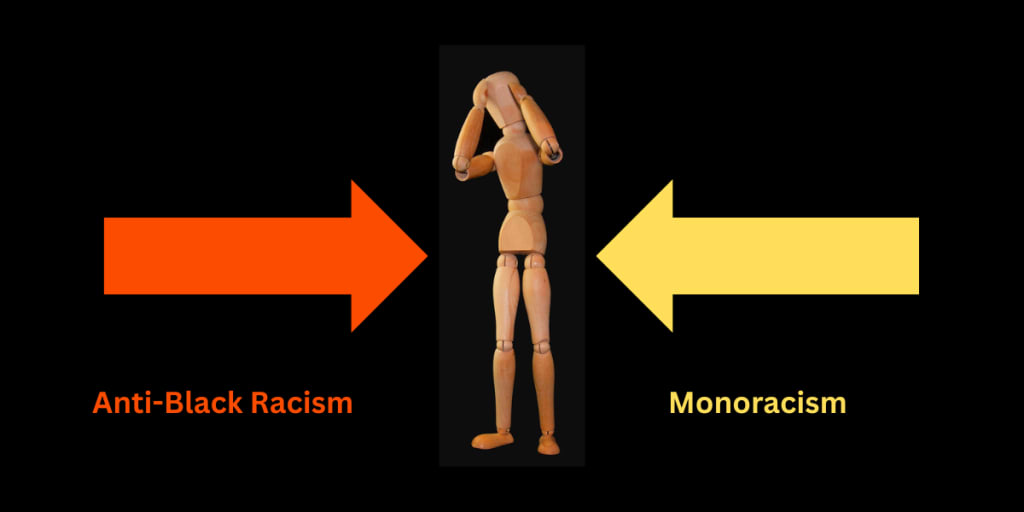
Black-White biracial individuals who are identified by society as monoracially Black bear the full weight of anti-Black racism while also experiencing monoracism that erases their mixed ethnic identity.

Author’s Note: This is an article written for a general audience and is distinct from the author’s academic work. The examples featured here happen to involve Black biracial women with White mothers.
For many, the word “biracial” evokes the image of an ethnically ambiguous celebrity who is widely perceived as white, if somewhat “exotic.” Think Meghan Markle.
But outside the world of the rich and famous, Black-White biraciality can look very different. A Pew Research Center report found that 61% of Black-White biracial individuals in the United States are perceived as Black.
Often unseen, then, are non-famous Black-White biracial individuals (people like me) whose mixed ethnicity is rendered invisible by a society fixated on maintaining rigid racial categories. I refer to this group as Black biracial individuals: people with one Black parent and one White parent who are socially categorized as monoracially Black.
Even after decades of research on multiracial identities, scholars often treat Black-White biracial individuals as a homogeneous group, frequently lumping “Black mixed-race” people together with non-Black mixed-race individuals in studies. Much of this work overlooks the fact that Black biracial people hold a unique positionality in society, existing at the intersection of Black and biracial identities. While non-Black biracial individuals experience monoracism (a form of oppression specific to mixed-race people), Black biracial individuals must deal with both anti-Black racism and monoracism.
Racism in White Spaces
When it comes to racism, it’s possible that Black biracial individuals face more frequent racialized encounters than monoracial Black people. Why would this be, you might ask? Well, having one white parent often translates to spending more time in predominantly white environments. This, in turn, increases the likelihood of experiencing prejudice when the biracial individual is socially read as Black. Black biracial American author Julie Lythcott-Haims shares a childhood memory from when she was about seven, living in Rockland County, New York. While swimming in a friend’s pool with several other children, she recalls:
… apparently one kid's father got wind of the fact that I was in the pool polluting it with my blackness, and he came to the door and said he wanted to bring his child home.
Growing up in 1980s Liverpool (UK), I went through experiences that were reminiscent of the racial hostility of the Jim Crow era. Once, my sister and I were chased by boys on bikes yelling racial slurs. Another time, a group of men stopped their car to order me to “smile” as I walked down the street. At school, anti-Blackness was usually more covert, though no less hostile: I was socially ostracized during my first year, and later, a classmate angrily lashed out when I objected to being patronized. I got through this period by keeping my emotions in check, staying hypervigilant, walking on eggshells, and focusing on my studies so I could eventually escape Liverpool. (As detailed in a personal narrative piece and mentioned in a previous op-ed).
The Monoracial Gaze
For Black biracial individuals, racism is compounded by monoracism, often manifesting as identity invalidation: misrecognition of family relationships; dismissal of multiethnic heritage; and pressure to identify with a single racial group. Being assigned to a group different from one’s mother and feeling obliged to conform to that group’s norms can be especially challenging during childhood, since the mother often serves as the primary attachment figure and, for girls, the principal role model. A 2024 study found that racial identity invalidation significantly contributes to depressive symptoms in Black-White biracial adolescents.
In her 2018 Master’s thesis examining how Black mixed-race women navigate dominant monoracial norms in the U.S., Corey Rae Evans describes how intense societal pressure pushed her to adopt a performative Black identity, modifying her speech and behavior to meet others’ expectations. She notes that failing to conform often resulted in judgment for straying from what was regarded as “Black behavior.” Evans also recalls her relationship with her white mother being misrecognized while visiting her mother’s hometown of Garrison, North Dakota:
…my sister and I experienced being racialized and “othered” by waitresses who disassociated us from our white mother when trying to provide us separate checks…
A similar account appears in the work of scholars Chandra Waring and Samit Bordoloi, who share the experience of a biracial interviewee describing how others perceive her when she is out in public with her white mother. The first scenario demonstrates the extent to which people attempt to impose a plausible explanation when encountering a family relationship that unsettles the monoracial gaze:
Typical experience will be if I am in a predominantly white town with my mother and people kind of give [us] a second look . . . like “Are they lesbians?” It’s very strange. Or they don’t think we’re together. We’ll be in line and she’ll start ordering something and they’ll ask me to the next counter and I’ll be like “I’m with her. Hello, I just called her Mom!”
During my undergraduate student years, I discovered that a fellow student had attended a secondary school in Liverpool, UK, where my mother taught English. I mentioned this, suggesting he might know her. Initially, the young white man was adamant that he didn’t and seemed almost irritated by the suggestion. However, a few minutes later, he returned, visibly embarrassed, and admitted, “I just realized your mother did teach me. I’m so sorry.” This encounter, which I first wrote about here, illustrates the role that societal racial categorization played in his initial inability to recognize me as her daughter.
Missing from the Conversation
While I cannot claim to speak for all Black biracial individuals, it is clear that many of us deal with intersecting forms of oppression. We experience the full weight of anti-Black racism: the hostility, the slurs, the constant scrutiny, as well as systemic bias. Growing up, we often face these challenges in predominantly white communities without the “safety in numbers” that more diverse spaces might offer. At the same time, we deal with monoracism: our close family relationships are misrecognized; we’re judged for speaking or acting in ways that do not correspond with society’s ideas of our identity. All of this creates ongoing pressure to disavow significant chunks of who we are.
Existing studies on multiracial individuals have tended to group all Black-White biracial people together, overlooking their unique circumstances. By paying closer attention to Black biracial people, researchers can explore new areas of study that address the neglected lived realities of this group. Additionally, focusing on the Black biracial experience can offer a deeper understanding of how racial categorization is imposed and experienced in modern Western societies.
© 2025 Clare Xanthos
About the Creator
Clare Xanthos
Researcher & Writer. Interests: racial equity, social justice, cultural identity. Co-editor & an author of 2 chapters in the book "Social Determinants of Health among African-American Men." PhD in Social Policy (London School of Economics).
Keep reading
More stories from Clare Xanthos and writers in The Swamp and other communities.
How Britain Creates Mental Illness: Racial Inequity, Misdiagnosis and a System that Won’t Change
Note: These problems are not unique to the UK. Across Western nations, Black populations face similar issues. Society’s tendency to blame the victim has always made me indignant, especially the pathologization of ethnic minorities. In the early 2000s, I became aware of the high rates of severe mental illness among Black people in the UK, often framed as individual pathology. This prompted me to research the issue, leading to a 2008 article, Racializing Mental Illness.
By Clare Xanthos8 months ago in The Swamp
RWE Secures Contracts for Difference for 6.9 Gigawatts of Offshore Wind Capacity in UK Allocation Round 7 and Agrees a Long-Term Partnership with KKR
The United Kingdom’s renewable energy sector reached a significant milestone as RWE, one of Europe’s leading renewable energy companies, secured Contracts for Difference (CfDs) for 6.9 gigawatts (GW) of offshore wind capacity in UK Allocation Round 7 (AR7). Alongside this achievement, RWE also announced a long-term strategic partnership with global investment firm KKR, reinforcing confidence in the UK’s offshore wind market. This development highlights the UK’s continued leadership in offshore wind and signals strong investor confidence despite global economic challenges. Understanding the Contracts for Difference (CfD) Scheme The Contracts for Difference scheme is a key mechanism used by the UK government to support low-carbon electricity generation. It guarantees renewable energy developers a fixed price for the electricity they produce, protecting them from market volatility while ensuring consumers benefit from stable energy costs. By securing CfDs in Allocation Round 7, RWE has ensured long-term revenue stability for its offshore wind projects, enabling large-scale investment and timely project delivery. Scale and Impact of the 6.9 Gigawatts Offshore Wind Capacity The 6.9 GW of offshore wind capacity secured by RWE represents one of the largest allocations in the latest funding round. Once operational, these projects are expected to generate enough clean electricity to power millions of UK homes. This capacity will significantly reduce carbon emissions, lower dependence on fossil fuels, and contribute directly to the UK’s target of achieving net-zero emissions by 2050. Contribution to the UK’s Net-Zero and Energy Security Goals Offshore wind is central to the UK’s clean energy strategy, with a national goal of reaching 50 GW of offshore wind capacity by 2030. RWE’s successful bids in Allocation Round 7 make a substantial contribution toward this target. In addition to environmental benefits, these projects strengthen energy security by increasing domestic power generation and reducing exposure to global energy market volatility. Strategic Long-Term Partnership Between RWE and KKR Alongside its success in AR7, RWE announced a long-term partnership with KKR, a global investment firm with a strong track record in infrastructure and energy investments. This partnership combines RWE’s technical expertise in offshore wind development with KKR’s financial strength and investment capabilities, allowing both companies to scale projects efficiently and manage long-term risks. Boosting Investor Confidence in the UK Renewable Market The RWE–KKR collaboration sends a strong message to international investors about the attractiveness of the UK offshore wind sector. Despite challenges such as inflation, rising interest rates, and supply chain constraints, the UK remains a stable and competitive market for renewable energy investment. Such partnerships are crucial in maintaining momentum as global competition for clean energy capital intensifies. Economic Growth and Job Creation Opportunities Large-scale offshore wind projects bring wide-ranging economic benefits. From turbine manufacturing and port infrastructure to maintenance and engineering services, RWE’s projects are expected to support thousands of jobs across the UK. The long-term nature of these developments ensures sustained employment opportunities, particularly in coastal and industrial regions. Challenges Facing Offshore Wind Development While the announcement is largely positive, the offshore wind sector continues to face challenges, including rising construction costs, grid connection delays, and complex regulatory processes. However, the success of Allocation Round 7 demonstrates that with stable policy frameworks and strong private-sector partnerships, these challenges can be effectively managed. A Defining Moment for the UK Energy Transition RWE securing 6.9 GW of offshore wind capacity and entering a long-term partnership with KKR marks a defining moment in the UK’s clean energy journey. This achievement underlines offshore wind’s role as a cornerstone of the UK energy system, driving sustainability, economic growth, and long-term energy resilience.
By Aarif Lashari2 days ago in The Swamp
Wild Card Weekend Recap: What Happens Now?
I think I figured out why I love Wild Card Weekend so much. It's because it's the first playoff anything of the calendar year. The NFL season starts in the fall, and once upon a time, the champion was crowned either on or slightly before New Year's. The evolution of the NFL schedule has resulted in the playoffs starting just into the New Year, and currently, the final week of the season falls on the first weekend of the New Year, with Wild Card Weekend coming a week after that. So yes, chronologically, the NFL's Wild Card Weekend serves as the first playoff anything of the calendar year.
By Clyde E. Dawkins4 days ago in Unbalanced



Comments
There are no comments for this story
Be the first to respond and start the conversation.