
The Death of the Dollar? BRICS’ Bold Revolt That Could End U.S. Hegemony
Why an American Forecaster Says the World Is Shifting — and How It Could Change Your Wallet Forever


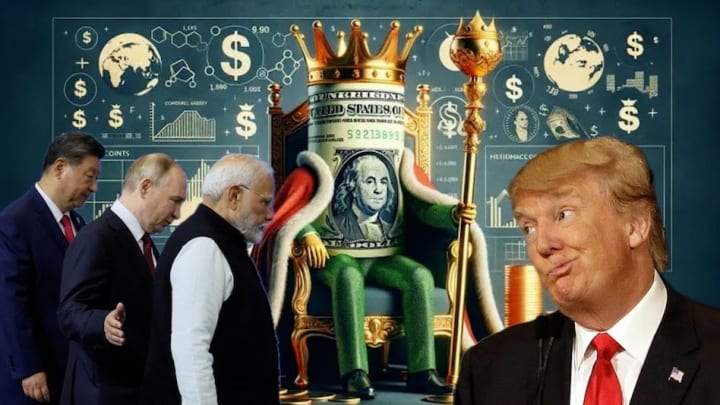
A Shockwave From the East
When Gerald Celente — one of America’s most outspoken trend forecasters — says “The death of the dollar has begun,” people listen.
In a recent podcast with journalist Rick Sanchez, Celente warned that the once-untouchable U.S. dollar is now under siege from a coordinated push by BRICS nations (Brazil, Russia, India, China, and South Africa, plus new members). This isn’t just about currency charts or economic jargon — it’s about the potential reshaping of global power, trade, and even the price of your morning coffee.
The Heart of Celente’s Warning
Celente paints a clear picture: the dollar’s dominance has relied on two things — global trust and global dependence. Both, he says, are fading.
1. BRICS Self-Reliance Is Rising
India’s minimal U.S. trade: Just 2% of its GDP involves America.
China’s manufacturing power: From electric vehicles to advanced tech, it’s producing and selling more domestically and regionally.
The takeaway? These nations are learning to thrive without U.S. markets, reducing the need for dollar-based transactions.
2. The Decline of U.S. Economic Grip
For decades, the U.S. dollar has been the world’s go-to currency — a safe harbor in storms. But Celente says Washington’s reliance on military might and interventionist policies has bred resistance.
He points to Trump-era interest rate cuts in 2018 and ballooning national debt as cracks in the system. “America has turned into a militaristic nation that no longer invests in its own prosperity,” Celente warns.
3. BRICS’ Coordinated Pushback
BRICS nations aren’t just talking; they’re acting:
- Russia and China now conduct over 90% of their trade in rubles and yuan.
- BRICS Pay, a new payment system, allows trade in local currencies.
- Leaders like India’s Modi and Brazil’s Lula are openly resisting U.S. sanctions — even buying discounted Russian oil without paying in dollars.
Why This Matters to You
If the dollar’s dominance fades, the ripple effects will touch everyday life:
- Imports Could Cost More: A weaker dollar means you pay more for foreign goods — from electronics to coffee beans.
- Higher Interest Rates: To defend the dollar, the U.S. might hike rates, making loans, mortgages, and credit card debt more expensive.
- Investment Shifts: Gold, foreign stocks, and even cryptocurrencies could become more attractive as dollar confidence erodes.
The Bigger Picture: Gradual, Not Instant
While Celente’s language is dramatic, most economists see de-dollarization as a slow-moving trend.
- In 1999, the dollar made up 71% of global reserves; today, it’s closer to 59%.
- Central banks are quietly buying more gold.
- China is pushing the digital yuan.
In other words — the dollar isn’t collapsing tomorrow. But the foundation is shaking.
What You Can Do Now
If this trend continues, financial flexibility will be key.
- Diversify Your Savings: Consider assets outside the U.S. dollar.
- Stay Informed: Follow global economic news, not just local headlines.
- Think Globally: Your future investments, career moves, and even retirement plans could benefit from understanding the shifting balance of power.
Final Word
The “death of the dollar” may not happen overnight, but the warning signs are flashing. Whether you see BRICS as liberators of a multipolar world or challengers to the status quo, one thing is certain: the financial landscape we’ve known for decades is changing — and we’re all going to feel it.
The next time you buy a coffee, remember — what’s in your cup might just be brewing a revolution in your wallet.
About the Creator
The Narrative Hub
Your daily destination for the most compelling stories and insightful articles. At The Narrative Hub, we bring you trending topics, human experiences, and thought-provoking narratives—all in one place.
Keep reading
More stories from The Narrative Hub and writers in The Swamp and other communities.
Trump executive order aims to rename the Department of Defense as the Department of War
A Nation in Shock History doesn’t always change with gunfire. Sometimes, it changes with a single word. On September 5, 2025, President Donald Trump stunned the world by rebranding the U.S. Department of Defense into the Department of War.
By The Narrative Hub6 months ago in The Swamp
The Forsyth House Fire
Since 1851, Forsyth House has stood on the corner of Union Street and Gordon Street in the heart of Glasgow. Its iconic, or was... because on Sunday 8th of March, 2026, a fire broke out in a small, seemingly un-named shop in the building and tore all that history down. As I write, the rubble is still unsettled and the street is still blocked off. Central Station is quiet on the upper level, and around 30 small businesses have quite literally gone up in smoke.
By S. A. Crawford3 days ago in The Swamp
Spain’s New Amnesty Offers Legal Status, Work Rights, and Hope to Hundreds of Thousands of Undocumented Migrants
Madrid — When Spain’s government unveiled a sweeping amnesty plan in late January designed to offer legal status to hundreds of thousands of undocumented migrants, reactions ranged from political controversy to deep relief among the very people the policy aims to help. For many undocumented residents struggling on the margins of Spanish society, the initiative has been described in deeply personal terms as a “gift” and a “lifeline.” The extraordinary regularisation scheme, approved as a Royal Decree by the coalition government of Prime Minister Pedro Sánchez, will open a temporary path to legal residency and work authorisation for foreign nationals who can show they were living in Spain before Dec 31 2025 and have maintained at least five months’ continuous residence. Applicants also must have a clean criminal record to qualify. Once the programme begins in April 2026, beneficiaries will receive a one‑year renewable residence permit that immediately allows them to work legally, access Spain’s public health system, and register for social security. Estimates of the number who could benefit vary: the government cites around 500,000, while some internal police estimates suggest the figure could be as high as 750,000 – 1.1 million. “It’s Going to Help Us in Every Way” For migrants who have lived for years in legal limbo, the news has sparked genuine optimism. Diana, a 40‑year‑old from Peru who spoke with reporters in Madrid, said that life without formal status has been extremely difficult — limited job options, exploitation by employers, and exclusion from basic services have left many struggling. “It will help us in every possible way,” she said, adding that being able to earn a regular wage, pay taxes, and even start a business were among the most meaningful aspects of the amnesty. Before the programme was announced, many undocumented workers laboured in Spain’s informal economy: cleaning, construction, hospitality, agricultural fields and other low‑wage sectors where a lack of legal status left them vulnerable to exploitation and under‑payment. For these workers, the amnesty offers not just legal protection but economic inclusion — an ability to negotiate fair wages and integrate into the formal job market for the first time. Manuel, a Peruvian caregiver, explained that after losing his job when his asylum claim was rejected, he struggled to find regular employment. “Companies don’t want to hire you without residency — and if they do, they pay you less than the minimum wage,” he said. The regularisation, he added, would “allow me to work and contribute to the social security system.” A Policy Rooted in Humanitarian and Economic Logic The Spanish government has defended the measure on both humanitarian and pragmatic grounds. Officials say it acknowledges the reality that hundreds of thousands of people have made lives in Spain, contributing informally to the economy, and deserve a chance to settle with dignity. Elma Saiz, Minister for Inclusion, Social Security and Migration, underlined that foreign workers make up a significant portion of the workforce and have been essential to economic growth — particularly at a time when Spain boasts one of Europe’s lowest unemployment rates. Supporters argue the policy will generate positive economic effects: bringing informal workers into the formal economy expands the tax base, makes labor markets more transparent, and helps reduce labour exploitation. Agricultural groups and major employers have echoed this view, noting that a legalised workforce could stabilise sectors that have faced labor shortages. Political Pushback and Polarisation As expected with a major immigration reform, the amnesty has triggered fierce political debate. Conservative parties such as the People’s Party (PP) have criticised the initiative, suggesting that it rewards “illegality” and could incentivise more irregular migration. The far‑right Vox party has characterised the policy as harmful to public services and national security. Meanwhile, European partners have expressed caution, stressing that while member states can manage immigration autonomously, they must also coordinate within Schengen and the broader European Union framework to avoid policy “pull” effects that could increase migratory pressures elsewhere. A Turning Point for Migrants and Society For beneficiaries, the significance of the legalisation goes beyond economic opportunity. It represents a chance at long‑term stability: eligibility for formal housing markets, access to social services, legal protection against exploitation, and the possibility of eventually pursuing permanent residency or family reunification. “Today’s decision,” said one legal advisor working with migrants, “transforms lives. It’s not just about paperwork — it’s about dignity, safety, and being recognised as part of this society.” In a Europe where migration debates have become increasingly restrictive, Spain’s amnesty stands out as a bold attempt at inclusion — and for those who have lived in uncertainty, it could indeed help in every way.
By Fiaz Ahmed 8 days ago in The Swamp




Comments
There are no comments for this story
Be the first to respond and start the conversation.