
The Big Lie Behind the ‘Big Beautiful Bill
Inside the Tax Plan That Takes from the Many to Give to the Few
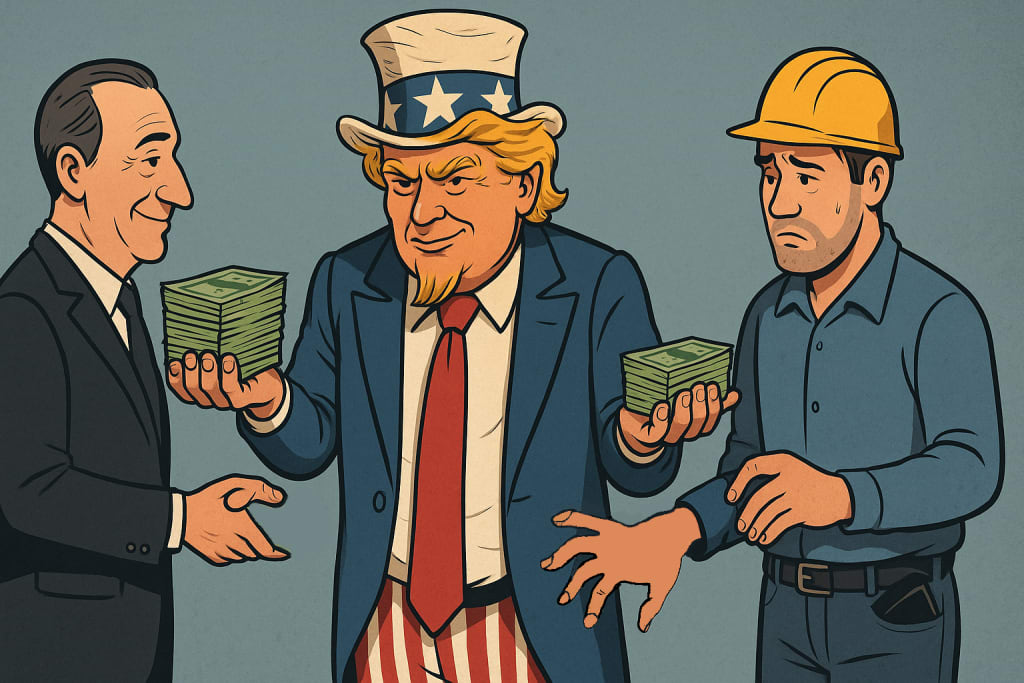
The 2017 tax cuts made corporate breaks permanent—locking in massive gains for the wealthy. Cuts for everyday Americans? They’re expiring this year.
According to the Tax Policy Center, the top 1% of earners got nearly 60% of the total benefits from the 2017 tax law. And now, the GOP wants to extend those benefits—deepening the inequity that law already set in motion.
Trump’s new tax push—referred to lovingly as the “One Big Beautiful Bill” (OBBB)—isn’t subtle about its priorities. It locks in permanent breaks for the wealthy and corporations, while offering a handful of short-term sweeteners for everyone else. Sure, there’s some relief on tips, overtime, child tax credits, even a new deduction for seniors—but all of it comes with caps, income limits, and an expiration date in 2028. Blink and it’s gone.
And while the top keeps cashing in, the rest of the bill quietly guts programs like Medicaid, SNAP, and housing assistance according to an analysis from the Center on Budget and Policy Priorities. That’s not reform—it’s redistribution. Just not the kind that helps people struggling to get by.
Republicans assert that slashing corporate taxes sparks investment, job growth, and higher wages. But we’ve heard that one before, many times.
In reality, the 2017 tax cuts led to record stock buybacks and executive bonuses—not booming hiring or better pay for everyday workers. The so-called “job creators” used their windfall to reward shareholders, not expand opportunity.
If tax breaks for the wealthy actually trickled down, we’d all be swimming in prosperity by now. Instead, what we got was more inequality, stagnant wages, and a bigger hole in the federal budget. Real growth—the kind that lifts people up—comes from investing in workers, not just padding balance sheets.
In 2017, no Democrats or independents voted for the tax reforms driven by Donald Trump’s agenda. The OBBB is also garnering no support from Democrats or independents. It is, surprisingly, facing resistance from Republicans. However, they are fractured between Fiscal/Deficit Hawks on one side who want deeper spending cuts and more Moderate “Blue State” Republicans who oppose the offsets that will profoundly impact constituents and potentially harm their chances of reelection. Unfortunately, in today’s political climate and with Trump’s control of his party, it still stands a significant chance of becoming law.
So ask yourself, if this plan is really about helping everyday Americans…
- Why are tax breaks for multi-millionaires and billionaires destined for permanence?
- Why are the benefits for the largest segment of the population packaged with limitations and hurdles with an expiration date stamped on the label?
- Why do the people writing these laws keep making sure they come out ahead?
Consider that over half of Congress are millionaires, and the House Ways and Means Committee—the group shaping our tax code—is packed with members who stand to benefit from the very cuts they’re proposing.
Add to this that every attempt by Democrats to amend the bill—in both its original form and during reconciliation—to preserve protections for low- and middle-income earners was rejected outright by their Republican counterparts.
Here’s the paradox: the Republican Party claims to stand for limited government, fiscal responsibility, and free markets.
But slashing tax revenue while demanding spending cuts is just government spending by another name—the kind that shrinks opportunity for most and protects advantage at the top.
Groups like the Committee for a Responsible Federal Budget (CRFB) and CBPP say it plainly:
“By slashing revenue while demanding austerity, the GOP’s approach amounts to reverse engineering the deficit—starving the government and then pointing to the emptiness as justification for further cuts to public programs.”
And then there’s the trade piece. The same lawmakers championing tax cuts in the name of economic freedom are also mostly supportive of Trump’s tariffs—government-imposed taxes on imports. If you're pro-free-market, backing tariffs doesn’t make sense. It’s a contradiction of Republican values—and not a small one.
In the end, the OBBB doesn’t fix the problems it claims to address. It delivers a permanent windfall to the wealthy, offers short-lived relief to most Americans, and undermines the very programs people need when times get hard.
Passing this bill? It’s like putting a Band-Aid on a bullet wound. Maybe it looks like help at first glance—but it ignores the damage underneath. And the longer we pretend this is a solution, the worse the wound becomes.
About the Creator
Lanny Newville
Retired public sector professional with 30+ years in law enforcement and community corrections. Keenly interested contributor in areas of governance, public policy, and the intersection of technology and justice. Seeks truth. Exposes lies.
Keep reading
More stories from Lanny Newville and writers in The Swamp and other communities.
Can America Bring Jobs Back?
Can America Bring Jobs Back? The Truth About Policies, Politics, and People For decades, the United States has seen its manufacturing base shrink. Once the backbone of the American middle class, industries like steel, automobiles, textiles, and electronics have either downsized or moved operations abroad. In response, both Republicans and Democrats now say they want to “reshore” jobs — bring them back to the U.S.
By Lanny Newville10 months ago in The Swamp
Parallel Protests
I haven't written for quite some time, but I have A LOT of thoughts about yesterday's protest rally against our government's involvement and complicity in America's war on Iran, on the harbourside of my home city Bristol, and I need to put them somewhere. My gorgeous girlfriend is always a loving and listening ear and sharing it all with her will always be a healthy and happy way of processing the mental and emotional weight, but getting it straight in my brain to share means writing it all down in straight lines, so, here we are and thanks for being here.
By Steph Cole6 days ago in The Swamp
Worth the Wait: Puerto Viejo, Costa Rica
Beach bumming in a small Caribbean beach town sounded like a perfect way to end our 6-month trip through Mexico and Central America. Or so we thought. The foul, fishy stench of rotten seaweed hit our nostrils as we stepped from the cramped bus and looked out at a rather depressing, empty, and underwhelming black sand beach. It was pouring with rain, and we had to quickly fish out our ponchos. We thought, this couldn’t be it, could it?
By Sh*t Happens - Lost Girl Travel3 days ago in Wander



Comments
There are no comments for this story
Be the first to respond and start the conversation.