
Can America Bring Jobs Back?
Reshoring the Truth: Policy, Power, and the Future of Work in the U.S.
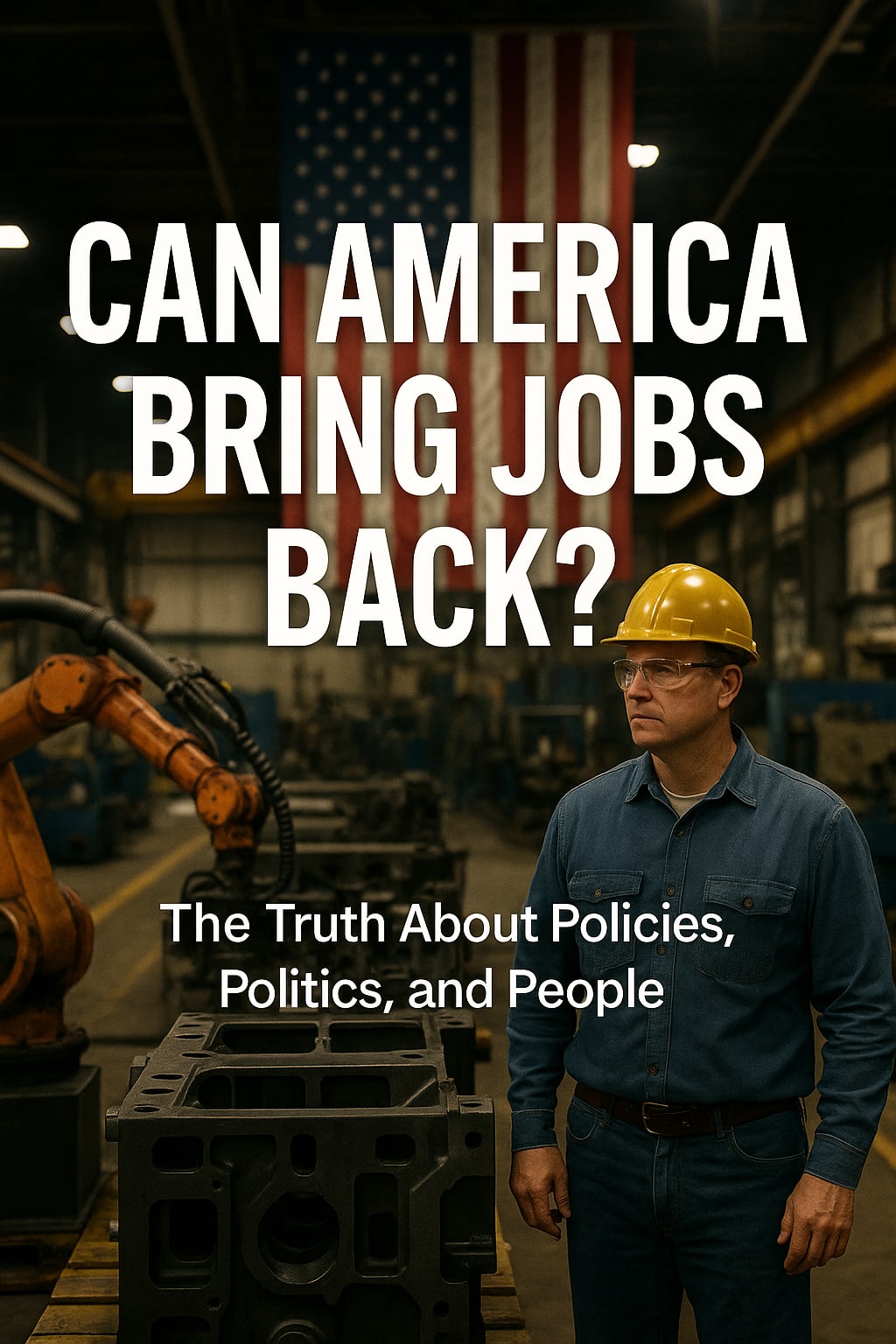
Can America Bring Jobs Back?
The Truth About Policies, Politics, and People
For decades, the United States has seen its manufacturing base shrink. Once the backbone of the American middle class, industries like steel, automobiles, textiles, and electronics have either downsized or moved operations abroad. In response, both Republicans and Democrats now say they want to “reshore” jobs — bring them back to the U.S.
But their strategies are very different, and so are the consequences of those approaches. To truly understand what’s happening, we must look at history, labor policy, trade decisions, and the actual data behind job losses — not just political slogans.
🧮 What Really Happened to Manufacturing Jobs?
The assertion that America has “lost millions of good-paying jobs” holds true — yet the reality is more complex than it sounds. Manufacturing employment in the U.S. peaked in 1979 at approximately 19.5 million jobs. Over the subsequent four decades, this figure declined substantially, reaching 12.3 million jobs by 2020, representing a loss of over 7 million manufacturing jobs. Sectors with strong union participation in the Midwest and Southeast experienced the most significant impact.
These job losses unfolded across several key periods:
- 1994: After the U.S. signed NAFTA, many factories moved operations to Mexico, where wages were lower.
- 2001: China joined the WTO, leading to a flood of cheap imports and a large wave of offshoring to Asia.
- 2008: The Great Recession triggered widespread layoffs across all sectors, but manufacturing took an especially hard hit.
- 2020: The COVID-19 pandemic disrupted supply chains and accelerated trends like automation and "lean" manufacturing processes.
📊 U.S. Manufacturing Jobs Timeline (with presidential terms and key events) illustrates how these changes unfolded under both Republican and Democratic administrations — showing that job loss is not a partisan issue but a systemic one.

🟥 The "America First" Approach: Tariffs, Deregulation, and Nationalist Messaging
President Trump’s second term continues to push the “America First” agenda that shaped his earlier time in office. At the heart of this strategy is a belief that foreign countries — especially China — “stole” American jobs and that U.S. policy should focus on punishing bad actors through tariffs, reducing business costs with deregulation, and cutting immigration to “protect” American workers.
The Trump administration's main reshoring tools include:
- Broad tariffs on steel, aluminum, electronics, and autos, aimed at making foreign goods less competitive
- Strong criticism of multilateral trade deals like NAFTA and support for renegotiated agreements like USMCA
- A renewed push for “universal tariffs” — a 10% baseline tax on all imports, regardless of origin
- Strong rhetoric and policies targeting undocumented immigrants and foreign labor competition
This approach resonates with the frustrations of many Americans who have witnessed industrial decline in their communities. Proponents argue that tariffs can incentivize domestic production by making foreign goods more expensive, while deregulation can reduce the burden on businesses, encouraging investment and job creation. Furthermore, limiting immigration is framed as protecting domestic workers from wage competition.
However, critics point to the potential for retaliatory tariffs from other countries, leading to increased costs for American consumers and businesses. They also argue that deregulation could come at the expense of environmental and worker safety standards. Additionally, economists often cite automation and technological advancements as significant drivers of manufacturing job losses, suggesting that tariffs alone may not be a sufficient solution. There is also the argument that this approach ignores the fact that offshoring manufacturing and skilled jobs was not caused by foreign entities but was a conscious decision by corporations to take advantage of inexpensive in search of increased profits.
🧾 Side Note: What About USMCA?
In 2020, President Trump signed the United States–Mexico–Canada Agreement (USMCA) to replace NAFTA, which he had long criticized as “the worst trade deal ever.” At the time, he celebrated USMCA as a historic win for American workers.
Yet in his 2024 campaign and second term, Trump has largely stopped praising USMCA and now frames all trade with Mexico or Canada in the same negative light as before. This reversal raises key questions:
- If the USMCA was a victory, why disown it?
- If it failed, why declare it a success?
The contradiction highlights the shifting nature of political messaging — and how even major policies can be reframed when politically convenient.
Beyond rhetoric, the current administration’s approach also includes a strong push to deregulate industries, arguing that environmental and labor rules make the U.S. uncompetitive. But aggressive deregulation has serious long-term consequences:
- Weakened pollution controls can harm public health
- Looser safety rules put workers at risk
- Rolling back oversight may lead to environmental disasters and legal battles
These trade-offs highlight the danger of short-term economic gain without long-term responsibility.
🟦 The Democratic Strategy: Investment, Workforce, and a Sustainable Vision
Rather than focusing on punishment or fear, the Democratic strategy for reshoring jobs emphasizes building future industries, creating high-quality jobs, and supporting the workforce that will fill them.
Under President Biden, Democrats advanced landmark laws including:
- The CHIPS and Science Act, which allocates $52+ billion to revitalize semiconductor manufacturing in the U.S.
- The Inflation Reduction Act (IRA), which funds clean energy production — including electric vehicle batteries, solar panels, and wind power components
- Strengthened Buy American requirements for federal projects
What sets this approach apart is the idea that good jobs must also be sustainable jobs. Democratic policies tie federal incentives to standards like:
- Use of union labor
- Prevailing wage requirements
- Support for workforce development and apprenticeship programs
- Environmental responsibility in construction and manufacturing
Rather than looking backward to revive declining industries, this strategy seeks to modernize American manufacturing to meet 21st-century needs — from clean energy to advanced tech — while helping workers transition into new roles.
Critics say this approach is slower and more bureaucratic, and it’s true that big infrastructure and investment projects take time to show results. But the Democratic strategy aims to ensure reshoring is not just a political win — but a long-term economic renewal that benefits workers, communities, and the planet. And remember, it took us 40 years to get where we are today.
⚙️ Why Labor and Education Matter
You can’t bring back jobs without people trained and ready to do them. Unfortunately, many of the areas hit hardest by offshoring and industrial decline now face serious challenges:
- Aging populations
- Underfunded schools and shrinking vocational programs
- Low labor force participation rates
- Diminished union presence
Labor unions were once the engines of workforce development. They offered apprenticeships, training, wage protections, and a sense of pride. But decades of union-busting laws, especially in southern and midwestern states, have weakened their ability to support workers — and reshoring plans will suffer as a result.
Similarly, public education cuts and culture wars over what is taught limit students’ readiness for modern manufacturing jobs, which require skills in math, computer systems, and robotics.
MAGA-aligned policies often make this worse by:
- Opposing labor protections that raise wages and job quality
- Promoting "right-to-work" laws that weaken collective bargaining
- Attacking public education through funding cuts and curriculum restrictions
The bottom line? No factory investment or tax break matters if we don’t have enough skilled, motivated, and protected workers to fill the jobs.
🌍 The Balance: Jobs, Environment, and the Truth
A major risk in the MAGA-style reshoring effort is sacrificing environmental and workplace protections for economic speed. If the U.S. deregulates too much, we risk:
- Polluted water and air
- Unsafe working conditions
- Long-term harm to the communities where factories return
It’s also risky to pretend that reshoring is just about 'sticking it to China.' Global supply chains are complicated, and many American companies depend on materials, components, and relationships that span borders. Any serious reshoring plan has to acknowledge those realities, not oversimplify them.
Real economic recovery must be sustainable. That means not just bringing jobs back, but doing it the right way — with clean energy, ethical labor practices, and smart planning.
Meanwhile, both parties must stop using political spin and emotional appeals to oversimplify the challenges. Americans deserve:
- Honest assessments of past policy mistakes
- Transparent data on what reshoring will really cost and deliver
- Leadership that puts people over partisanship
✅What the Future Demands
Looking at both strategies, the Democratic approach stands out as more aligned with the country’s long-term interests. It prioritizes structural investment, workforce development, clean energy, and broad-based economic inclusion — rather than relying on short-term tools like tariffs, deregulation, or immigration crackdowns.
By strengthening education, expanding union opportunities, and conditioning public incentives on fair labor and environmental standards, the Democratic model seeks not just to create jobs, but to build lasting economic systems. This strategy also encourages domestic innovation in critical sectors such as semiconductors, renewable energy, and advanced manufacturing — areas where the U.S. needs to regain ground to remain globally competitive.
In contrast, the MAGA/Trump strategy remains rooted in economic nationalism, regulatory rollbacks, and punitive trade tools. While emotionally appealing and potentially effective in delivering short-term political wins or symbolic job announcements, it largely fails to address the root causes of industrial decline — such as automation, skills mismatch, corporate profit-maximization, and decades of disinvestment in labor and education systems.
When comparing outcomes, the Democratic model is:
- More future-focused, emphasizing long-term competitiveness in clean tech and advanced manufacturing
- Less likely to exacerbate wealth inequality, due to labor protections and inclusive incentives
- Better equipped to navigate global trade, leveraging alliances and innovation instead of isolation
- More stable for communities, thanks to investments in training, infrastructure, and environmental protections
While neither approach is perfect — and both depend on effective implementation — the Democratic strategy is fundamentally more forward-looking, equitable, and economically sustainable.
📍Final Thought
Bringing back American jobs isn’t just about tariffs or trade — it’s about building a country that works for everyone. That means:
- Telling the truth about what really caused job loss
- Supporting workers through education and union rights
- Reshoring with responsibility, not recklessness
- And investing not just in factories — but in people, places, and the planet
If we do it right, we won’t just restore jobs — we’ll restore faith in the future.
📖Sources & References
- CHIPS and Science Act, 2022 – congress.gov
- Inflation Reduction Act, 2022 – whitehouse.gov
- Bureau of Labor Statistics – Manufacturing employment data
- Autor, Dorn, Hanson (2016) – “China Shock” study on job losses
- Economic Policy Institute – Trade and labor reports
- Brookings Institution – Globalization and workforce studies
- Environmental Defense Fund – Impacts of deregulation
- National Immigration Forum – Immigration labor analysis
- Pew Research Center – Public views on labor, education, and trade
- The Guardian, 2025 – Robert Reich commentary on tariffs and jobs
- USTR.gov – USMCA details and implementation reviews
About the Creator
Lanny Newville
Retired public sector professional with 30+ years in law enforcement and community corrections. Keenly interested contributor in areas of governance, public policy, and the intersection of technology and justice. Seeks truth. Exposes lies.
Keep reading
More stories from Lanny Newville and writers in The Swamp and other communities.
Can We Make Americans Lives Better
Can We Make American Lives Better When it comes to improving the lives of Americans, Republicans and Democrats have vastly different approaches with their own strengths and weaknesses. Republicans tend to push for tax cuts and fewer government rules. They emphasize goals of helping businesses grow and creating jobs. Some tax cuts, especially those aimed at working families, have shown clear benefits. But tax cuts for corporations and the wealthy rarely lead to higher wages or more jobs for most people. Studies show those cuts often result in stock buybacks or bigger bonuses for executives, and infrequently "trickles down" to improve the lives of low- and middle-income earners.
By Lanny Newville10 months ago in The Swamp
A Gathering of Evil Bosses
“I’m the queen of chin jutting while I smooth my hair, attacking, insulting, and deflecting to protect my appointer.” “Oh, please, Blondi, my hair is curled, highlighted, and longer than yours. I feature television commercials telling immigrants that we will give them a free plane ride home, and if they voluntarily turn themselves in, they will be allowed to legally apply for re-entry. It runs everywhere, and I look good in it! You can’t compete because of your blond hair. Mine is nicer, and my lips are prettier than yours.”
By Andrea Corwin 18 days ago in The Swamp
Father and Daughter Killed in Gaza as War Intensifies and Civilian Toll Rises
Renewed strikes highlight the growing humanitarian crisis as the conflict spreads across the region. A father and his young daughter were killed in the Gaza Strip during a recent airstrike as the ongoing war continues to claim civilian lives. Local health officials reported that the victims were among several people killed during strikes that struck residential areas amid escalating hostilities between Israel and the militant group Hamas. The deaths occurred in a densely populated neighborhood in northern Gaza Strip, where residents said explosions hit a cluster of buildings late at night. Emergency responders rushed to the scene, pulling survivors and casualties from damaged structures while families searched through rubble for missing relatives. According to local medical authorities, the father and daughter were inside their home when the strike occurred. Both were declared dead after being transported to a nearby hospital. Several other civilians were injured in the same attack. Rising Civilian Casualties The incident reflects the mounting civilian toll in Gaza as the conflict continues. Hospitals in the enclave, already strained by shortages of medical supplies and staff, have reported a steady flow of wounded civilians in recent weeks. Health officials in Gaza say many of the victims are women and children, highlighting the severe humanitarian impact of the fighting. Residential buildings, roads, and infrastructure have sustained heavy damage as military operations and rocket fire continue across the territory. The Israeli military has stated that its operations are directed at militant targets linked to Hamas and other armed groups. Officials say strikes are aimed at weapons storage sites, command centers, and launch positions used to fire rockets into Israeli territory. However, the densely populated nature of Gaza — home to more than two million people — means that military operations often occur close to civilian homes and infrastructure, increasing the risk of casualties among residents. Wider Regional Tensions The Gaza conflict has unfolded alongside growing instability across the Middle East. Regional actors have become increasingly involved, raising fears that the fighting could expand into a broader confrontation. Analysts say the situation remains volatile as exchanges of fire continue on multiple fronts. Cross-border tensions and military activity have been reported in several areas, reflecting the complex web of alliances and rivalries that shape the region’s security landscape. The humanitarian situation in Gaza has also drawn global concern. International organizations and aid agencies have warned that civilians face severe shortages of food, water, and medical supplies as the conflict disrupts supply routes and infrastructure. International Reactions Several governments and international bodies have called for restraint and renewed diplomatic efforts to reduce violence. The United Nations has repeatedly urged all parties to protect civilians and allow humanitarian aid to reach affected communities. Aid agencies working in Gaza say that access to essential supplies remains limited in many areas. Damage to roads and infrastructure has complicated efforts to deliver assistance, while overcrowded shelters struggle to accommodate displaced families. Human rights organizations have also emphasized the need for independent investigations into civilian deaths during the conflict. They argue that accountability and adherence to international humanitarian law are essential to protecting noncombatants. A Continuing Humanitarian Crisis For families living in Gaza, the loss of loved ones has become an all too familiar reality. Survivors of the latest strike described scenes of devastation, with damaged homes and grieving relatives gathering outside hospitals. The father and daughter killed in the recent attack are among the many civilians whose lives have been lost during the war. Their deaths underscore the human cost of the conflict and the urgent need for efforts to reduce violence and protect vulnerable populations. As fighting continues and regional tensions persist, the humanitarian consequences of the war are expected to deepen. For the people of Gaza, each day of conflict brings renewed uncertainty about safety, security, and the future.
By Fiaz Ahmed about 5 hours ago in The Swamp




Comments
There are no comments for this story
Be the first to respond and start the conversation.