
The Beginner's Guide to Free Speech
Everything You Need to Know About That First Amendment Right


Author's Note: Originally published January 10, 2021.
If you’ve been following the news lately, you probably already know that Donald Trump has been permanently suspended from Twitter. On January 8, 2021, the social media company posted the following statement to their blog:
“After close review of recent Tweets from the @realDonaldTrump account and the context around them – specifically how they are being received and interpreted on and off Twitter – we have permanently suspended the account due to the risk of further incitement of violence...”
Though most of Twitter rejoiced, his supporters immediately began to talk about censorship and freedom of speech. Some threatened to delete their own accounts; others cried that Twitter’s reaction was Orwellian, and that Trump’s First Amendment rights were being violated.
With all this talk about free speech and First Amendment rights, you might be feeling a little confused. Maybe you don’t remember your high school history class, or maybe you’re from another country and want to keep up with the news in the United States. Maybe you can’t even name all five First Amendment rights, so you’re just curious.
This is your brief, beginner’s guide to free speech.
What happened?
Let's recap: on January 6, 2021, pro-Trump extremists stormed the United States Capitol in Washington, DC. They believed false claims (spread by Mr. Trump and other Republican politicians) that the 2020 presidential election results were fraudulent, and that President-elect Joe Biden was not the true winner.
The mob interrupted the counting of electoral college votes, triggering a lockdown in the Capitol and the evacuation of important political figures. Five people died during the attack, including Capitol Police officer Brian D. Sicknick, who was hit in the head with a fire extinguisher; one woman was shot by police while attempting to crawl through a window, and three members of the mob died from medical emergencies.
They were invited to DC by Trump himself, who addressed the crowd that morning and told them to fight to take back the country. After the riot, he addressed them again, calling them “great patriots” and telling them to go home, adding, “We love you.”
On January 8, 2021, the same day Twitter permanently suspended his account, Trump finally conceded and condemned the “heinous” attack against the Capitol. He has since announced that he will not be attending Biden’s January 20 inauguration, leading some to suspect his supporters have something planned for that day.
What does this have to do with the First Amendment?
Much of Trump’s inciting speech and behavior is expressed online, using sites like Twitter and Parler to address his followers. Because this was happening on their platform, Twitter decided to permanently suspend his account to avoid further incitement.
To his followers, this is a form of censorship that violates his First Amendment right to free speech.
So, what is the First Amendment?
The First Amendment was ratified in 1791, along with nine other amendments to the Constitution. These ten amendments make up the Bill of Rights, which was introduced after several delegates of the Constitutional Convention refused to sign the Constitution without it.
"Congress shall make no law respecting an establishment of religion, or prohibiting the free exercise thereof; or abridging the freedom of speech, or of the press; or the right of the people to peaceably assemble, and to petition the government for a redress of grievances."
In simpler terms, the First Amendment states that Congress cannot pass legislation that: establishes an official religion, enforcing the separation of church and state, or prevent citizens from worshipping other religions; regulates the expression of citizens, either in speech or print; prohibits people from gathering for peaceful reasons, or prevent people from asking the government to right a wrong.
Are there exceptions to the First Amendment?
Yes. Since it was passed in 1791, Supreme Court cases have helped define citizens' rights under the First Amendment. Though most speech is protected, there are certain categories of speech that are NOT, such as:
• Incitement
• Fighting Words
• Obscenity
• Defamation
• Commercial Speech
Incitement
Inciting others to violence is not protected speech. In Gitlow v. New York (1925), the Supreme Court ruled that states had the right to punish citizens for “utterances inimical to the public welfare, tending to corrupt public morals, incite to crime, or disturb the peace.”
You might consider hate speech a form of incitement, but some hateful speech and acts are protected by the First Amendment, while others are not. In Brandenburg v. Ohio (1969), the Supreme Court chose to overturn the conviction of KKK member Clarence Brandenburg, stating that his anti-Semitic and anti-black statements were unlikely to incite action.
In Virginia v. Black (2003), they ruled that states had the authority to ban cross-burning and arrest individuals who broke that law. Because cross-burning had been used for years by white supremacists to intimidate and incite violence against black Americans, therefore becoming a symbol of violent bigotry, the Supreme Court decided it did not fall under the protection of Mr. Black’s First Amendment Rights.
Fighting Words
“Fighting words” were first defined in Chaplinsky v. New Hampshire (1942). They are defined as words which, “by their very utterance, inflict injury or tend to incite an immediate breach of the peace.”
Essentially, you can’t say something that presents a clear and present danger to someone else.
Obscenity
Obscenity has been difficult to define; Miller v. California (1973) inspired the “Miller Test” to determine whether something is obscene. The material is considered obscene if it lacks value (be it literary, artistic, or scientific), depicts or describes sexual conduct in an offensive way, and if the average person would find the material to contain sexually desirable content. Courts use the Miller Test to determine whether a material is truly obscene.
The only exception to the Miller Test is child pornography, which is inherently obscene and not protected by the First Amendment, in any form.
Defamation
Defamation is a statement that harms the reputation of a party. It includes libel (written statements) and slander (spoken statements), and the statement must include these key elements: the statement is false but presented as fact; it is published or communicated to others; the offending party is at fault due to negligence; and the statement caused some sort of harm to the subject.
In The New York Times Co. v. Sullivan (1964), the Supreme Court ruled that false statements against public figures need to be made with “actual malice.”
Commercial Speech
Commercial speech refers to speech that promotes some type of commerce. The four-part Central Hudson Test is used to determine whether government regulation of commercial speech is constitutional. If the speech passes the first step, it is considered protected speech; this first step looks at whether or not the speech is misleading and if it concerns lawful activity.
In Zauderer v. Office of Disciplinary Counsel (1985), the Supreme Court ruled that states may have their own rules regarding commercial speech, such as requiring an advertiser to disclose certain, relevant information.
Were Donald Trump’s First Amendment rights violated?
No, they were not. Twitter is a private company; they have the right to remove content that doesn’t fit their community guidelines and ban individuals who are posting harmful content on their platform. In the same way Twitter would remove content depicting self-harm or sharing revenge porn, they have to remove content that incites violence, as Trump’s tweets have done on many occasions.
His violent rhetoric is a danger to our democracy. He encouraged civilians to trespass on federal property, putting the lives of everyone inside the Capitol at risk. His words got five people killed, including a Capitol Police officer. He could still be impeached, but it's important he not have a public platform on which to spread his bigotry.
If you enjoyed this article, please consider leaving a tip!
Update: September 19, 2025
I never thought I would update this. I thought that after the horror of the first four years, Americans would never be stupid enough to vote Donald Trump into office a second time. I was very, very wrong. Now, because conservative voters were dumb enough to vote him into office once again, America is witnessing the decline of democracy and—very quickly—seeing its rights and freedoms stripped away.
Since Trump took office again in January:
- Robert F. Kennedy Jr. (former heroin addict and, self-admittedly, not a medical doctor) was appointed as the United States Secretary of Health and Human Services, and has claimed Tylenol causes autism, alleged SSRI (selective serotonin reuptake inhibitor) medications cause violent behavior after a school shooting, and declared that states can determine vaccine mandates.
- Immigration and Customs Enforcement (ICE) deported nearly 200k people in seven months, abducting even legal US citizens in broad daylight, making it increasingly clear that this is not about immigration status, but about skin color.
- A concentration camp built in the Florida Everglades has "lost" nearly 1,000 immigrants since it opened its doors in July, with unsanitary conditions and inhumane treatment being reported; dubbed Alligator Alcatraz, it's become popular for conservatives to take photographs with the sign, and far-right activist Laura Loomer stated that the alligators would have "65 million meals" provided for them.
Oh—did I mention that the sitting president is a pedophile? Yeah, a pedophile. Why else would he refuse to release the Epstein Files, which detail all of the clients who flew to Jeffrey Epstein's island to rape children? He's managed to convince his supporters that there are no files, or the files were written by Barack Obama or Joe Biden to frame him, or whatever other lie he's come up with to avoid releasing them. They believe it, too—because Obama and Biden writing it to frame him is more believable than, you know, him being a pedophile.
But, of course, those are just a handful of the daily horrors Americans are witnessing. The focus here is free speech, which is, once again, a topic of debate—although this time, the First Amendment rights of Americans are undoubtedly being violated.
On Sept. 10, 2025, Charlie Kirk—an American right-wing activist and media personality—was shot in the neck while on stage at Utah Valley University in Orem, Utah. His murder divided an already-divided country: some considered his death-by-gun-violence ironic or deserved, considering his stance that gun deaths were "worth it" in order to protect the Second Amendment; others acknowledged that, while his views and beliefs were abhorrent, no one deserved to be murdered; and right-wing politicians and supporters turned him into a martyr.
The discourse over Kirk's death led to a clear violation of the First Amendment. On Sept. 15, comedian Jimmy Kimmel opened his late-night show with a monologue critiquing the response to Kirk's death. Two days later, on Sept. 17, it was announced that Jimmy Kimmel Live would be suspended indefinitely, due to the host's comments regarding Charlie Kirk.
Here's the thing—the issue was not so much what Kimmel said about Kirk, but what Kimmel said about Donald Trump and other conservatives. Kimmel acknowledged that Kirk's murder was a tragedy, and pointed out, among other critiques, how conservatives were using the event to "score political points."
Sinclair, ABC's largest affiliate group, stated they would air a special honoring Charlie Kirk in place of Jimmy Kimmel Live on Sept. 19, and gave Kimmel conditions for a potential return to the air: apologize to the Kirk family, and make a "meaningful personal donation" to both Kirk's family and Turning Point USA, a nonprofit, conservative organization co-founded by Kirk in 2012.
Jason Smith, the Sinclair vice chairman, called for The Federal Communications Commission (FCC) to "take immediate regulatory action to address control held over local broadcasters by the big national networks.”
Donald Trump also remarked that the FFC should begin censoring programs that are critical of him, saying, “I mean, they’re getting a license. I would think maybe their license should be taken away. It will be up to [FCC chairman] Brendan Carr."
This isn't the first time a late-night talk show has been cancelled due to Trump's personal feelings.
On July 17, 2025, CBS announced it was cancelling The Late Show with Stephen Colbert in May 2026. They cited financial reasons; it was heavily implied that Stephen Colbert's on-air commentary on Trump was the deciding factor, with Trump celebrating the announcement on X.
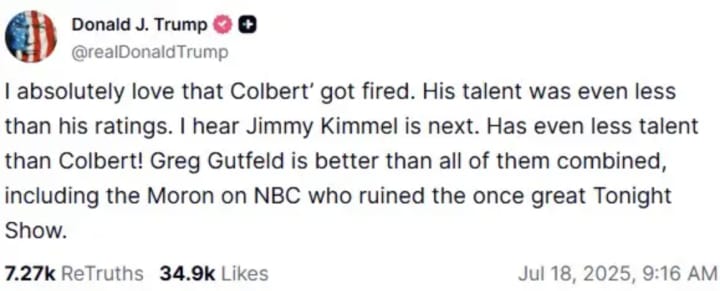
I mean, it's pretty obvious that the cancellation/suspension of both Colbert and Kimmel's shows was due to Trump's bruised ego. However, the difference between these cases is that the FCC has been directly involved in the suspension of Kimmel's case. Both federal law and the First Amendment prohibit the FCC from revoking a station's broadcast license simply because it disagrees with the station's content. Bottom line: the FCC does not legally have the right to regulate free speech.
These are incredibly dangerous times. There are laws defining what free speech is—and what it is not—and simply criticizing the President and current administration does not fall under obscenity, defamation, or any other exceptions to our freedom of speech. Unlike the example from this original article, in which Trump was removed from Twitter for sharing content that could incite violence, all Stephen Colbert and Jimmy Kimmel did was tell jokes.
Do not let the government censor you. Read the banned books they don't want you to read. Continue to speak up for your rights, and the rights of others. Engage with media that allows you to think critically and form your own opinions. We cannot let democracy fall to fascism.

About the Creator
Katherine J. Zumpano
poet & writer in the pnw | bookworm
writing a little of everything
find me on instagram & threads: @kjzwrites
'from me, to you' out now.
Keep reading
More stories from Katherine J. Zumpano and writers in The Swamp and other communities.
Apple Pie Cobbler, for a Crowd
INGREDIENTS Apples 4 lbs. peeled and diced apples 1 stick unsalted butter 1 cup packed light brown sugar ¼ cup fresh squeezed lemon juice 4 tbsp. all-purpose flour 6 tsp. ground cinnamon 1 tsp. ground nutmeg 1 tsp. ground cardamom
By Katherine J. Zumpano6 months ago in Feast
A Gathering of Evil Bosses
“I’m the queen of chin jutting while I smooth my hair, attacking, insulting, and deflecting to protect my appointer.” “Oh, please, Blondi, my hair is curled, highlighted, and longer than yours. I feature television commercials telling immigrants that we will give them a free plane ride home, and if they voluntarily turn themselves in, they will be allowed to legally apply for re-entry. It runs everywhere, and I look good in it! You can’t compete because of your blond hair. Mine is nicer, and my lips are prettier than yours.”
By Andrea Corwin 10 days ago in The Swamp
A Knight of the Seven Kingdoms Series Review (Season 1)
As one of the biggest properties in fantasy, A Song of Ice and Fire remains immensely popular with audiences. After reaching far into the past with House of the Dragon, a second spin-off was on the cards. A Knight of the Seven Kingdoms serves up a bite-sized slice of action and drama, but it still claims a spot among the best small-screen titles.
By Robert Caina day ago in Geeks




Comments
There are no comments for this story
Be the first to respond and start the conversation.