history
Past politicians, legislation and political movements have changed the course of history in ways both big and small. Welcome to our blast to the past.
Book Review: History of the Russian Revolution
Leon Trotsky's History of the Russian Revolution is, in many ways, one of the most important works of historical writing. Simply put, this book retells the story of 1917's Bolshevik Revolution, a communist uprising that ushered in a new era of human history, the effects of which are still being felt today. These three volumes collect an (almost tediously) in-depth retelling of the event, made all the more significant because it was put down in words by one of the foremost architects of the event itself.
By Calvin Hayes8 years ago in The Swamp
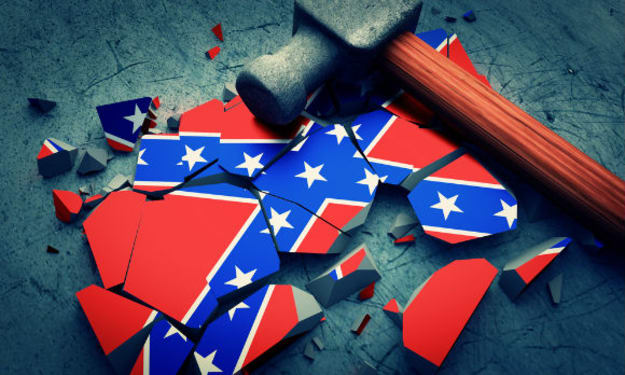
Why You Should Remove My Ancestor's Statue… And All the Other Confederate Monuments. Top Story - August 2017.
My ancestor was Commander Matthew Fontaine Maury, the Pathfinder of the Seas. You may have never heard of him, but he is buried between presidents James Monroe and John Tyler at the Hollywood Cemetery in Richmond, VA.
By Justin @ Vocal8 years ago in The Swamp
The Silence of Patton
Many times we are taught there are absolutes. What we read and are taught there are certain facts that shouldn't be called into question. In mathematics, for instance, 1+1=2 is a fact that should not be questioned. Many times we are taught, especially in history, there are underlying circumstances where certain facts come into light years and even decades afterward that dispute what we originally thought was true and factual. Some believe in conspiracy theories backed up by unsubstantiated incidents and non-verifiable information. Then there are other times what we think are just conspiracy theories; later on, verifiable information comes to light that suggests that maybe it wasn't a conspiracy after all but certain events really did happen.
By Dr. Williams8 years ago in The Swamp
Campaign to Bring Justice Back to the Law
Campaign to put justice back as the center of legal systems. Laws were originally written down because the king of that time — who was absolute ruler — wanted all the people under his rule to get the same justice in disputes. I do not mean to affront the feminists but in late “Dark Ages”, pre-medieval, when Alfred the Great in Britain first started having his laws writing down, only men were kings since their first duty was to fight in hand-to-hand battles. The rights were, by modern standards, very limited but his objective was to impose his rule on the whole kingdom and stop local “Lords” imposing their own laws on the local people.
By Peter Rose8 years ago in The Swamp
Womanhood and Witchcraft
My town still bears the scars of its past. Tucked away in the form of plaques on walls and sculptures in parks, memorials record the names of those tried and executed here for the crime of witchcraft. Everyone who lives here knows the history of the area, but it’s not the only place with a bloodthirsty history.
By Anne Morley8 years ago in The Swamp
Brief History of the Black Panther Party
The Black Panther Party was a civil rights organization whose primary focus was the protection of black neighborhoods from police brutality founded by Huey P. Newton and Bobby Seale in October 1966. The group’s goal was condensed into a ten-point program to create areas of opportunity in human and civil rights, employment, housing, the inclusion of African American history in public schools, exclusion from military service, and equal justice within the court system. The group also published its own newspaper, self-titled The Black Panther, which first circulated in 1967 edited by Eldridge Cleaver. One of the groups early successes was the Sacramento California State Capital March, which protested the ban against public display of loaded weapons. This event attracted a lot of new membership.
By GAHMEIH THE VAGAHBOND8 years ago in The Swamp
Brief History of the Young Lords Organization
In general, The Young Lords was a nationalist group for Puerto Ricans who lived in — and migrated to — America. The group began as a gang in Lincoln Park Neighborhood of Chicago, Illinois. By Sept 1969, the organization evolved into a human rights group led by Jose Cha Cha Jermenez with one of their main causes being the independence of Puerto Rico. The catalyst for the organization’s upgrade from “gang” into “human rights group” was the displacement of Puerto Rican immigrants — through Mayor Richard J. Daley’s political policies — which evicted entire Latino communities for the sake of lakefront and downtown properties.
By GAHMEIH THE VAGAHBOND8 years ago in The Swamp
The Conflicts Waged In the Name of War
History is an invaluable tool. For it tells us of the mistakes made in the past so as to not repeat those same mistakes. Yet, our leaders have continually failed to head the lessons that history is supposed to teach us. The present Administration is again repeating history. We have to remember that the last time the United States declared war was in 1941. The conflicts waged in the name of war from Korea, Vietnam, the Persian Gulf, Afghanistan, and Iraq were never sanctioned by the Congress. These conflicts disguised as wars were designed as tools to increase the profitability of the Military Industrial Complex, certain politicians, and major corporations.
By Dr. Williams8 years ago in The Swamp
Racism
According to Buck, white privilege was established in the USA. To explain it, she takes us back to the 16th and the 17th century. Before the construction of race that exists today, there were only two main classes of Europeans and Africans or whites and blacks. And the whites dominated over blacks using them as slaves. The Native Americans were also treated as inferior to the whites. They suffered from the same oppression that the blacks did. To support her rationales, Buck uses examples of historical changes like the Bacon’s Rebellion. “Given the tendency of slaves, servants, and landless free Europeans and Africans to cooperate in rebellion, the elite had to "teach Whites the value of whiteness" in order to divide and rule their labor force.” (P. S. Rothenberg, 32) After that rebellion, the Europeans implemented stricter voting rights that prevented Africans, Native Americans, and sub tribes who did not identify themselves as Europeans from voting. They even increased the punishment for white women who married African men, and black children of white fathers were given the status of slavery rather than 30 years of indenture. Many such punishments were implemented to maintain the status quo of white privilege.
By Beena Patel8 years ago in The Swamp