controversies
It seems every time one racially-charged incident ends, a gender or religious controversy takes its place; Ruminate on the issues dividing our nation and world.
Doomsday Politics 2018
Doomsday Politics February 2018 We now have two doomsday arguments going on in the popular media. Climate change, with its deceitful presentations from just about everyone, from all sides of the debate has now been joined by lurid stories of a change in planet Earth's magnetic polarity.
By Peter Rose8 years ago in The Swamp
The Truth Behind Police Violence in America
I finally had the courage to tell my Great Aunt Genie what I want to be when I grow up. Under my breath I said timidly, “I’m going to be a police officer”. Like always, she comes back at me with her leftist response. “Oh, dear, police are nothing like they used to be. I remember when they would protect the people, not shoot them.” I don’t know if you have ever had an elephant’s foot pound on your chest, compressing all the air out of you, but I have. I felt chained down to my chair. Her words crushed me. Hearing false stereotypes about one of the positions you’ve been dreaming about filling one day isn’t the easiest conversation to hold over Thanksgiving dinner.
By Summer Schoening8 years ago in The Swamp
Controversial Freedoms
By the time most American students enter high school, they have been acquainted with the Constitution of this country and more specifically the First Amendment. The amendment that protects the American peoples’ right to free speech, protects press/media, and protects the freedom of worship and religion. Because these freedoms and protections have been in our Constitution since the foundation of our country, they seem required for any functioning democracy. However, this is not always the case, while these freedoms and protections help a democracy survive and succeed, they are not required for democracy to work. European nations are perfect examples of this, the two most notable examples are in England and in France. England passed strong “anti-slander laws” approved by their parliament in 2013, which says anybody who hurts someone through publication/general publicity, can be charged under this law. In France, all conspicuous religious symbols in public are banned, including the Hijab and the burka, which are instrumental to the Muslim faith.
By Jonah Yannis8 years ago in The Swamp
Raising Minimum Wage
The minimum wage is the lowest pay an employee can be paid according to the federal government. The current minimum wage is too low; $7.25 an hour is just not enough. Let's look at who is working for minimum wage, why increasing it would help, and how we should raise the minimum wage.
By Sarah Eubanks8 years ago in The Swamp
The War on Drugs in America and the Failure of US Policy
Dating back to the 1960s, the supply of and demand for illegal drugs has perhaps been the worst threat to the United States justice system. In late June of 1971, President Richard Nixon stated: “America’s public enemy number one, in the United States, is drug abuse.” Due to the rise of illegal heroin, crack cocaine, opioid, and marijuana usage in adults and teenagers, the White House and the United States Congress acted with the goal of erasing the epidemic, not controlling it. Faced with the task of solving the illegal drug problem, Nixon and many future leaders, including Ronald Reagan, Bill Clinton, and George W. Bush strongly supported a greater use of law enforcement and the incarceration of all offenders. Backed by Congressional funding of upwards of 105 million dollars, the “solution” for sobriety began.
By Luke Hamlin8 years ago in The Swamp
Why America Hates Kaepernick
I would like to preface this article with saying that I am a 30-year-old white male. Why America Hates Kaepernick Welcome to America, where football, beer, and hotdogs make a patriot blush. In a world where a Bart Starr and Otto Graham are history icons, where knowing concepts that beat cover two, three, and four shows intelligence, it's no surprise to me the majority of the country reacted in the manner they did after Colin Kaepernick's protest. As facetious as that opening paragraph sounds, football without a doubt is one of, if not the most underrated game(s) when it comes to the level intelligence a NFL player, especially a QB, must possess—more often than not an aspect that goes highly overlooked. True football fans often quiver with disapproval upon hearing false claims like "Meatheads" or " How smart do you have to be to catch a ball?" Anyone that knows how difficult it is diagnosing 11 players in a matter of seconds; anyone that understands the unpredictability of 11 players and the adaptation to that unpredictability; anyone that knows how consistent fundamentals have to be play in play out; anyone that knows the week of preparation before a game knows how ignorant those statements are. On August 26th 2016, Kaepernick was televised kneeling during the National Anthem. Though not his first time, it was the first airing of it. On August 28th, Kaepernick started to expand on his protest within the media. Without quoting, he stated his mission was to bring awareness to black issues in this county. He stated he had no ill will towards our military, informed us of close friends and family in the military who he held in high regard, even stated the protest had nothing to do with the military. However, upon turning on major media networks, you could never have guessed his response was one of which it was —a black man knelt during the anthem. Explained. And all we heard, apparently, was he hates the country. See, I grew up playing football, which is why I know how ignorant it is when someone suggests football is for un-intelligent meatheads. I also grew up fascinated by history, and for the past ten years, I have dedicated my life to American History, and let me tell you...we have missed out on so much of our beautiful history. Our history books give us nothing in the sense of a grasp on the big picture. Why? Because European-American history isn't the only American history, yet it's the only history that is widely written about.Without a clear illustration of our history, it is impossible to understand a clear illustration of a better future. For example: Ireland. When Ireland talks about its negative issues of today, it brings up its history of oppression. Because it tells the story, it gives a full illustration. It provides the necessary information to move in the right direction for that specific chain of events. Or a more relative example: Upon preparing for next week's match-up, you look over a team's history of plays. It gives you a better outlook on how to handle them presently.This is where America has failed its people. Ask yourself right now: How much do you honestly know about black American history? Think about the figures, the events you know. If MLK, Malcom X, Civil Rights, Rosa Parks, are just about all you can think of, you have been robbed of the most resilient story never told. That story is that of black American history—something Kaepernick, I can guarantee you, dove into. America hates Kaepernick because America has been told we live in equality, which is a claim that one simply cannot make knowing the history of this country. From slavery, to Jim crow, to red summer, to urban renewal, a 300 year freeze on capital—while, on the flip side, a 300 year head start on capital. While I'm not going to elaborate much more on the history, I can promise you, if you have any confusion, reading our beautiful black American history will change that, and I challenge you to do so.One major note: Black communities have been dealing with deaths by police since the slave patrols well over 200 years ago. It didn't just start happening, which is where there is a real disconnect. For most Americans, this is a new image, which would completely explain why it's such a shock and so hard to believe on a systemic, racist level. However, this has been a reality in black communities for hundreds of years, explaining such heavy emotions within them. It's not just deaths, either. There has been a major mass incarceration in these communities, completely devastating the families within them. For more information on that, a book written by Michelle Alexander called The New Jim Crow has amazing facts with all of its sources cited. Martin Luther King is one of the most beloved black Americans in history by almost all American people. Unfortunately, it's highly likely that wouldn't be the case had he been represented correctly. MLK hated American capitalism. He understood the need for social policies because of the socialist manner in which we started this country (ie: Headright program) which you can read about in Tim Wise's White Like Me. Martin King I can guarantee you would stand with Kaepernick in this moment. He would be out in Baltimore protesting along with the rest of the community that knows the history of this country. When you are the direct descendant of the untold history, you become born into the untold history. You are the untold history, therefore the majority of these communities are very aware of this history and our present situation, making them much more qualified to speak on the matter than someone who learned high school "history."Yet this is not the narrative in America, and as far as I can tell, it is the only subject we get to know less about, yet have a more correct answer to.
By Jeffre Wade8 years ago in The Swamp
Personal Responsibility and the Law
I read in the press of so many situations where a person claims they were drunk and so could not have given consent to a subsequent act. If the media is to be believed, and this is increasingly unlikely, lawyers appear to be trying to persuade the courts that these claims are valid in law.
By Peter Rose8 years ago in The Swamp
Religious Allegiance
The relationship between American patriotism and dissent has a significant history of both overlapping coexistence and frank opposition, revealing a semi-consistent series of debates on the grounds of religion and politics that began during the American independence movement and continue to be debated to this day. The presidency of George W. Bush reestablished a sense of patriotism in American politics through religious foundational ideas after the 9/11 bombings, causing a reasonable amount of dissent among the non-Christian American population. Court cases calling to question the Establishment Clause of the First Amendment, such as Everson v. New Jersey Board of Education, have a history of creating conflict between state governments and religious organizations.
By Josh Whitehead8 years ago in The Swamp
Carillion’s Collapse – What Does It Mean?
So, it has happened – a lot quicker than I thought it would. Although I should really have been keeping abreast of the news, I didn't actually hear last year's profit warnings or know that Carillion had been awarded a contract by Chris Grayling for HS2 in what turned out to be their dying days. Because of this, I didn't know that they were in trouble, and so their collapse did come as a surprise to me – apparently many other people saw it coming. In the end, the UK government decided not to bail them out, resulting in Carillion's liquidation. I hope that this was for sound economic reasons, rather than purely ideological ones, although we may never know as what matters now is the consequences. No point poring over what might have been; there's quite enough to put right whatever decision they might have reached. It is worth exploring the type of work that Carillion was employed for: this will allow us to see just how many pieces there are to pick up.
By Katy Preen8 years ago in The Swamp
The Americans Who Can't Vote: Puerto Ricans
I asked a good friend of mine a question the other day and I’d never felt so awkward or odd after asking someone something in all my life. I felt entitled; I felt as if I was in a superior social class and I felt like, in some way, the question made them beneath me. Who was I talking to? A Puerto Rican friend of mine. And what did I ask? "Who would you vote for if you were allowed to vote for the P.O.T.U.S?"
By Regular Person8 years ago in The Swamp
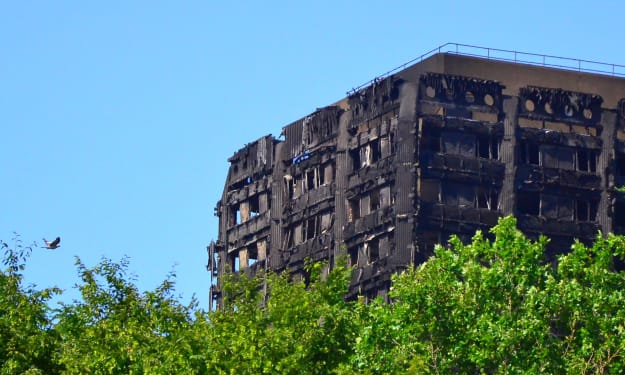
Cosmetic Damage — Was the Grenfell Fire a Consequence of Gentrification?
Brutalist architecture is one of the most divisive styles currently in existence. I have no doubt that in future, we will come up with something even more controversial, or ugly, depending on your viewpoint. Grenfell Tower was originally designed in this style. I say originally, because the infamous cladding brought its external appearance more up-to-date, closer to the style of 21st-century builds.
By Katy Preen8 years ago in The Swamp