
Stocks Gripped by Geopolitical Tensions as Trump Heads to Davos; Bonds Remain Steady
Investors navigate uncertainty amid political headlines and global market volatility

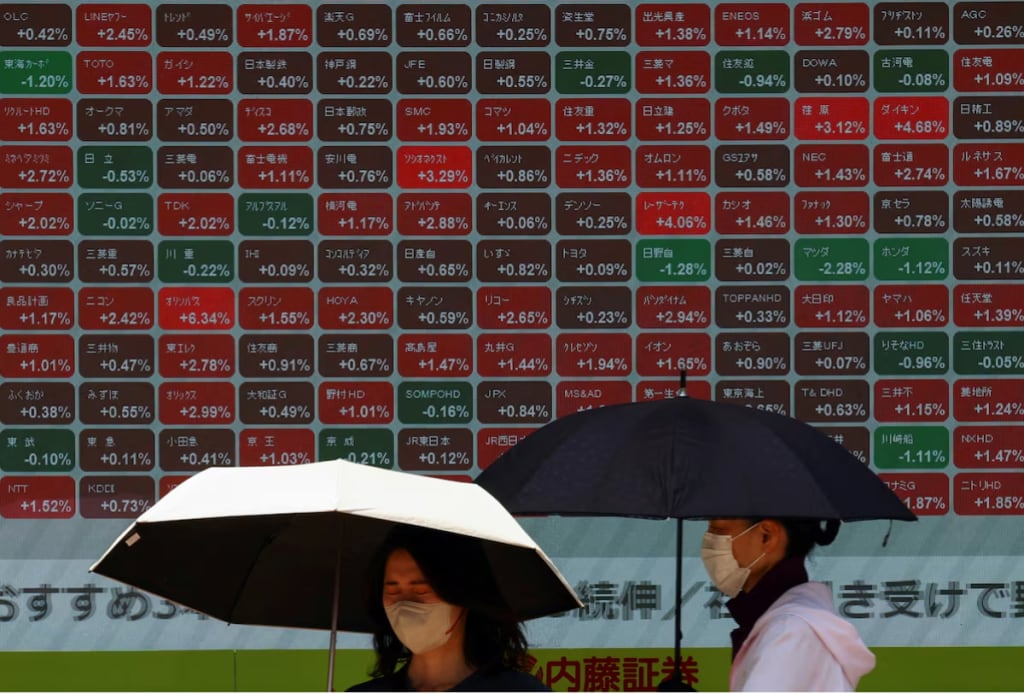
Global financial markets are experiencing a wave of uncertainty as former President Donald Trump prepares to attend the World Economic Forum in Davos, Switzerland. Investors are closely monitoring geopolitical developments, wary of potential policy announcements and international tensions that could sway markets. While equities have shown volatility, bond markets have remained relatively stable, reflecting investor caution and a search for safe-haven assets.
Stock Markets on Edge
Stock indices in the United States and Europe have experienced fluctuating trading sessions over the past week. The S&P 500, Nasdaq, and Dow Jones all saw periods of decline as traders reacted to headlines surrounding Trump’s upcoming Davos visit and ongoing geopolitical concerns in Eastern Europe and the Middle East.
Analysts attribute the volatility to several factors, including trade uncertainties, diplomatic tensions, and investor sentiment about potential economic policy shifts. “When political figures of Trump’s stature are in the spotlight internationally, markets react,” said Sarah Whitman, a senior market strategist at a New York investment firm. “Even the perception of policy changes can influence investor behavior.”
Tech stocks and multinational corporations appear particularly sensitive to geopolitical developments. Companies with significant exposure to Europe or conflict-prone regions face additional uncertainty about supply chains, tariffs, and trade restrictions. Meanwhile, energy stocks have seen increased volatility amid concerns about global supply disruptions.
Bonds Offer Stability
In contrast to equities, the bond market has shown relative steadiness. U.S. Treasury yields have remained largely unchanged, suggesting that investors are seeking security amid equity market turbulence. Bonds traditionally act as a safe haven during periods of political and economic uncertainty, and their stability indicates a cautious approach by institutional and retail investors alike.
“Bonds are essentially the financial market’s safety net,” said Michael Greene, a fixed-income analyst. “When equities are volatile due to political headlines, investors often move funds into Treasuries or high-quality corporate bonds to preserve capital and hedge risk.”
The steady performance of bonds highlights a divergence in investor sentiment: while stock traders react quickly to news and speculation, bond investors tend to prioritize long-term safety and income.
The Geopolitical Context
Trump’s visit to Davos comes at a time of heightened geopolitical tension. Issues ranging from trade negotiations and tariffs to international conflicts and energy policy have all contributed to investor unease. Markets are particularly sensitive to statements that could signal shifts in U.S. foreign policy or global economic strategy.
For example, even minor comments on trade agreements or sanctions during Davos panels could influence investor expectations. Historically, financial markets have responded sharply to policy signals from prominent political figures, especially those with a track record of influencing trade, defense, and regulatory decisions.
Investor Strategies Amid Uncertainty
Many investors are adopting a cautious approach in light of the volatility. Diversification across asset classes—combining equities, bonds, and alternative investments—remains a primary strategy. Sector rotation is also being employed, with money flowing into more defensive industries such as utilities, healthcare, and consumer staples.
“Volatility isn’t necessarily bad,” noted Whitman. “It can create opportunities for those who remain disciplined and focus on long-term fundamentals rather than short-term headline reactions.”
Some institutional investors are increasing positions in international markets perceived as less sensitive to U.S.-related geopolitical events, while others are leveraging options and derivatives to hedge potential downside in equities.
The Role of Market Sentiment
Investor sentiment is a critical driver during periods of geopolitical tension. Fear and uncertainty can lead to rapid sell-offs, even in the absence of tangible economic impacts. Social media, financial news networks, and analyst commentary amplify these reactions, sometimes creating self-reinforcing cycles of volatility.
“Markets are psychological as much as they are financial,” Greene said. “When headlines dominate the narrative, traders react quickly, often amplifying price swings.”
For retail investors, the key takeaway is the importance of maintaining a long-term perspective and avoiding knee-jerk reactions to short-term volatility. Financial advisors often emphasize sticking to investment plans and keeping an emergency fund in place to weather market swings.
Global Implications
The ripple effects of U.S. market reactions extend globally. European and Asian markets are influenced by trading in U.S. equities, and shifts in investor sentiment can impact foreign exchange rates, commodity prices, and cross-border investment flows.
Trump’s attendance at Davos adds an additional layer of complexity. Investors are watching for potential announcements on international agreements, business policy initiatives, or statements on energy, trade, and technology. Any indication of policy shifts could trigger rapid adjustments in global portfolios.
Outlook for Investors
While short-term volatility is likely to continue, many analysts suggest that long-term market fundamentals remain intact. Corporate earnings, economic growth, and innovation in key sectors provide a stabilizing influence amid geopolitical noise.
Whitman advises investors to remain informed but measured: “Stay aware of the headlines, but don’t let every statement or media report dictate investment decisions. Markets are resilient, and disciplined strategies tend to outperform reactive behavior over time.”
As Trump heads to Davos and geopolitical developments unfold, investors are likely to remain on alert. Equities may experience continued swings, while bonds and other defensive assets offer a measure of stability. For those navigating this environment, diversification, patience, and adherence to long-term goals will be essential tools for managing uncertainty.
About the Creator
Muhammad Hassan
Muhammad Hassan | Content writer with 2 years of experience crafting engaging articles on world news, current affairs, and trending topics. I simplify complex stories to keep readers informed and connected.
Keep reading
More stories from Muhammad Hassan and writers in The Swamp and other communities.
Trump’s Greenland Crusade Pushes European Allies to a Breaking Point
Former President Donald Trump’s renewed interest in Greenland has once again placed the Arctic territory at the center of international attention. What began as a bold statement about strategic land acquisitions has evolved into a full-fledged diplomatic challenge, pushing European allies—particularly Denmark and France—to a breaking point. Trump’s public statements, policy proposals, and private communications regarding Greenland’s geopolitical importance have highlighted the fragile balance of trust and cooperation between the United States and its European partners.
By Muhammad Hassanabout 10 hours ago in The Swamp
Trump Says He Will “100%” Carry Out Greenland Tariffs Threat, as EU Vows to Protect Its Interests
When former U.S. President Donald Trump declared that he would “100%” follow through on imposing tariffs connected to Greenland, the statement landed like a geopolitical thunderclap. Once again, Trump revived a familiar mix of economic pressure, unconventional diplomacy, and headline-grabbing rhetoric—this time triggering a firm response from the European Union, which vowed to protect its interests. The moment reflects more than a trade dispute; it reveals how economic tools are increasingly used as instruments of political power. Greenland, the world’s largest island, occupies a unique position in global politics. Though geographically part of North America, it is an autonomous territory within the Kingdom of Denmark and closely tied to the European Union through trade and political agreements. Its strategic importance has grown in recent years due to melting Arctic ice, access to rare earth minerals, and its location along emerging shipping routes. Trump’s renewed focus on Greenland taps into these realities, but his approach has reignited controversy rather than cooperation. Trump’s tariff threat echoes his earlier, widely publicized interest in acquiring Greenland during his presidency. At the time, the idea was dismissed by Danish officials as absurd, yet it underscored a serious point: the United States views Greenland as a critical strategic asset. Now, instead of proposing a purchase, Trump is leaning on tariffs—an economic lever he frequently favored while in office. By framing the move as something he would carry out “100%,” Trump signaled both resolve and defiance, a style that has long defined his political brand. From Trump’s perspective, tariffs are a straightforward solution. He has repeatedly argued that they protect American interests, rebalance unfair trade relationships, and force allies and rivals alike to negotiate on U.S. terms. Supporters see this approach as tough but effective, believing that economic pressure is sometimes the only language international partners respect. In this context, Greenland becomes part of a larger narrative: America asserting itself in a competitive, multipolar world. The European Union, however, sees the issue differently. EU officials responded swiftly, making it clear that any tariffs affecting Greenland or Denmark would be met with firm resistance. For the EU, the threat is not just economic but symbolic. Allowing unilateral tariffs to go unanswered could set a precedent that undermines collective bargaining power and the rules-based international order the bloc relies on. The EU’s vow to protect its interests reflects a broader determination to stand united when faced with external pressure. At the heart of the dispute lies a clash of philosophies. Trump’s worldview prioritizes national leverage and bilateral deals, often at the expense of multilateral institutions. The EU, by contrast, emphasizes cooperation, shared rules, and mutual benefit. When these two approaches collide, trade disputes quickly escalate into political standoffs. Greenland, despite its relatively small population, finds itself caught in the middle of this ideological tug-of-war. There are also economic implications to consider. Tariffs rarely operate in isolation; they ripple through supply chains, affect prices, and influence investor confidence. Greenland’s economy, which relies heavily on fishing, mining, and trade partnerships, could face uncertainty if caught between U.S. tariffs and EU countermeasures. For ordinary people—workers, exporters, and consumers—these high-level political decisions translate into real-world consequences. Beyond economics, the situation raises questions about sovereignty and respect. Greenland’s leaders have consistently emphasized their right to self-determination and their desire to shape their own future. Being treated as a bargaining chip in a larger power struggle risks sidelining local voices. Any long-term strategy involving Greenland will need to acknowledge not only its strategic value but also the aspirations of its people. The timing of Trump’s statement is also notable. As global tensions rise and alliances are tested, bold declarations resonate more strongly than ever. For Trump, reaffirming his willingness to use tariffs reinforces his image as a decisive leader unafraid of confrontation. For the EU, responding firmly helps maintain credibility and unity among member states. Both sides are speaking not only to each other but also to domestic audiences watching closely. Ultimately, Trump’s promise to “100%” carry out the Greenland tariffs threat highlights a broader reality of modern geopolitics: economic policy is inseparable from political strategy. Whether this standoff evolves into a full-blown trade conflict or becomes a catalyst for renewed dialogue remains uncertain. What is clear is that Greenland—once seen as remote and peripheral—is now firmly at the center of global conversations about power, influence, and the future of international relations. As the EU prepares to defend its interests and Trump doubles down on his hardline stance, the world is reminded that even the most unexpected places can become flashpoints. In this new era, tariffs are not just about trade—they are about who sets the rules and who is willing to challenge them.
By Aqib Hussaina day ago in The Swamp
Omani-Italian Relations Enter New Economic Chapter
Oman and Italy are taking their longstanding diplomatic and economic relationship to a new level, exploring opportunities to boost trade, investment, and technological collaboration. His Majesty Sultan Haitham bin Tariq of Oman has emphasized the importance of deepening economic ties with Italy, signaling a fresh chapter in bilateral cooperation.
By Aarif Lashari6 days ago in The Swamp



Comments
There are no comments for this story
Be the first to respond and start the conversation.