
States Where You Can Still Get a COVID-19 Vaccine at CVS After RFK Jr. Policy Changes
States where you can get a COVID vaccine at CVS following RFK Jr. changes

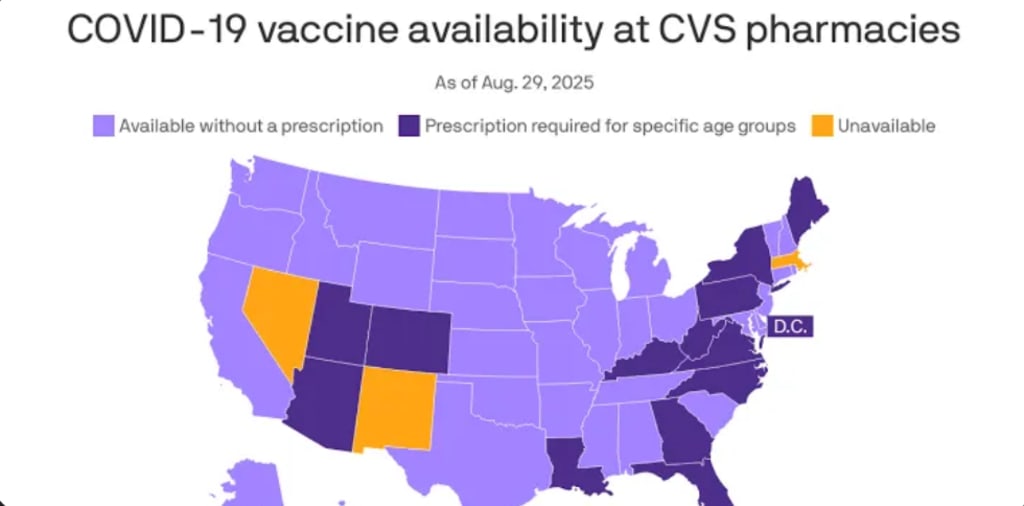
**States where CVS still sells the COVID-19 vaccine after JFK Policy Changes**
As of late August 2025, changes in U.S. federal vaccine policy have significantly impacted the way COVID-19 vaccines are distributed, particularly at retail locations like CVS. Under Health Secretary Robert F. Kennedy Jr., the U.S. The Food and Drug Administration (FDA) issued stricter guidelines regarding eligibility for the COVID-19 vaccine, restricting access to individuals over the age of 75 or those with specific high-risk medical conditions. Consequently, CVS has modified its vaccine availability policies to provide varying levels of access based on state regulations. ### Overview of the Policy Changes
Under the new federal guidelines, COVID-19 vaccines are now available only for high-risk groups. This decision follows ongoing research into vaccine efficacy and the changing dynamics of COVID-19 spread. Individuals who do not meet these high-risk criteria must now secure a prescription from a healthcare provider before receiving a vaccine.
### CVS Vaccine Availability: State-by-State Breakdown
CVS has been a crucial player in the distribution of COVID-19 vaccines across the U.S., but the pharmacy giant’s ability to offer vaccines has been altered by local and federal changes.
#### **1. States where you don't need a prescription** CVS pharmacies continue to provide the COVID-19 vaccine without a prescription in 34 states. These states have opted to align with federal guidelines that permit pharmacies to provide the vaccine directly to individuals who are eligible based on their age or medical condition. Individuals in these states can walk into a CVS pharmacy, check their eligibility, and receive their vaccine without additional documentation.
Alabama, Alaska, Arkansas, California, Connecticut, Delaware, Hawaii, Iowa, Illinois, Indiana, Kansas, Maryland, Michigan, Minnesota, Missouri, Mississippi, Montana, Nebraska, New Hampshire, New Jersey, Ohio, Oklahoma, Oregon, South Carolina, South Dakota, Tennessee, Texas, Vermont, Washington, Wisconsin, and Wyoming are among the states in which CVS does not require a prescription. #### **2. States with Prescription Requirements** CVS locations in 13 states and Washington, D.C., on the other hand, will still administer COVID-19 vaccines, but only if a prescription is presented. These states have implemented stricter guidelines, requiring patients to obtain a prescription from a healthcare provider before receiving the vaccine, even if they meet the age or medical condition requirements.
These states include Arizona, Colorado, District of Columbia, Florida, Georgia, Kentucky, Louisiana, Maine, North Carolina, New York, Pennsylvania, Utah, Virginia, and West Virginia.
#### **3. States Where CVS Is Not Offering Vaccines**
Three states—Massachusetts, Nevada, and New Mexico—are currently not offering COVID-19 vaccines at CVS locations. Even with a prescription, pharmacies cannot distribute vaccines in these states due to local laws or regulations. For those who might otherwise rely on CVS as a convenient location for vaccinations, this restriction has created an accessibility issue. ### Impact of the Policy Shift
The narrowing of eligibility for COVID-19 vaccinations has created a mixed landscape for vaccine access. While CVS continues to play a significant role in vaccine distribution, its reach has been limited in some states. For individuals living in states where a prescription is required or where vaccines are not offered at all, they will need to explore alternative locations such as hospitals or health clinics.
Additionally, as a result of this policy change, many individuals who were previously able to purchase vaccines at CVS will now require authorization from a physician or other healthcare professional. In states like California or Texas, where access is still relatively straightforward, individuals will find it easy to get vaccinated without the added step of securing a prescription.
The situation is less straightforward in states with stricter vaccine access rules, where individuals will face barriers to obtaining the vaccine, potentially affecting public health outcomes, especially among younger and generally healthy individuals who do not fall into the high-risk categories defined by the FDA.
### What to Do If You Need a Vaccine
You can simply walk into your nearest CVS location if you are in one of the states where CVS continues to offer vaccines without a prescription. However, if you live in a state where a prescription is required or CVS does not sell vaccines, you should talk to your doctor about your eligibility and other options. Additionally, public health clinics and other community vaccination sites may be able to offer vaccinations, particularly for those who face challenges accessing them through traditional pharmacy routes.
### Conclusion
As the U.S. navigates the evolving landscape of COVID-19 vaccination, it is crucial for individuals to stay informed about the specific rules and guidelines in their state. CVS, as one of the largest providers of vaccines, has adapted to these changes, but access to the vaccine now varies considerably depending on location. To ensure that you can get vaccinated if necessary, make sure to check the current policies in your area and seek advice from healthcare professionals, regardless of whether you are eligible for or seeking a vaccine.
About the Creator
GLOBAL NEWS
World News Updated
Short News upload
Technology News
Keep reading
More stories from GLOBAL NEWS and writers in The Swamp and other communities.
Amazon now sells used Hertz rental cars
Amazon has once again expanded its vast marketplace in a way that surprises industry analysts and excites consumers. The company that began as an online bookseller and grew into a retail and logistics empire is now selling used Hertz rental cars directly on its platform. This move demonstrates how Amazon continues to blur the lines between traditional commerce and digital convenience while further cementing its influence across multiple industries.
By GLOBAL NEWS7 months ago in The Swamp
The Forsyth House Fire
Since 1851, Forsyth House has stood on the corner of Union Street and Gordon Street in the heart of Glasgow. Its iconic, or was... because on Sunday 8th of March, 2026, a fire broke out in a small, seemingly un-named shop in the building and tore all that history down. As I write, the rubble is still unsettled and the street is still blocked off. Central Station is quiet on the upper level, and around 30 small businesses have quite literally gone up in smoke.
By S. A. Crawford3 days ago in The Swamp
Success uncertain, but Israelis continue to back ‘heroic’ war with Iran
Tens of thousands of Israelis continue to express strong support for their country’s military campaign against Iran, even as doubts grow about the war’s ultimate objectives, costs and outcomes. According to a March 2026 poll by the Israel Democracy Institute, roughly 82 – 93 % of Israelis — particularly Jewish Israelis — support the ongoing conflict with Iran, a level of consensus that crosses traditional political divides. That backing includes many who have historically opposed Prime Minister Benjamin Netanyahu’s government, who now describe the campaign as a necessary defence against Tehran’s long‑standing threats. A Nation Rallying Around the Flag The war, which escalated after a series of Israeli strikes deep inside Iranian territory, has largely united public opinion behind the government. Within Israel, many citizens view the campaign not only as a defence of national security but as a “heroic” initiative to dismantle Iran’s capabilities and prevent future threats. Mainstream political parties, including many in the centre and moderate right, now publicly support the war effort — often with little political dissent. Political analysts describe this phenomenon as a classical “rally‑round‑the‑flag” effect, where public opinion consolidates during wartime irrespective of the government’s overall popularity. Within Israeli society, foreign policy and security threats — particularly those tied to Iran’s nuclear and missile programmes — have long dominated the national consciousness. In Tel Aviv, veteran activist Alon‑Lee Green of the Palestinian‑Jewish advocacy group Standing Together noted that efforts to protest the war were met with rapid police intervention, reflecting both the high level of public support and a sensitive atmosphere around dissent during active conflict. Leadership Frames War as Existential and Historic Prime Minister Netanyahu, speaking from Jerusalem, has repeatedly framed the operation against Iran as not just a tactical military endeavour but a defining moment in Israel’s history. In public addresses, he has described the campaign as one that will be “recorded in the annals of Israel” and one fought for the security of future generations. In these speeches, the struggle against Iran is often placed in existential terms — as defending the nation from decades of hostile rhetoric and regional interference. Netanyahu’s messaging resonates particularly strongly among older generations who remember repeated threats from Iran’s leadership and proxy militias. For many Israelis, memories of past wars and missile attacks from Lebanon and Gaza inform their acceptance of expansive military action. Uncertainty and the Lack of Clear Endgame Despite overwhelming public support, there is growing unease — among experts and some politicians — about the lack of a well‑defined strategy for achieving long‑term goals in Iran. Even within Israeli security circles, questions have emerged about how a prolonged campaign, focused on airstrikes and targeted operations, might lead to meaningful regime change in Tehran, or whether the country could instead become entrenched in a drawn‑out conflict with unpredictable regional consequences. Israeli officials themselves acknowledge that success is not guaranteed. While military operations have reportedly degraded Iran’s nuclear and missile‑related infrastructure, analysts point out that dismantling these capabilities entirely — let alone securing the collapse of Iran’s political leadership — remains uncertain. Iranian authorities, despite suffering high‑profile losses, including the killing of Supreme Leader Ali Khamenei in late February, have maintained internal control and continued retaliatory operations. More broadly, strategic analysts say that Tehran’s decentralised defence doctrine — designed to absorb shocks from heavy bombardment and stay operational — makes it unlikely that short‑term military actions will achieve decisive victory. Instead, these analysts argue that Iran may be prepared for a long, attritional conflict that external military force alone cannot quickly resolve. Political and Regional Implications The domestic political landscape in Israel has also shifted. Opposition figure Yair Lapid has publicly said that he no longer intends to pursue no‑confidence motions against Netanyahu’s government amidst the war, reflecting how national security concerns have overshadowed traditional partisan disputes. Regionally, the conflict has triggered broader instability. Israel’s ongoing military activities have overlapped with fighting in Lebanon, where the militant group Hezbollah has escalated hostilities, and tensions continue across the Middle East as neighbouring states grapple with the conflict’s ripple effects. Internationally, leaders have responded with mixed messaging. While the United States, under President Donald Trump, has expressed support for Israel’s actions and claimed progress in degrading Iran’s capabilities, several European leaders have urged a return to diplomacy to avoid a wider regional conflagration. A War Without a Clear Ending in Sight For ordinary Israelis, the war’s human and economic costs — compounded by global energy market volatility and regional civilian casualties — are often viewed through the prism of long‑term national security. Yet beneath widespread support lies a complex calculus: a recognition that decisive victory may be elusive and that the path to a stable Middle East might require more than military force. As the campaign continues, both the government and the public are left to weigh short‑term achievements against the uncertainties of an open‑ended war, where the outcome is not predetermined and the consequences echo far beyond Israel’s borders.
By Fiaz Ahmed 2 days ago in The Swamp
Babbling Dixie
The short form of tomorrow is never the whole story. Abbreviations mean nothing when we are born to die and we all are aren't we? Being spoken for before birth is something we're not supposed to remember like some kind of karma after effect. Still here we are spending our lives looking for each other.
By Canuck Scriber Lisa Lachapelleabout 7 hours ago in Fiction



Comments
There are no comments for this story
Be the first to respond and start the conversation.