
States are banning abortion. Birth control might be next…
Since 2022, at least 14 states have implemented total abortion bans… now there’s chatter about coming after some forms of birth control or its accessibility.


The landscape of reproductive health laws in the United States has undergone significant changes in recent years, particularly following the Supreme Court's decision in Dobbs v. Jackson Women’s Health Organization (2022), which overturned Roe v. Wade. This decision gave individual states the authority to regulate abortion, leading to a wide range of restrictions and bans across the country. In addition to abortion, some states have also proposed or enacted limits on birth control access, though these are less common and often subject to ongoing legal challenges. In the 2024 elections, only 7 states voted to protect women’s reproductive rights. Here’s a look at the attack on reproductive rights in each state.
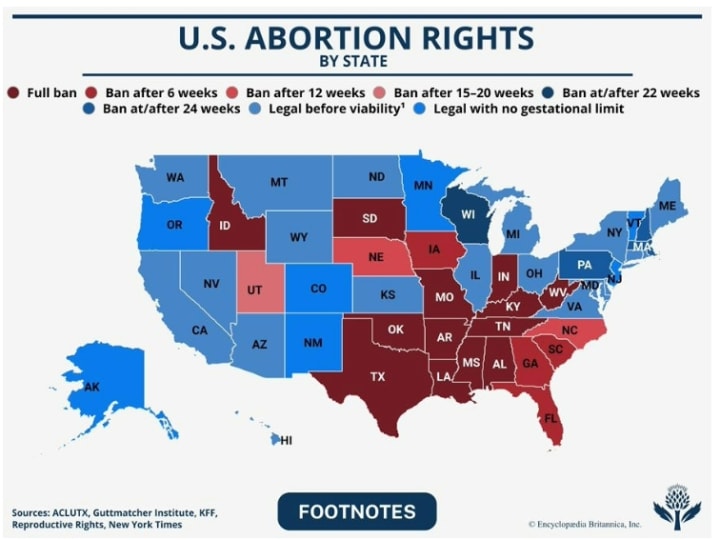
Abortion laws vary widely, with some states implementing total bans with or without exceptions, others imposing bans after a certain gestational period, and some maintaining more permissive access. Below is an overview of states with notable abortion restrictions or outright bans:
• Alabama: There is a near-total ban on abortion, with exceptions only if the pregnant individual's life is at risk. Alabama’s definition of abortion does not include the termination of an ectopic pregnancy or a fetus with a lethal anomaly. There are no exceptions for rape or incest. Minors must get parental or judicial consent. The state will not file charges against an individual receiving an abortion but rather the healthcare workers involved. Abortion medication, such as mifepristone and misoprostol) is not available.
• Arkansas: Abortion is banned except to save the life of the pregnant person in cases of a medical emergency; this does not include removing a dead fetus caused by miscarriage or removal of an ectopic pregnancy. There are no exceptions for rape or incest, even for minors. Those who perform or obtain an abortion outside of these parameters could potentially face up to 10 years in prison and/or a $100,00 fine. Abortion medication is not available.
• Idaho: Abortion is prohibited except to save the life of the pregnant person. There are also exceptions for rape or incest, although the pregnant individual or legal guardians of minors must report the crime to law enforcement and provide the report to their healthcare provider before the procedure. Minors must have parental consent. Physicians who provide an abortion can have their medical license suspended and be sentenced to 2-5 years in prison. A woman who obtains an abortion could be sentenced to 1-5 years in prison and a fine up to $5,000.
• Kentucky: Abortion is banned except in extreme situations to save the life of the pregnant person, at which point there needs to be a second doctor in agreement. Minors must have written informed consent of a parent or guardian, except in cases of an emergency. There are no exceptions for rape or incest. Anyone who performs an illegal abortion may be guilty of a Class D felony, which is 1-5 years in prison and a fine anywhere from $1,000 to $10,000. Physicians will be charged with a Class A misdemeanor and a fine of $500.
• Louisiana: There is a total abortion ban, with exceptions only for life-threatening medical emergencies or cases when the feus is “medically futile.” It is also a crime to deliver abortion medications to Louisiana residents via mail. These medications were classified as controlled dangerous substances and anyone who obtains them without a prescription can face up to 5 years in prison and fines of up to $50,000. On top of that, anyone who performs an abortion may face 1-10 years in prison and fines between $10,000 and $100,000. Anyone who performs a criminal abortion after 15 weeks will face 1-15 years in prison and up to $200,000 in fines.
• Mississippi: Abortion is banned except for in circumstances involving rape or incest, or to save the life of the pregnant person. In cases of rape or incest, the crime must be reported to law enforcement. Any provider who performs an abortion will face 1-10 years in prison.
• Missouri: This was the first state to ban abortion after Dobbs, making all abortions illegal, unless the pregnant person’s life was in jeopardy. However, in the 2024 elections, voters approved Amendment 3, which protects an individual’s right to abortion up to the point of viability (around 23-24 weeks, according to the state law). Abortions after viability are only allowed in cases of protecting the life of the pregnant person. Performing an unlawful abortion is a Class B felony and carries a penalty of 5-15 years in prison and the suspension or revocation of the provider’s medical license.
• Oklahoma: As soon as Dobbs was certified, Oklahoma state law had an existing “trigger law” in place that activated a pre-Roe total ban law that was written in 1910. After many court challenges in and out of the state, the OK Supreme Court issued refined guidance, somewhat broadening the availability of abortion: i.e. providing an abortion in cases of an ectopic pregnancy, miscarriage, trauma or assault or no fetal heartbeat. Abortion providers are still allowed to provide information on how to obtain an abortion in another state. Performing an elective abortion is a felony and punishable by up to 10 years in prison and fines up to $100,000.
• South Dakota: Abortion is illegal at all stages of pregnancy except to save the life of the pregnant person. This state has one of the most restrictive bans in the U.S. There are no exceptions for sexual assault, rape, incest or human trafficking. There are also no exceptions pertaining to risks to the pregnant person’s health, unless it is to save their life in emergency situations. Furthermore, there are strict regulation laws related to minors seeking abortions, informed consent (which involves counselling with a physician to promote birth over abortion), waiting periods and scheduling restrictions to create even more obstacles. Abortion medication is not available and there are no operating abortion clinics in the state. Participating in an abortion can result in 2 years in prison and a fine of up to $4,000.
• Tennessee: Abortion is banned except for serious health risks to the pregnant person, with no exceptions for rape or incest. When Roe was overturned, Tennessee had a trigger law, but state lawmakers added a few exceptions in 2023. The state laws currently in place heavily restrict abortion medication and punish anyone who assists a minor with getting an abortion without parental consent. Tennessee also has the “Human Life Protection Act” that makes abortion illegal even before a heartbeat can be detected. Unlawful abortion is punishable by up to 10 years in prison and a fine of up to $100,000. “Abortion trafficking” of a minor (meaning someone takes a minor to another state to receive treatment) is considered a Class A misdemeanor that may result in jail time and fines.
• Texas: Abortion is banned, with exceptions only for life-threatening conditions; however, in order for this exception to apply, three things must be met: a licensed physician must perform the abortion, the patient must have a life-threatening risk that could lead to death or substantial impairment to bodily function, and the physician must first try to save the life of the fetus. There are no exceptions for rape, incest or lethal fetal anomalies. A person who performs an abortion outside of these parameters may be charged with a first- or second-degree felony, depending on if the abortion resulted in the death of the fetus. The physician will have their medical license revoked and be subject to a civil penalty of at least $100,000 and the potential of up to 99 years in prison.
• West Virginia: Abortion is banned except for medical emergencies to save the life of the pregnant person, a nonviable pregnancy or an ectopic pregnancy. There are exceptions for sexual assault or incest only until the eighth week of pregnancy—before many people may know they are pregnant—and only if a report was filed with law enforcement. This timeline is extended to 14 weeks for minors. Any physician who performs an unlawful abortion can face 3-10 years in prison.
• Florida, Georgia, South Carolina: Bans abortions after six weeks of pregnancy, often before many know they are pregnant. Florida and Georgia have exceptions for rape and incest, as long as the assault was reported to law enforcement. South Carolina currently follows similar restrictions, but Republican state lawmakers are actively working towards passing bill S. 323, which would outlaw abortion and eliminate all exceptions aside from saving the pregnant person’s life. The bill also aims to restrict access to other forms of reproductive healthcare, such as birth control and IVF.
Many states have enacted laws that restrict abortion access but do not outright ban the procedure. Common restrictions include mandatory waiting periods, parental consent or notification for minors, counseling requirements, and limitations on abortion after certain gestational ages (often 15, 20, or 24 weeks). States with restrictions include:
• Arizona: Bans abortion after 22-24 weeks, or the point of viability, with exceptions to save the life or preserve the mental or physical health of the pregnant person. These protections come after a voter-approved constitutional amendment in November of 2024. Penalties for unlawful abortions fall on providers rather than the individual seeking abortion. These can include a misdemeanor, civil penalties, fines or the suspension of their medical license.
• North Carolina: Bans most abortions after 12 weeks. There are exceptions allowing the procedure up to 20 weeks for rape or incest, up to 24 weeks for life-threatening fetal anomalies, or any time during the pregnancy if there is a medical emergency.
• Iowa: Bans abortion after 20 weeks unless the pregnant person’s life is at risk or there are severe fetal abnormalities. State lawmakers are trying to pass a much more restrictive ban, but so far, the Iowa Supreme Court has blocked such efforts.
• Ohio: While abortion is currently permitted up to 21 weeks with some restrictions in place, state lawmakers have been working hard to implement a 6-week ban with few exceptions. The “heartbeat” bill remains blocked as of October 2024.
• Utah: Restricts abortion after 18 weeks with a 72-hour informed consent period requiring counseling approved by the state, with exceptions for rape or incest (which must be reported to law enforcement), fetal abnormalities (only if it is lethal) and risks to the pregnant person’s life. The state prohibits dilation and evacuation (D&E) procedures unless medical conditions apply. This restriction has been legally challenged. The abortion laws in Utah could change soon, however. There was a “trigger law” in place banning nearly all abortions with limited exceptions. It was designed to take place if Roe was ever overturned, but it has remained blocked due to ongoing litigation.
• Nebraska: Restricts abortion after 12 weeks (the end of the first trimester) with exceptions for rape, incest, or to save the pregnant person’s life. This law came as a voter-approved constitutional amendment and cannot be changed or repealed via petition for two years.
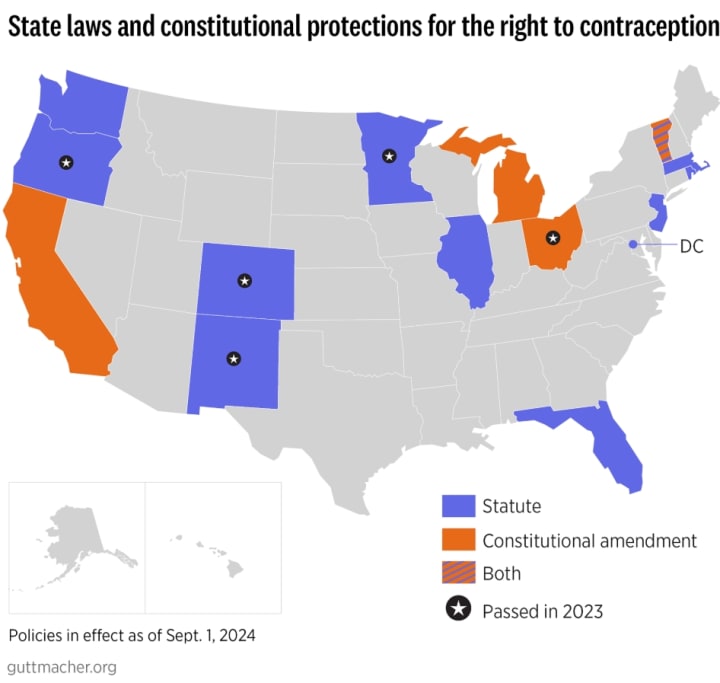
Approximately 65% of women ages 14 to 49 use some form of contraception. In June 2024, Senate Republicans blocked a bill that would have enshrined a national right to birth control into law, leaving the issue to the states. While most states have not banned birth control, there have been legislative efforts and proposed bills to restrict access to certain types, particularly emergency contraception (such as Plan B) and intrauterine devices (IUDs). Some states have also mentioned limiting or restricting access to in vitro fertilization (IVF). These efforts have primarily focused on religious beliefs, redefining when life begins or on pharmacy refusal clauses, and many have failed due to backlash and legal blockings.
An estimated 20 million people of reproductive age currently live in areas referred to as “contraceptive deserts,” or counties where they have trouble accessing a range of birth control options. Currently, the right to contraception is protected by 1965 Supreme Court case Griswold v. Connecticut, which established the right for married couples to use birth control. This was expanded in 1972 to include single people. After overturning Roe v. Wade, Supreme Court Justice Clarence Thomas has been clear about revisiting Griswold v. Connecticut, along with a few others. Several states have since added laws and constitutional protections for the right to contraception.
It is important to note that federal law still protects access to most forms of birth control, but local laws and policies, as well as individual provider decisions, can affect availability in certain areas.
The patchwork of state laws regarding abortion and birth control in the United States creates significant disparities in reproductive health access. Individuals seeking abortion or certain forms of birth control may face substantial barriers depending on where they live or what their circumstances are. Ongoing legal battles and shifting legislative landscapes mean these laws are subject to change, and staying informed is crucial for anyone impacted by these restrictions.
About the Creator
Shaley Speaks
Wife. Mom. Creator.
Politics. Life. Motherhood. Fiction. Music.
I love it all. I hope you do, too.
Keep reading
More stories from Shaley Speaks and writers in The Swamp and other communities.
Trump Advocates for the "Charlie Kirk Act": Examining the Debate Over Government Policing of Free Speech
In a recent and highly charged series of events, President Donald Trump has begun advocating for what is being referred to as the "Charlie Kirk Act," as suggested By TikTok user Ellie May in a video that has since gone viral. This is a legislative proposal that, if enacted, would empower the federal government to play an active role in policing free speech across the United States. The measure, named after conservative activist Charlie Kirk, has ignited a wave of debate among lawmakers, legal scholars, civil libertarians, and everyday citizens who are now reckoning with its potential consequences for the cherished First Amendment, of which Kirk himself was a very firm believer.
By Shaley Speaks5 months ago in The Swamp
Parallel Protests
I haven't written for quite some time, but I have A LOT of thoughts about yesterday's protest rally against our government's involvement and complicity in America's war on Iran, on the harbourside of my home city Bristol, and I need to put them somewhere. My gorgeous girlfriend is always a loving and listening ear and sharing it all with her will always be a healthy and happy way of processing the mental and emotional weight, but getting it straight in my brain to share means writing it all down in straight lines, so, here we are and thanks for being here.
By Steph Cole8 days ago in The Swamp


Comments
There are no comments for this story
Be the first to respond and start the conversation.