
Sporadic Protests in Tehran as Clashes Erupt in Iran’s West
Tensions Rise Amid Economic Struggles and Political Discontent, Sparking Widespread Unrest Across the Country

In recent weeks, Iran has seen a surge of unrest, with sporadic protests breaking out in Tehran and reports of violent clashes in the western regions of the country. These incidents have reignited concerns about the political climate in Iran, highlighting ongoing tensions between the state and a growing discontented population. The protests, largely fueled by political, social, and economic grievances, have become a focal point of international attention, sparking debates on the future of Iran's leadership and its domestic policies.
The Context Behind the Unrest
Iran has long struggled with political and economic instability, with deep-rooted issues such as corruption, economic inequality, and a lack of political freedom. The government, led by the Supreme Leader and a conservative clerical elite, has faced increasing pressure in recent years from both domestic and international sources. The protests in Tehran and the unrest in the western provinces are part of a broader wave of dissent that has been brewing in Iran since the 2017–2018 nationwide protests. These earlier demonstrations were driven by a sharp economic downturn and the government's inability to address the widespread dissatisfaction with the political status quo.
The latest unrest in Tehran is viewed by many as a continuation of this long-standing dissatisfaction, with protesters once again taking to the streets to voice their frustrations. But what sets this wave apart is the escalation of violence and the increasingly harsh tactics used by security forces to quell the demonstrations.
Tehran: The Heart of the Protests
Tehran, the capital and political center of Iran, has witnessed sporadic protests in various districts in recent weeks. These protests, while not as widespread as the 2019 fuel protests or the earlier demonstrations, have been significant in terms of their symbolism and the boldness of the protesters.
The protests in Tehran have been driven by a wide array of issues. Economic hardship, high unemployment rates, inflation, and the devaluation of the national currency have been at the forefront of the demonstrators' grievances. Many Iranians have struggled to make ends meet, and the rising cost of living has made it increasingly difficult for ordinary citizens to sustain a decent standard of living. These economic issues have been exacerbated by US-led sanctions, which have had a severe impact on Iran's economy and limited its ability to trade on the international market.
Furthermore, calls for greater political freedom and an end to government corruption have been key demands of the protesters. Many Iranians, particularly younger generations, feel that their voices are being ignored by the ruling elite. The government's heavy-handed approach to dissent, including the imprisonment of activists, journalists, and political opponents, has only fueled resentment.
Despite the sporadic nature of the protests in Tehran, the government's response has been swift and severe. Security forces have deployed in large numbers to disperse crowds, often using tear gas, rubber bullets, and even live ammunition. There have also been reports of arbitrary arrests and brutal treatment of detainees. The Iranian government has consistently framed these protests as the work of foreign agents or "enemies of the state," seeking to undermine the stability of the country.
The West: A Flashpoint of Violence
While Tehran has seen sporadic protests, it is in the western provinces of Iran, such as Kermanshah and Kurdistan, where the situation has been particularly volatile. In these regions, protests have evolved into violent clashes between protesters and security forces, with reports of fatalities and injuries on both sides.
The unrest in the west of Iran is not new. These provinces, home to large Kurdish populations, have historically experienced tensions with the central government in Tehran. The Kurdish people in Iran have long faced discrimination and political marginalization, and many have called for greater autonomy or even independence. In recent years, these grievances have become more pronounced, with the Kurdistan Workers' Party (PKK) and other Kurdish nationalist groups operating in the region, often clashing with Iranian forces.
The recent escalation of violence in these areas can be traced back to a number of factors, including an increase in Kurdish nationalist sentiment, widespread discontent over economic conditions, and the presence of external actors like the PKK. The western border regions of Iran have long been a strategic concern for the Iranian government, and Tehran has been unwilling to tolerate any threats to its control over these territories.
Reports from the region indicate that security forces have engaged in heavy-handed tactics, including airstrikes, artillery bombardments, and ground operations against suspected Kurdish separatists and protesters. While the Iranian government claims that these actions are necessary to maintain order and security, human rights organizations have condemned the use of force and the civilian casualties resulting from these operations.
International Reactions
The international community has closely monitored the situation in Iran, with several countries and human rights organizations expressing concern over the violence and the government's response to the protests. The United Nations, the European Union, and various international human rights groups have called for an immediate end to the crackdown on peaceful protesters and for an independent investigation into the use of force by Iranian security forces.
The US, which has had a tense relationship with Iran for decades, has condemned the violent suppression of protests and expressed support for the Iranian people’s right to peacefully express their grievances. However, this support has often been framed within the broader context of US sanctions and the ongoing standoff over Iran's nuclear program, complicating the international response.
For Iran’s leadership, the protests present a serious challenge to its authority. While the government has vowed to maintain stability and continue its crackdown on dissent, it is clear that the unrest is a sign of broader dissatisfaction with the status quo. The protests in Tehran and the clashes in the west highlight the deep divisions within Iranian society and the growing desire for change.
Conclusion: A Fractured Society
The sporadic protests in Tehran, coupled with the violent clashes in the western provinces, represent a fragile moment in Iran’s history. The underlying issues driving the unrest—economic hardship, political repression, and social inequality—are not new, but the intensity and scope of the protests signal that the Iranian government may soon face even greater challenges.
As the protests continue to unfold, it remains unclear whether they will spark a wider revolution or lead to meaningful change. What is certain is that the people of Iran are increasingly disillusioned with their government, and the leadership in Tehran must decide how to respond to this growing demand for reform. The outcome of these protests could shape the future trajectory of Iran for years to come, and the eyes of the world will remain fixed on this pivotal moment in the country’s history.
About the Creator
Keep reading
More stories from Aqib Hussain and writers in The Swamp and other communities.
Swiss Ski Bar Fire: Former Pupil at Hertfordshire School Among Those Missing
A tragic fire at a Swiss ski bar has left several people feared missing, including a former pupil from a Hertfordshire school. The blaze, which broke out on the night of December 25, 2025, has sent shockwaves through the local community in Hertfordshire, as well as across the globe. As details continue to emerge, many are left grappling with the devastating loss and the impact it has had on families, friends, and loved ones.
By Aqib Hussain2 months ago in The Swamp
A Gathering of Evil Bosses
“I’m the queen of chin jutting while I smooth my hair, attacking, insulting, and deflecting to protect my appointer.” “Oh, please, Blondi, my hair is curled, highlighted, and longer than yours. I feature television commercials telling immigrants that we will give them a free plane ride home, and if they voluntarily turn themselves in, they will be allowed to legally apply for re-entry. It runs everywhere, and I look good in it! You can’t compete because of your blond hair. Mine is nicer, and my lips are prettier than yours.”
By Andrea Corwin 23 days ago in The Swamp
Forsyth House
Since 1851, Forsyth House has stood on the corner of Union Street and Gordon Street in the heart of Glasgow. Its iconic, or was... because on Sunday 8th of March, 2026, a fire broke out in a small, seemingly un-named shop in the building and tore all that history down. As I write, the rubble is still unsettled and the street is still blocked off. Central Station is quiet on the upper level, and around 30 small businesses have quite literally gone up in smoke.
By S. A. Crawfordabout 8 hours ago in The Swamp
Early March 2026: 4 Goals Accomplished
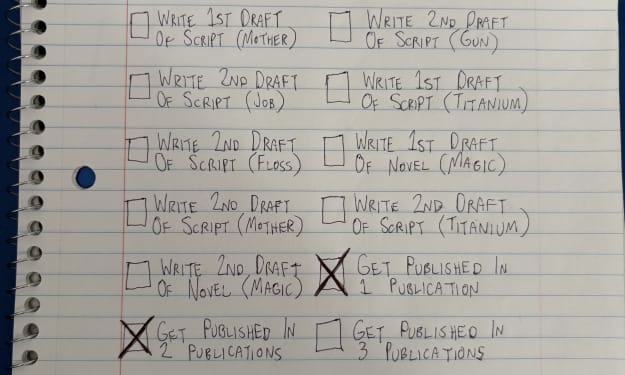
It's early March and I've now accomplished my 4th writing goal for the year of 2026. Before diving into the behind-the-scenes of it... why not tell you up front what that accomplishment was? I was published in a 2nd publication for this year. Published in Helix Literary Magazine out of Central Connecticut State University. You can read it for free right now!
By Stephen Kramer Avitabile8 days ago in Writers

Comments
There are no comments for this story
Be the first to respond and start the conversation.