
Sodium-ion Battery Market Trends & Summary
A Cheaper, Safer, and Sustainable Alternative Rising in the Global Battery Race

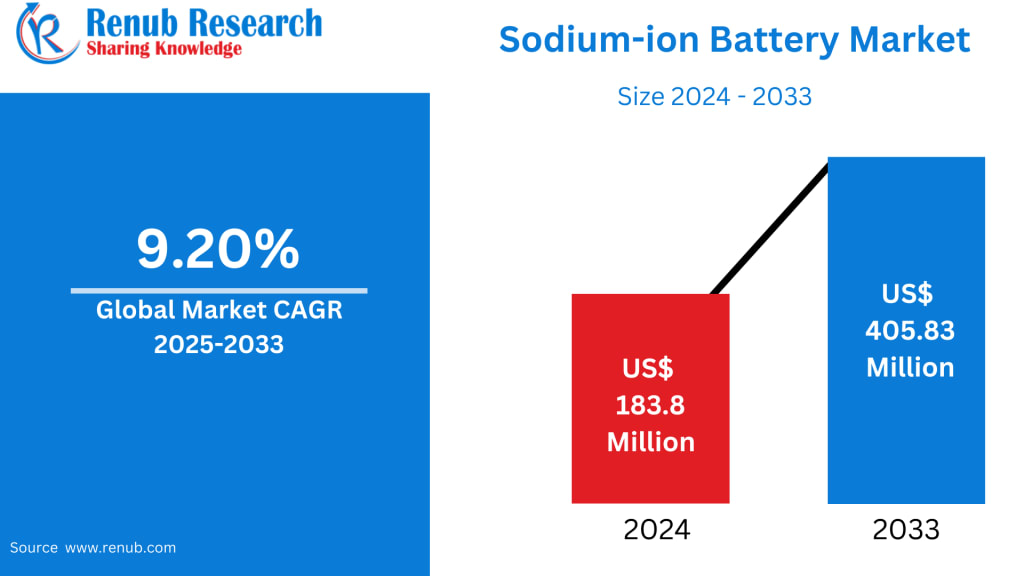
The global Sodium-ion Battery Market, valued at US$ 183.8 million in 2024, is set to grow remarkably to US$ 405.83 million by 2033, expanding at a CAGR of 9.20% from 2025 to 2033. This rise comes at a time when industries worldwide are searching for safer, cheaper, and more sustainable battery alternatives to lithium-ion. With abundant sodium reserves, rapid innovation, and strong government-backed initiatives, sodium-ion batteries are emerging as a promising candidate for mass energy storage, low-speed electric mobility, and grid applications.
According to Renub Research, key factors accelerating market expansion include a surge in demand for renewable energy storage, the abundance and low cost of sodium, increasing R&D in next-generation chemistries, and growing interest in alternative battery solutions to mitigate lithium scarcity and pricing volatility.
Global Sodium-ion Battery Industry Overview
The sodium-ion battery industry is rapidly strengthening its position as a viable and scalable alternative to lithium-ion storage solutions. While lithium-ion batteries dominate the market today, concerns over lithium supply constraints, geopolitical dependencies, and increasing material costs have pushed global researchers and manufacturers to explore sodium-based solutions.
Unlike lithium, sodium is widely available across all continents and does not require environmentally damaging extraction. Sodium-ion batteries function similarly to lithium-ion systems but use sodium ions as charge carriers. They also offer distinct advantages such as improved safety, faster charging, and robust performance in cold environments — making them ideal for stationary energy storage and low-speed electric vehicles.
One of the most notable industry milestones came in April 2024, when Natron Energy officially commenced commercial-scale production of sodium-ion batteries at its Michigan, USA facility — the first large-scale sodium-ion battery manufacturing line in the United States. Natron’s technology, known for exceptional cycle life and enhanced safety, also became the first UL-listed sodium-ion chemistry, marking a historic step toward commercial adoption.
Global interest is further fueled by strategic pilot projects, massive investments in gigafactory-scale facilities, and rapid adoption across Asia and Europe. As the world moves toward decentralized, renewable-driven energy systems, sodium-ion batteries appear poised to play a central role.
Key Growth Drivers for the Sodium-ion Battery Market
1. Abundant Sodium Resources and Stable Supply Chains
Sodium is far more abundant than lithium — appearing in concentrations of nearly 282,000 ppm in the Earth’s crust, compared to lithium’s mere 20 ppm. This abundance eliminates major risks associated with lithium, such as supply shortages, import dependencies, and offshore mining disputes.
With sodium accessible globally, manufacturers can establish stable, cost-efficient, and geopolitically secure supply chains. This advantage significantly reduces production costs and accelerates the commercialization of sodium-ion batteries for consumer electronics, stationary storage, and industrial applications.
2. Cost-efficiency and Performance Benefits Over Lithium-ion
Sodium-ion batteries offer substantial cost benefits because of their inexpensive raw materials and compatibility with existing lithium-ion manufacturing infrastructure. Their ability to function effectively across wider temperature ranges also gives them an edge in markets with extreme climates.
A major leap forward in the industry came when BYD unveiled the MC Cube-SIB ESS, the world’s first high-efficiency sodium-ion battery BESS product. Featuring BYD’s Long Blade sodium-ion design, it provides fast charge/discharge rates, enhanced safety, and cost-effective industrial-scale deployment — further strengthening sodium’s potential as a lithium alternative.
3. Growing Demand for Environmentally Friendly Energy Storage
The global shift toward renewable energy is directly influencing sodium-ion battery adoption. As solar and wind power continue expanding, the need for sustainable, grid-scale storage solutions becomes more urgent.
The European Environmental Agency reported that 24.1% of the EU’s total energy consumption in 2023 came from renewables. With renewables generating intermittent power, sodium-ion batteries are being increasingly deployed to stabilize grids, manage peak loads, and store surplus energy efficiently.
Their ability to withstand long-duration energy cycles makes them especially attractive for utility-scale applications.
Major Challenges in the Sodium-ion Battery Market
Despite massive potential, the sodium-ion battery sector faces technological challenges that could delay widespread adoption:
Material and Electrolyte Stability Issues
Sodium ions are larger and more reactive than lithium ions, which causes electrode degradation and reduces battery lifespan. Current electrolytes also struggle to maintain long-term stability.
Breakthroughs in cathode designs, electrolyte formulations, and protective coatings are essential to improving cycle life.
Performance Limitations in Extreme Temperatures
Sodium-ion batteries show reduced efficiency at very low temperatures due to poor ionic conductivity. At extremely high temperatures, safety concerns such as increased reactivity and thermal instability arise.
Improving thermal management will be key for future applications in EVs, aerospace, and heavy industry.
Regional Insights
United States Sodium-ion Battery Market
The U.S. sodium-ion market is accelerating, driven by strong federal support for domestic battery manufacturing, clean energy goals, and national energy security.
Natron Energy remains a pioneer, with its Michigan plant making the U.S. the first country to produce sodium-ion batteries commercially. Sodium-ion solutions are increasingly used in:
Grid-scale energy storage
Data centers
Backup power systems
Short-range electric vehicles
Federal initiatives like the Energy Storage Grand Challenge are providing additional momentum, encouraging innovation and industrial-scale adoption.
Germany Sodium-ion Battery Market
Germany is emerging as Europe’s sodium-ion innovation hub. With its strong engineering ecosystem and commitment to clean energy, the country has launched major research projects such as:
ENTISE Program
SIB:DE FORSCHUNG initiative
These collaborative efforts between academia, government, and industry are focused on developing high-performance sodium-ion solutions for EVs and stationary storage.
Germany’s energy transition agenda requires scalable, sustainable storage technologies, making sodium-ion an attractive long-term fit.
China Sodium-ion Battery Market
China currently leads the global sodium-ion battery race. Major companies such as CATL and BYD are heavily investing in sodium-ion production.
Notable developments include:
CATL’s Naxtra sodium-ion batteries, which could replace up to 50% of LFP battery demand.
BYD’s 30 GWh sodium-ion battery manufacturing plant in Xuzhou.
A 100 MWh sodium-ion energy storage station in Nanning, developed with HiNa Battery.
China is projected to achieve 275.8 GWh of sodium-ion production capacity by 2025, positioning it as the global manufacturing powerhouse for sodium-ion technology.
United Arab Emirates Sodium-ion Battery Market
The UAE is emerging as a promising sodium-ion adopter as it transitions toward renewable energy and clean technology. Government-led initiatives on grid modernization, energy diversification, and sustainable electrification are paving the way for sodium-ion deployment.
While still a nascent market, collaborations between local entities and global technology providers are expected to accelerate growth. Sodium-ion’s cost-effectiveness makes it an appealing option for remote electrification, off-grid power, and utility-scale renewable storage across the Middle East.
Market Segmentation Overview
By Type
Sodium-Sulphur Battery
Sodium-Salt Battery
Sodium-Air Battery
By Application
Stationary Energy Storage
Transportation
By End User
Consumer Electronics
Automotive
Industrial
Energy Storage
Others
By Country (25 Viewpoints)
North America: United States, Canada
Europe: France, Germany, Italy, Spain, UK, Belgium, Netherlands, Turkey
Asia Pacific: China, Japan, India, Australia, South Korea, Thailand, Malaysia, Indonesia, New Zealand
Latin America: Brazil, Mexico, Argentina
Middle East & Africa: South Africa, Saudi Arabia, UAE
Key Companies Covered (with 4 Viewpoints Each)
Altris AB
Faradion Limited
AMTE Power plc.
Natron Energy Inc.
Aquion Energy
NGK Insulators Ltd.
HiNa Battery Technology Co. Ltd.
Tiamat Energy
NEI Corporation
Final Thoughts
As countries look for secure, cost-effective, and sustainable energy storage technologies, sodium-ion batteries are emerging as a powerful contender in the global battery landscape. Their advantages — abundant raw materials, strong safety profile, and suitability for grid and industrial applications — make them especially appealing in a world grappling with lithium scarcity and rising electricity demand.
While challenges such as energy density and electrolyte stability still need attention, rapid investments and technological breakthroughs indicate a promising future. With major players like CATL, BYD, and Natron Energy scaling up commercial production and governments worldwide supporting battery diversification, sodium-ion batteries are positioned to become a cornerstone of the next-generation energy ecosystem.
About the Creator
Ben Tom
Ben Tom is a seasoned content writer with 12+ years of experience creating SEO-friendly blogs, web copy, and marketing content that boosts visibility, engages audiences, and drives results.
Iraq to Nationalise West Qurna 2 Oilfield Operations, Government Says
Iraq is making headlines this week with a bold decision: the government has announced plans to nationalise operations at the West Qurna 2 oilfield, one of the largest and most vital oil assets in the country. This step comes amid geopolitical tensions, economic uncertainty, and concerns about the stability of oil production. For a nation where oil revenues fund everything from public salaries to infrastructure, keeping West Qurna 2 running smoothly is critical. But what does this move really mean — and why now? West Qurna 2: Iraq’s Oil Powerhouse West Qurna 2 isn’t just another oilfield. Located near Basra in southern Iraq, it produces between 465,000 and 480,000 barrels per day — roughly 9% of Iraq’s total output and about 0.5% of global supply. That makes it strategically vital. Any disruption in production could have ripple effects on Iraq’s economy and even global oil markets. Historically, the Russian giant Lukoil has managed the field, holding a 75% stake under a service contract. But recent developments forced Baghdad to reconsider this arrangement. Why Iraq Is Taking Control Now The catalyst? Sanctions on Lukoil over Russia’s actions in Ukraine. In late 2025, Lukoil declared force majeure, citing sanctions that prevented it from fulfilling contractual obligations. That raised alarms in Baghdad. If Lukoil couldn’t operate normally, Iraq risked losing vital oil production. The solution? Bring operations under state control through the Basra Oil Company (BOC), the government’s own oil management firm. For now, this nationalisation is temporary — planned for about 12 months — giving Iraq time to maintain production while exploring future ownership solutions. How Iraq Plans to Keep Production Running According to officials, BOC will handle day-to-day operations, from paying staff to covering operating costs. Revenue from other major oilfields, like Majnoon, will help fund operations at West Qurna 2. The government assures that production remains steady at pre-nationalisation levels, a key point for Iraq’s economy and its commitments to OPEC. Maintaining output stability also signals to international markets that Iraq is managing the transition carefully. The Geopolitical Context Nationalising West Qurna 2 cannot be separated from global politics. Sanctions against Russian companies disrupted Lukoil’s ability to operate, forcing Iraq to act. By taking control, Iraq safeguards its energy security and reduces dependence on foreign companies that may be vulnerable to political pressure or sanctions. It’s a clear example of how geopolitics can directly affect energy production. What Comes Next? Potential Buyers and Partnerships Although Iraq has nationalised operations temporarily, it’s not shutting the door to foreign investment. Reports suggest interest from major players like ExxonMobil and Chevron, as well as private equity firms, to acquire Lukoil’s stake in the long term. This creates a balancing act: Iraq wants the technical expertise and investment that foreign companies can bring, while also asserting sovereign control over one of its most important resources. Global Implications For the world, Iraq’s move is significant. West Qurna 2 contributes nearly half a million barrels of oil per day to the global market. Keeping production stable protects not just Iraq’s economy, but also global energy prices. At the same time, the episode highlights how international sanctions and politics can have unintended consequences, forcing nations to make tough decisions to maintain essential operations. A Strategic Assertion of Control Ultimately, Iraq’s nationalisation of West Qurna 2 is about more than oil. It’s about energy security, national sovereignty, and strategic autonomy. Whether the takeover remains temporary or evolves into a longer-term model involving foreign partners, it underscores a larger truth: oil is not just a commodity in Iraq — it’s a matter of national security. For investors, governments, and energy watchers, the West Qurna 2 story is a reminder of how interconnected geopolitics, sanctions, and energy markets have become. Key Takeaways: Iraq has nationalised West Qurna 2 operations due to Lukoil’s sanctions-related operational issues. The move is temporary, allowing state control while exploring future ownership. Production is being maintained through the Basra Oil Company and revenue from other oilfields. The decision reflects a mix of economic necessity, geopolitical pressure, and strategic sovereignty. Global oil markets are watching closely, as disruptions could affect supply and prices.
By Muhammad Hassan4 days ago in The Swamp
The steps to losing a child
Step One: Lose a child. Not what anyone wants to happen and nothing you can do to change it, but you can go through steps to becoming happy again. You can go through steps to loving again. You can go through steps to become a new you because after losing a child you will never be the same person you once were.
By Tabitha Hinkley3 days ago in Fiction


Comments
There are no comments for this story
Be the first to respond and start the conversation.