
Silver Market Volatility Trends and Investment Implications 2026
Navigating Price Swings, Industrial Demand, and Strategic Opportunities in a Shifting Global Economy
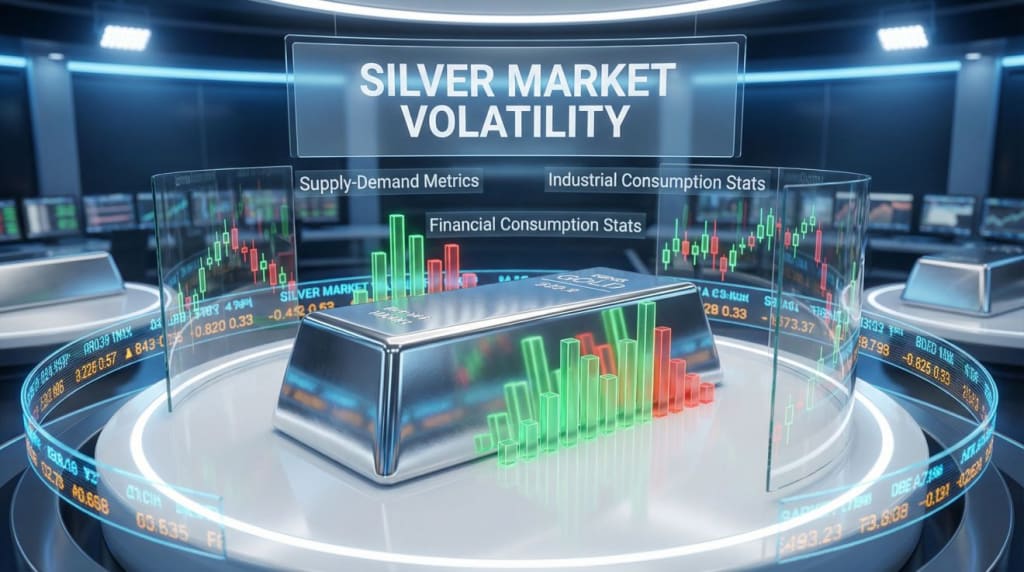
In 2026, the silver market stands at a crossroads of opportunity and uncertainty. Often overshadowed by gold in the precious metals arena, silver has quietly emerged as a compelling asset—driven not only by its traditional role as a store of value but also by evolving industrial demand and macroeconomic complexities. Understanding volatility trends and their investment implications is crucial for investors seeking strategic exposure in a market that blends monetary and commercial influences.
Unraveling Silver’s Volatility
Volatility refers to the degree of variation in the price of an asset over time. Historically, silver has exhibited more pronounced price swings than gold—not surprising given its dual identity as both a commodity and an investment asset.
There are several reasons why silver is more volatile:
Lower market liquidity compared to gold makes prices more sensitive to changes in supply and demand.
Industrial demand fluctuations, particularly from sectors like electronics, solar energy, and electric vehicles (EVs).
Speculative trading on global exchanges can amplify short-term price movements.
In 2026, these volatility patterns continue to shape investor sentiment and market behavior.
Macroeconomic Forces at Play
Several macroeconomic trends are influencing silver’s volatility in 2026:
1. Interest Rate Dynamics
Central banks around the world have been navigating the delicate balance between controlling inflation and supporting economic growth. Interest rates play a significant role in precious metal prices. When rates rise, the opportunity cost of holding non-yielding assets like silver increases, often pressuring prices downward. Conversely, rate cuts or dovish policy signals can buoy silver as investors seek alternative hedges against inflation and currency depreciation.
2. Inflation Uncertainty
Despite periods of cooling inflation, many economies are experiencing persistent price pressures in certain sectors. Silver, historically perceived as an inflation hedge like gold, sometimes rallies when real yields (interest rates adjusted for inflation) turn negative. However, silver’s industrial demand link means that inflation signals don’t always translate directly to price movements.
3. Currency Movements
The strength of the U.S. dollar significantly influences silver prices. Silver, like other commodities priced in dollars, typically moves inversely to the currency. A strengthening dollar—often a safe-haven response to geopolitical uncertainty—can dampen silver prices. Meanwhile, a weakening dollar can spur investor interest and higher prices.
Industrial Demand: A Key Volatility Driver
Unlike gold, silver has enormous industrial applications. In fact, industrial demand accounts for roughly half of global annual silver consumption. This makes silver uniquely sensitive to real-world economic activity.
Solar Energy and Renewables
Silver is a crucial component in photovoltaic (PV) cells. The ongoing energy transition—especially in markets like China, the U.S., India, and Europe—has sustained robust demand for solar installations. As countries adopt aggressive renewable energy targets, demand for silver in this sector is expected to grow, potentially mitigating downward price pressure from investment-led selloffs during risk-off periods.
Electronics and EVs
Silver’s conductivity properties make it indispensable in electronic devices, connectors, and EV components. The increase in EV adoption and broader digital infrastructure expansion continues to support baseline industrial demand. Although economic slowdowns can temporarily lower industrial consumption, long-term trends suggest sustained upward pressure.
Investment Implications for 2026
Investors considering silver in 2026 must navigate both risks and rewards accentuated by volatility. Here are key considerations:
1. Portfolio Diversification
Silver’s imperfect correlation with traditional equities and bonds makes it a valuable diversification tool. During equity market turmoil or political instability, silver—like gold—can act as a safe-haven asset, helping preserve capital. However, its industrial ties also make it sensitive to economic cycles, so it’s important to balance exposure with broader risk management goals.
2. Long-Term vs. Short-Term Strategies
Long-term investors may benefit from silver’s structural demand drivers (renewables and technology), while short-term traders might capitalize on volatility spikes triggered by macroeconomic news or shifts in investor sentiment.
Long Term Perspective:
Focus on silver’s role in green technologies.
Consider silver mining stocks or exchange-traded funds (ETFs) for diversified exposure.
Dollar-cost averaging can help smooth buying costs amid price swings.
Short Term/Active Trading:
Leverage technical analysis to identify entry and exit points.
Monitor news on interest rates and geopolitical events that can trigger rapid price changes.
3. Hedging Against Inflation and Monetary Policy Risks
In times of currency devaluation or aggressive monetary easing, precious metals often outperform risk assets. Silver can serve as a partial hedge, though its performance may lag behind gold due to industrial demand influences.
4. Risk Awareness and Position Sizing
Given silver’s volatility, prudent position sizing is essential. Allocating a small percentage of total portfolio value can mitigate risk while allowing investors to benefit from potential upside.
Emerging Trends to Watch
Looking ahead, several emerging trends may shape silver’s trajectory:
Technological advances that reduce silver usage in industrial applications could change demand dynamics. However, such innovations are likely to unfold gradually.
Recycling and sustainability initiatives within the electronics and solar industries may influence long-term supply dynamics, potentially reducing net demand.
Central bank policies will continue to underpin precious metal prices, especially if inflation expectations shift or global growth falters.
Conclusion
The silver market in 2026 reflects a nuanced interplay between monetary factors and real-world industrial demand. Its inherent volatility presents both challenges and opportunities: it can attract traders seeking price momentum while offering strategic portfolio diversification for long-term investors focused on structural growth trends.
Investors who understand the drivers of silver’s price swings—and who align their strategies with risk tolerance and investment goals—are well-positioned to navigate the evolving landscape. As the world pivots toward cleaner energy, smarter technologies, and complex geopolitical pressures, silver’s role as both an industrial metal and a financial asset is likely to remain compelling, dynamic,
About the Creator
Keep reading
More stories from Salaar Jamali and writers in The Swamp and other communities.
Turkey Joins UAE, Bahrain, Saudi Arabia, Qatar, Kuwait and Seven Other Nations in Middle East as UK Issues High-Level Travel Advisory Amid Regional Tensions, Security Threats, and New Identity Rules
The Middle East is once again in the global spotlight as the United Kingdom has issued a high-level travel advisory, urging its citizens to exercise extreme caution when visiting several nations in the region. The advisory now includes Turkey alongside the United Arab Emirates, Bahrain, Saudi Arabia, Qatar, Kuwait, and seven other nations, reflecting growing concerns about security threats, regional tensions, and evolving identity regulations affecting travelers.
By Salaar Jamaliabout 9 hours ago in The Swamp
Europe and China Take Step to Resolve Dispute on Electric vehicles
In a world where economic rivalries often dominate headlines, a fresh chapter of constructive dialogue has emerged between Europe and China over one of the most talked-about industries of the 21st century — electric vehicles (EVs). After years of friction, both sides have agreed on meaningful steps toward resolving their dispute over Chinese EV imports into the European Union, a move that could influence global EV markets and international trade standards for years to come. The Roots of the Dispute The tension didn’t start overnight. For several years, Chinese EV manufacturers — from BYD to Geely — have surged in global sales thanks to aggressive state support, large-scale production, and highly competitive pricing. European automakers, historically dominant in internal combustion vehicles, struggled to adapt quickly to the EV revolution. As Chinese EV imports to Europe increased dramatically, concerns over market fairness grew. In 2023, the EU launched an official anti-subsidy investigation, concluding that Chinese EV makers benefited from substantial government subsidies, giving them an unfair advantage. By late 2024, the European Commission imposed countervailing duties — tariffs ranging from roughly 8% to over 35% — on Chinese EV imports. While intended to protect European manufacturers, these measures also created political tension, as Beijing viewed them as unfair barriers to trade. Analysts warned that without resolution, this dispute could escalate, affecting investment in EV infrastructure and slowing Europe’s green transition goals. (ec.europa.eu) A New Path Forward: Price Undertakings and Dialogue On January 12, 2026, a breakthrough was announced. China and the EU agreed to pursue a cooperative solution instead of escalating tariffs and trade retaliation. The European Commission issued a guidance framework, allowing Chinese EV makers to submit price undertakings — formal proposals to sell vehicles at minimum prices designed to counteract alleged subsidies. If these proposals meet EU standards, they could replace existing tariffs and create a more predictable, stable trade environment. Key points of the framework include: Chinese exporters must propose pricing that offsets the effects of state support. Each offer will be assessed fairly, following World Trade Organization rules. Additional considerations, like future investments in European production, could strengthen proposals. Officials and experts hailed the initiative as a model of dialogue over confrontation, emphasizing that structured negotiation can resolve disputes without harming global markets. Implications for Europe, China, and the Global EV Market This compromise has far-reaching implications: 1. Stability for European Consumers and Makers European buyers can continue accessing competitively priced EVs, while local manufacturers are protected from being undercut by subsidized imports. For European automakers, the framework creates clarity and predictability, allowing them to plan investments in EV innovation and manufacturing without fearing abrupt trade shocks. 2. A Boost for China’s EV Ambitions China remains a global leader in EV production. A transparent price undertaking system allows Chinese brands to maintain market access in Europe without facing full tariffs, supporting their industrial strategy while aligning with international trade norms. 3. Encouraging Dialogue in Global Trade Perhaps most importantly, this step illustrates how major economies can resolve disputes in rapidly evolving industries through negotiation rather than confrontation. It may set a precedent for other sectors — like renewable energy technology, semiconductors, and high-tech manufacturing — where trade friction could otherwise escalate. The Bigger Picture: Green Transition and Economic Cooperation Electric vehicles are more than just cars — they symbolize the global green transition. Europe aims to reduce emissions and meet ambitious climate goals, while China seeks to expand clean technology exports. Resolving trade disputes in this sector helps both regions: Europe secures affordable EVs to accelerate adoption and infrastructure development. China demonstrates its commitment to fair trade practices while expanding global influence. Global markets benefit from reduced uncertainty, encouraging investment and innovation in EV technology. Analysts suggest that successful resolution could encourage other regions, such as the United States and Southeast Asia, to adopt similar frameworks, fostering cooperation over competition in climate-related industries. Looking Ahead It’s too early to say whether this framework will fully resolve the EU-China EV dispute or serve as a temporary truce. However, the shift from tariffs to cooperative pricing negotiations represents a thoughtful balance between economic interests and diplomacy. For Europe, it could mean a steady supply of EVs at fair prices. For China, it signals the importance of engaging constructively in global trade. In an era where electric vehicles are synonymous with innovation, climate action, and technological leadership, how Europe and China manage this dispute could shape not only global auto markets but also the broader trajectory of international trade and environmental progress.
By Muhammad Hassan5 days ago in The Swamp
Ludacris and Nelly draw backlash over bookings at MAGA-coded music festival
Ludacris and Nelly headlining a mostly right-wing event is good for them. It’s also great for the genre of hip hop. The two rap veterans have showcased their talents on other stages. Why can’t they perform for mostly MAGA folks and grab that bag?
By Skyler Saunders3 days ago in Beat




Comments
There are no comments for this story
Be the first to respond and start the conversation.