
“Sham” Anti-Zionist Ad Opposing Herzog’s Australia Visit Sparks Outrage
Full-page ad includes Nazi kapo names and offensive entries, raising ethical questions
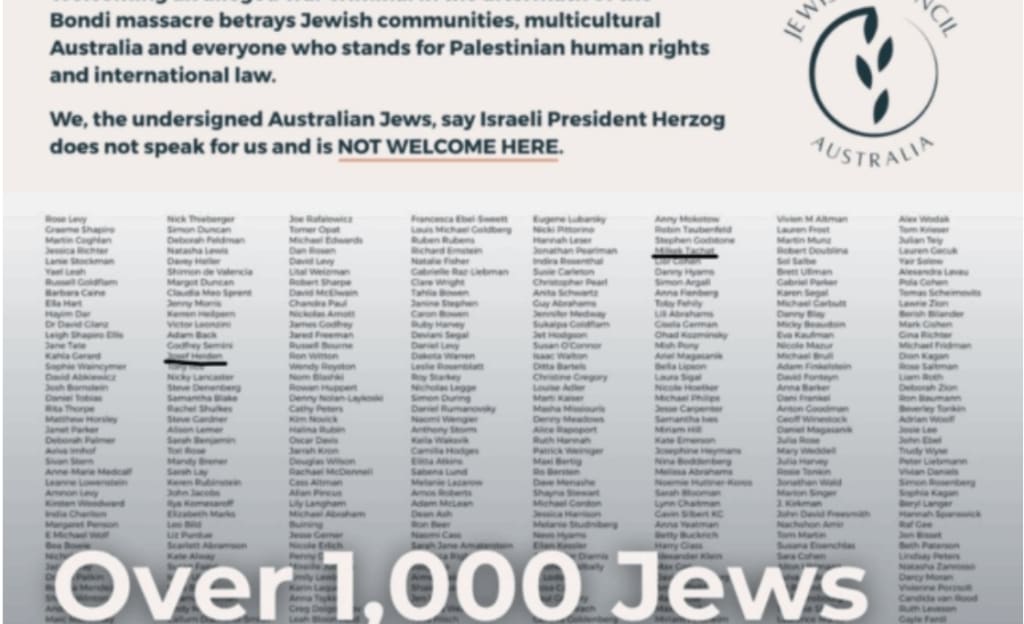
Earlier this February, a full-page newspaper advertisement opposing Israeli President Isaac Herzog’s state visit to Australia ignited a firestorm of criticism. Why? Because the ad included a bizarre and offensive mix of names — some belonging to Nazi kapos, others outright fabricated, and even one translating to “a**e licker” in Hebrew.
The ad, which appeared in The Age and The Sydney Morning Herald, was funded by a group calling itself the Jewish Council of Australia (JCA). It claimed that over 1,000 Jewish Australians opposed Herzog’s visit. On paper, it sounded like a significant statement — but a closer look quickly revealed glaring problems.
When history goes wrong
Some of the names on the list were shocking: kapos from Nazi concentration camps. For those unfamiliar, kapos were prisoners in Nazi camps who were given positions of authority by the Nazis, often forced to supervise fellow inmates, and in many cases notorious for brutal behavior. The inclusion of names like Josef Heiden (Dachau), Eliezer Gruenbaum (Auschwitz), and Carmen Mory (Ravensbrück) was not only historically inaccurate but deeply offensive.
It’s one thing to debate political issues; it’s another to throw in Holocaust-era collaborators as if it were a casual political statement. Jewish community leaders were quick to call out the ad for its tone-deafness and disregard for historical sensitivity.
Fabricated and offensive entries
If that wasn’t enough, the ad also included clearly fake and offensive entries. One name, transliterated in Hebrew as “Milkek Tachat,” literally means “a**e licker.” Others belonged to real individuals who publicly denied ever signing the petition. David Slade, a prominent Zionist figure, described the inclusion of his name as an “ethical failure” by both the JCA and the newspapers that published the ad.
Clearly, there was little to no verification of the list before it went public. Critics have argued that this negligence turned what could have been a legitimate political opinion piece into a laughingstock — and worse, a source of genuine offense.
Community response
Jewish organizations in Australia were quick to condemn the ad. Many stressed that it misrepresented the views of the community. Surveys and public statements suggest that most Australian Jews support strong ties with Israel and view Herzog’s visit positively, particularly in the context of responding to rising antisemitism.
That doesn’t mean dissent is forbidden. Protests against political figures are part of democracy. But the consensus among mainstream Jewish leaders was clear: if you are going to speak on behalf of a community, you need to do it responsibly.
JCA responds
After the backlash, the Jewish Council of Australia admitted that some names were incorrect and blamed “malicious actors” who had inserted false entries. They claimed they had tried to remove duplicates and offensive names but acknowledged that some slipped through. The digital version of the ad was taken down, and the newspapers later amended the list.
Still, many observers felt the apology didn’t address the deeper problem: the group’s credibility and approach to advocacy. Publishing unverified, offensive names undermines public trust and fuels division rather than productive debate.
Political and social context
Herzog’s visit comes at a tense time. Following a terror attack in Bondi Beach in December 2025, the visit was meant to express solidarity with the Jewish community in Australia. But it also coincided with protests and debates over Middle East politics, free speech, and the definitions of antisemitism.
In this context, the ad was particularly ill-timed. By including Nazi collaborators and offensive jokes, it distracted from real issues and risked trivializing Holocaust history. Leaders within the Jewish community stressed that such tactics are counterproductive, alienating allies rather than fostering discussion.
Lessons from the controversy
The ad controversy highlights a few key lessons for public campaigns and political discourse:
Fact-check everything – Using names without permission or verification can quickly turn a campaign into a scandal.
Respect history – Invoking sensitive historical figures like Nazi kapos demands extreme care; casual references are never acceptable.
Community consent matters – Claiming to represent a community requires transparency and accountability.
Ethics over shock value – Offensive or fabricated entries may grab attention, but they damage credibility and trust.
Moving forward
Australia now faces the challenge of reflecting on this incident. While freedom of expression is vital, it comes with responsibility. The controversy has sparked important conversations about how communities engage in political debate, how historical references are used, and how public discourse can stay grounded in truth and respect.
For the Jewish community, it has reinforced the need to protect historical memory and ensure that voices speaking on behalf of the community are authentic and ethical.
At the same time, it’s a reminder for all of us: in an era of polarizing politics, mistakes — whether careless or malicious — can spread quickly and leave a lasting mark.
This blog format keeps the tone informative yet conversational, breaks content into digestible sections, and emphasizes storytelling rather than just reporting.
About the Creator
Keep reading
More stories from Aqib Hussain and writers in The Swamp and other communities.
US Stresses Opposition to Annexation After Israel Expands West Bank Control
The Israeli-Palestinian conflict is heating up again, and the United States is making its position crystal clear: unilateral moves by Israel in the West Bank are not acceptable. Recent steps by Israel’s security cabinet to increase its control over occupied Palestinian territories have drawn sharp criticism from Washington, Arab nations, and Europe, raising fresh concerns about the future of the two-state solution and regional stability.
By Aqib Hussain5 days ago in The Swamp
Why Black History Matters in America?
The United States of America is celebrating their 250th anniversary in 2026. I'm proud to be an American and as someone who was born here, I wouldn't imagine myself living anywhere else. This is a country where opportunities are possible. Where anyone can be successful in anything they desire to do. Equality, community, and togetherness are the backbones of what America is and should be about. However, we have an administration who wants to erase and disregard those who have made positive, meaningful impacts in our country, specifically Black figures, such as Martin Luther King, Jr., Rosa Parks, and Maya Angelou. President Trump and his administration have been constantly complaining and fighting against what they call the "Woke agenda". They use this excuse as a distraction from other issues they refuse to address, such as the high cost of living, climate change, and inflation. That equality is dividing America, when in reality, it's bringing us together. Being woke is not tied to a specific political party. No matter where you stand on the political spectrum, you can still care about other people and their plights. Compassion and empathy for others isn't tied to a political party, either. We were taught as children to treat others the way we want to be treated and not judge others because they're different from us. Caring about others isn't a personal attack on your beliefs. It doesn't make you any less of a person. People who are easily offended over African American figures, past or present, or anything related to it, are grasping at straws. Current and future generations need to know who people like Harriet Tubman and Shirley Chisholm were, especially in the classroom. Black History is part of American History. It should be recognized, not hidden or forgotten. Besides, you can't shield children from everything, just because your feelings are easily hurt.
By Mark Wesley Pritchard 13 days ago in The Swamp




Comments
There are no comments for this story
Be the first to respond and start the conversation.