
Royal Navy’s Crewless Helicopter Set for First Flight
“A New Era in Military Aviation: How the Royal Navy’s Autonomous Helicopter Could Transform Future Warfare”

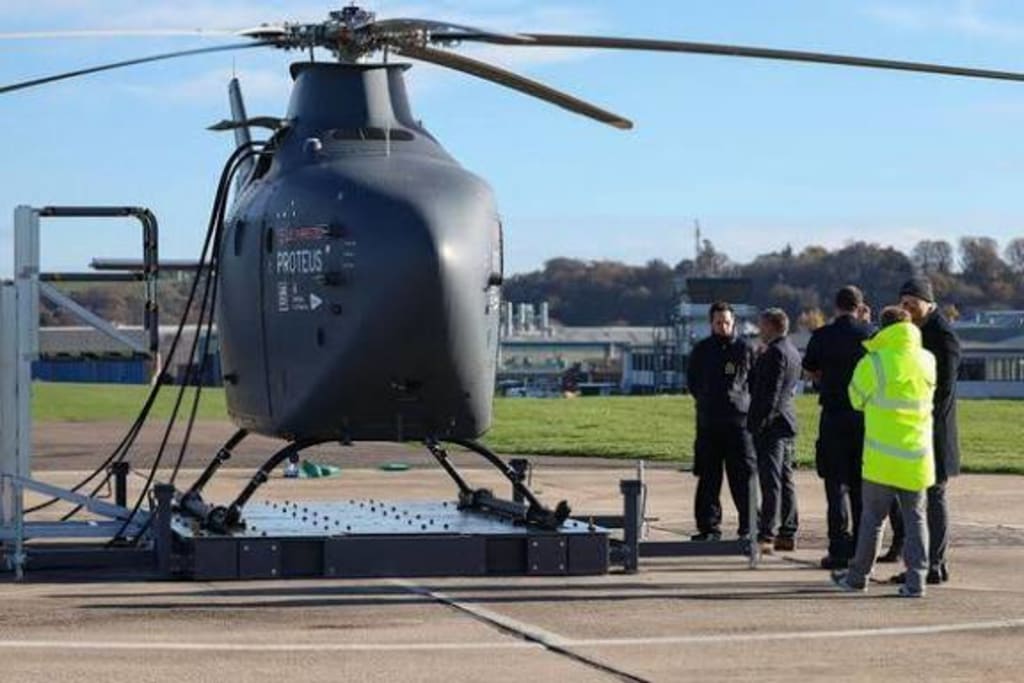
A Breakthrough Moment in Maritime Innovation
The Royal Navy is preparing to take a historic step as its new crewless helicopter—designed to transform maritime operations—moves closer to its first official flight. This cutting-edge aircraft represents one of the most significant advancements in naval aviation in decades, blending automation, advanced surveillance tools, and artificial intelligence to create a machine capable of performing high-risk missions without endangering human pilots.
As global militaries shift toward robotics and unmanned systems, the United Kingdom’s Royal Navy aims to position itself at the forefront of modern defense technology. The upcoming flight of the crewless helicopter highlights not just technological progress but also the changing nature of warfare, search-and-rescue missions, and maritime security.
A New Era of Naval Operations
Traditionally, helicopters have been essential for operations such as reconnaissance, anti-submarine warfare, supply transport, and emergency rescues. They offer mobility and versatility at sea—but they also carry significant risk. Rough weather, combat zones, and long-distance missions can place pilots in dangerous situations.
The Royal Navy’s crewless helicopter is designed to eliminate these hazards. Built with state-of-the-art navigation systems, sensors, and an AI-powered control system, the aircraft can operate autonomously or remotely, giving commanders flexibility depending on mission needs.
Its first official flight is expected to demonstrate capabilities such as:
Autonomous takeoff and landing on moving ships
Long-range surveillance and mapping
Cargo delivery without crew involvement
High-precision navigation in low-visibility conditions
These abilities could drastically reduce operational risks and free human pilots for missions that require direct decision-making.
Strengthening the UK’s Maritime Defense
As geopolitical tensions rise across the globe, maritime nations have turned their attention to advanced surveillance and rapid-response tools. Crewless helicopters offer a cost-effective and safer alternative for routine patrols or conflict-zone monitoring.
The Royal Navy sees this helicopter as a force multiplier, particularly in protecting trade routes, monitoring suspicious vessels, tracking submarines, and supporting humanitarian missions. Unmanned aviation systems can remain airborne longer than manned aircraft, collect more data, and operate in zones too dangerous for traditional helicopters.
The introduction of such technology also aligns with the UK’s broader strategy to modernize its armed forces, integrating unmanned aerial, surface, and underwater vehicles. The crewless helicopter is expected to work alongside autonomous ships and drones, creating a network of smart defense tools capable of sharing real-time information.
Reducing Risk and Expanding Capabilities
One of the strongest arguments for crewless aircraft is the protection of human life. Whether operating in severe storms, disaster zones, or near hostile forces, helicopters have always faced high-risk scenarios. Removing the need for onboard pilots means:
More missions can be attempted during unsafe conditions
Search-and-rescue operations can begin sooner
Hazardous surveillance routes can be monitored continuously
Logistic operations can continue even in conflict-heavy areas
Additionally, the helicopter is expected to carry specialized sensors capable of detecting small objects at sea, monitoring environmental hazards, and tracking enemy movement.
A Step Toward the Future
Experts believe the Royal Navy’s new crewless helicopter could become the blueprint for future aerial systems. If successful, the model might evolve into larger or more specialized versions—perhaps designed for anti-submarine warfare, long-range strike missions, or deep-sea scientific exploration.
Beyond military use, the technology could eventually support civilian sectors as well—offshore oil services, coast-guard search-and-rescue, wildlife monitoring, and disaster response.
A Significant Milestone for British Innovation
The upcoming first flight is more than a technical test—it represents confidence in the UK’s defense engineering and the Royal Navy’s vision for the future. As countries worldwide invest in unmanned technologies, the UK is positioning itself among leaders shaping modern military aviation.
If the flight is successful, it will mark the beginning of a new era where human pilots work alongside intelligent, unmanned systems—ensuring safer, faster, and more efficient maritime operations.
About the Creator
Fiaz Ahmed Brohi
I am a passionate writer with a love for exploring and creating content on trending topics. Always curious, always sharing stories that engage and inspire.
Keep reading
More stories from Fiaz Ahmed Brohi and writers in The Swamp and other communities.
Trump Says He Does Not Want Somalis in the US as ICE Plans Minnesota Operation
In a week already filled with political tension, former U.S. President Donald Trump once again drew national attention by stating that he “does not want Somalis in the United States.” The comment—made during a public appearance—immediately triggered reactions from immigrant communities, human-rights advocates, and political analysts across the country. Alongside this developing controversy, reports surfaced that U.S. Immigration and Customs Enforcement (ICE) is planning a major enforcement operation in Minnesota, a state home to one of the largest Somali-American populations.
By Fiaz Ahmed Brohi3 months ago in The Swamp
Parallel Protests
I haven't written for quite some time, but I have A LOT of thoughts about yesterday's protest rally against our government's involvement and complicity in America's war on Iran, on the harbourside of my home city Bristol, and I need to put them somewhere. My gorgeous girlfriend is always a loving and listening ear and sharing it all with her will always be a healthy and happy way of processing the mental and emotional weight, but getting it straight in my brain to share means writing it all down in straight lines, so, here we are and thanks for being here.
By Steph Cole9 days ago in The Swamp
Seven Countries to Boycott Paralympics Ceremony Over Flag-Flying Russians
Tensions surrounding international sport and geopolitics have once again surfaced after seven countries announced plans to boycott the opening ceremony of the upcoming Paralympic Games in protest against the participation of Russian athletes under their national flag. The decision has intensified an already heated debate over how global sporting bodies should respond to ongoing conflicts and political disputes. Officials from the seven nations — including several European countries that have been strong supporters of Ukraine since Russia’s invasion in 2022 — said they would not attend the opening ceremony if Russian athletes are permitted to compete while displaying national symbols. While the countries did not withdraw entirely from the competition, their symbolic protest aims to pressure international sports authorities to reconsider their stance. The controversy stems from a decision by the International Paralympic Committee (IPC) that allows some Russian athletes to participate under certain conditions. Initially, Russian and Belarusian athletes were banned from many international sporting events following the invasion of Ukraine. However, as global sporting federations reconsidered blanket bans, some organizations began allowing athletes to compete as neutral participants. In this case, critics argue that permitting athletes to appear with national symbols such as the Russian flag undermines the principle of neutrality. They say the move risks politicizing the Paralympics and sending a message that ongoing military actions can be overlooked in the pursuit of sporting inclusivity. Supporters of the boycott say their decision is not directed at individual athletes but at the political symbolism involved. Government representatives from the protesting nations stated that while they respect the dedication and perseverance of Paralympic athletes, allowing Russian competitors to march under their national flag during the ceremony would be inappropriate given the current geopolitical situation. “This is about standing up for the values of international sport,” one official from a participating country said. “Athletes deserve respect, but so do the principles of peace and international law.” Ukraine has been among the most vocal critics of Russia’s participation in global sporting events since the war began. Ukrainian officials have repeatedly argued that Russian athletes should not compete internationally while the conflict continues. The country’s Paralympic committee also expressed disappointment with the IPC’s decision, saying it fails to acknowledge the suffering experienced by Ukrainian athletes and civilians during the war. For the International Paralympic Committee, the issue represents a delicate balancing act. The organization has emphasized that its primary mission is to promote inclusion and ensure that athletes with disabilities can compete at the highest level regardless of political circumstances. IPC officials argue that individual athletes should not be punished for decisions made by their governments. However, the committee also recognizes the sensitivity of the situation. To address concerns, officials introduced restrictions that limit political displays and require participating athletes to comply with rules designed to prevent propaganda or political messaging during the Games. Despite these measures, the boycott announcement demonstrates the deep divisions that continue to affect international sport. The Paralympics, which are traditionally seen as a celebration of resilience, diversity, and human achievement, now find themselves entangled in global political disputes. Sports analysts say the situation reflects a broader trend in which international competitions increasingly become arenas for political expression. From Olympic boycotts during the Cold War to modern disputes over human rights and geopolitical conflicts, sports have often mirrored the tensions of the wider world. Athletes themselves have expressed mixed reactions to the controversy. Some believe that politics should remain separate from sport and worry that boycotts undermine the spirit of international competition. Others argue that sporting organizations cannot ignore global realities, especially when conflicts directly affect athletes and their families. As the Paralympic Games approach, the dispute has created uncertainty about the atmosphere surrounding the opening ceremony. While competitions will proceed as scheduled, the absence of several delegations from the ceremonial event is likely to draw global attention. Ultimately, the controversy highlights the difficult choices facing international sporting organizations. Balancing inclusivity, fairness, and political realities is never simple, particularly during times of global conflict. Whether the boycott leads to policy changes remains unclear, but it underscores how closely the world of sport is tied to the broader geopolitical environment.
By Fiaz Ahmed 7 days ago in The Swamp



Comments
There are no comments for this story
Be the first to respond and start the conversation.