
Renewable Energy Market Size and Forecast 2025–2033: The Global Shift Toward a Clean Energy Economy
Falling technology costs, climate urgency, and supportive government policies are accelerating the renewable energy market toward a USD 5 trillion future.

Renewable Energy Market Overview
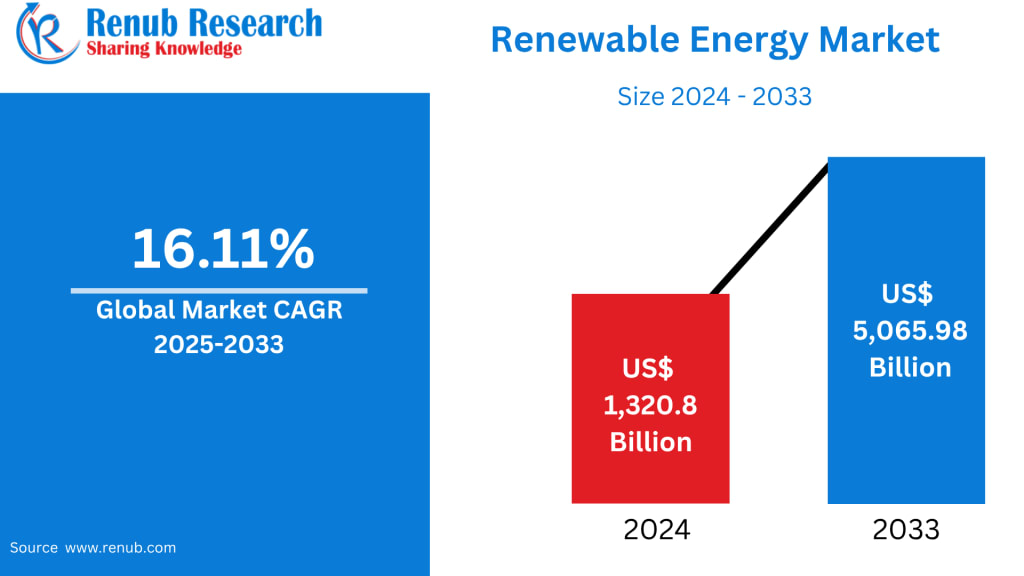
The global renewable energy market is undergoing one of the most significant transformations in modern economic history. According to Renub Research, the renewable energy market is projected to grow from US$ 1,320.8 billion in 2024 to US$ 5,065.98 billion by 2033, expanding at a robust CAGR of 16.11% during 2025–2033. This extraordinary growth reflects a worldwide push to reduce carbon emissions, strengthen energy security, and create a more sustainable future.
Renewable energy is derived from naturally replenishing sources such as sunlight, wind, water, geothermal heat, and biomass. Unlike fossil fuels, these resources are clean, abundant, and emit little to no greenhouse gases. As governments, corporations, and communities respond to the intensifying climate crisis, renewable energy has moved from being an alternative option to becoming a central pillar of global energy systems.
The surge in electricity demand across residential, commercial, and industrial sectors is further accelerating the adoption of renewable energy. In parallel, regulatory incentives, technological innovation, corporate sustainability commitments, and declining installation costs are reshaping the global energy landscape. What was once considered expensive and experimental has now become one of the most competitive and reliable energy sources worldwide.
Why Renewable Energy Is Becoming the Global Standard
Several powerful forces are converging to push renewable energy into the mainstream. Governments are setting ambitious climate targets, businesses are aligning with ESG (Environmental, Social, and Governance) goals, and consumers are demanding cleaner energy options. In addition, technological advancements in wind turbines, solar panels, battery storage, and smart grids have drastically reduced costs while improving efficiency.
Large corporations are increasingly signing long-term Power Purchase Agreements (PPAs) to secure clean electricity directly from renewable producers. Utilities are modernizing grids to handle decentralized and variable energy sources, and investors are channeling trillions of dollars into clean energy infrastructure. Together, these trends are fueling unprecedented growth across the renewable energy ecosystem.
Key Growth Drivers in the Renewable Energy Market
1. Rapid Expansion of Wind Power
Wind energy has become a cornerstone of the global renewable transition. In 2023 alone, 117 GW of wind capacity was installed worldwide, representing a 50% increase over the previous year. Both onshore and offshore wind projects are expanding rapidly, supported by favorable policies, tax incentives, and long-term PPAs.
Technological improvements—such as larger rotors, higher capacity turbines, and advanced grid connections—have significantly improved output while lowering costs per megawatt. Offshore wind, in particular, is gaining momentum because of its access to stronger and more consistent wind speeds, resulting in higher efficiency and reliability. The integration of energy storage and hybrid renewable systems is further strengthening wind power’s role in global electricity generation.
2. Government Policies Accelerating Renewable Adoption
Government action remains one of the strongest drivers of renewable energy growth. Subsidies, tax credits, feed-in tariffs, and renewable portfolio standards are making clean energy investments more attractive across regions. Carbon pricing mechanisms and emission reduction commitments are pushing utilities and industries to move away from fossil fuels faster than ever before.
In India, Andhra Pradesh’s Integrated Clean Energy Policy 2024 approved renewable projects worth ₹71,400 crore for 2025. Major players such as Greenko, Tata Power, Reliance Industries, and John Cockerill are investing heavily in solar, hydrogen, and compressed biogas projects. The policy aims to create 160 GW of renewable capacity, generate 7.5 lakh jobs, and attract ₹10 lakh crore in investments, highlighting the transformative potential of government-led initiatives.
3. Rising Global Warming Concerns
Climate change has moved from being a future threat to a present reality. Global CO₂ emissions from fossil fuels reached 37.4 billion tons in 2024, rising 0.8% year-over-year. This alarming trend is pushing governments and corporations to accelerate their transition to clean energy sources.
Renewable energy not only reduces emissions but also improves air quality, conserves water, and protects ecosystems. Countries around the world are committing to net-zero targets, launching large-scale renewable projects, and modernizing grids to support clean energy integration. International investment in renewable infrastructure continues to rise as the demand for sustainable energy solutions grows.
Challenges Facing the Renewable Energy Market
High Initial Capital Costs
Despite long-term cost benefits, renewable energy projects often require significant upfront investments. Infrastructure development, land acquisition, equipment procurement, and installation costs can be substantial, particularly in developing economies. While operating expenses are low, the initial capital barrier can slow adoption without government support, subsidies, or innovative financing mechanisms.
Grid Integration and Infrastructure Limitations
Integrating renewable energy into traditional power grids remains a major challenge. Solar and wind energy are variable and decentralized, while most grids were designed for steady, centralized fossil fuel generation. Upgrading transmission systems, deploying smart grids, and installing energy storage solutions require significant investments and regulatory reforms. Until these issues are addressed, grid integration will remain a key bottleneck in some regions.
Regional Market Insights
United States Renewable Energy Market
The United States continues to be one of the most dynamic renewable energy markets globally. Supportive federal policies, falling technology costs, and strong consumer demand are driving rapid growth in solar, wind, and bioenergy sectors. In November 2023, the Biden-Harris administration approved the Empire Wind offshore project, the sixth major offshore wind initiative under the current administration. This project supports the U.S. goal of achieving 30 GW of offshore wind capacity by 2030 and reinforces the country’s leadership in clean energy.
Germany Renewable Energy Market
Germany’s ambitious Energiewende program has positioned the country as a global renewable energy leader. The nation continues to expand its solar, wind, and biomass capacity, with offshore wind playing an increasingly important role. In May 2023, RWE acquired a 49% stake in the 1.6 GW Nordseecluster offshore wind project for USD 37.5 million, strengthening Germany’s offshore wind portfolio and accelerating its goal of achieving 100% renewable electricity by 2035.
India Renewable Energy Market
India is one of the fastest-growing renewable energy markets in the world, driven by ambitious government targets and rising energy demand. The country aims to achieve 500 GW of non-fossil fuel capacity by 2030, with strong growth in solar, wind, and hydropower. In June 2022, Ayana Renewable Power Pvt Ltd announced a USD 1.53 billion investment to develop 2 GW of renewable projects in Karnataka, highlighting growing private-sector participation in India’s clean energy transition.
Saudi Arabia Renewable Energy Market
Saudi Arabia is rapidly diversifying its energy mix under Vision 2030, targeting 50% renewable electricity by the end of the decade. In July 2023, ACWA Power, along with Saudi Aramco and Badeel, secured USD 2.37 billion in financing for the Al Shuaibah 1 and 2 solar projects. These projects will deliver 2.6 GW of clean electricity by 2025, enough to power 450,000 homes and significantly reduce emissions.
Recent Developments in the Renewable Energy Industry
May 2025: REplace raised USD 2.1 million to launch an AI-powered site-selection tool for renewable projects.
May 2025: Toyota Boshoku America initiated a 5.7 MW solar project at its Kentucky manufacturing facility.
February 2025: Australia introduced the Hunter Hydrogen Infrastructure Masterplan to develop a global hydrogen hub.
January 2025: Nevada announced the USD 1.2 billion Valmy solar-plus-storage project.
June 2024: ReNew inaugurated a 400 MW solar plant in Rajasthan under a 25-year PPA with SECI, producing 1,331 million units annually and offsetting 1.4 million tons of CO₂.
Renewable Energy Market Segmentation
By Type
Hydropower
Wind Power
Solar Power
Bioenergy
Others
By End User
Industrial
Residential
Commercial
By Region
North America, Europe, Asia Pacific, Latin America, and the Middle East & Africa, covering 25 countries including the U.S., Germany, India, China, Saudi Arabia, Brazil, and Australia.
Leading Companies in the Renewable Energy Market
Key players are shaping the competitive landscape through innovation, strategic partnerships, and large-scale investments:
Innergex Renewable Energy Inc.
ABB Ltd.
Siemens Energy AG
Acciona S.A.
National Grid plc
Électricité de France S.A.
Enel S.p.A.
General Electric Company
Duke Energy Corporation
Invenergy
Each company has been analyzed across five key dimensions: company overview, leadership, recent developments, SWOT analysis, and sales performance.
Final Thoughts
The renewable energy market is no longer just an environmental necessity—it is a global economic opportunity. With strong policy support, rapid technological advancements, and growing public awareness, renewable energy is redefining how the world produces and consumes power. As investments accelerate and innovation continues, the industry is on track to surpass US$ 5 trillion by 2033, signaling a decisive shift toward a cleaner, more resilient energy future.
The coming decade will determine how effectively the world can transition away from fossil fuels. Based on current momentum, renewable energy is poised to lead that transformation—powering economies, protecting the planet, and reshaping global energy systems for generations to come.
About the Creator
Janine Root
Janine Root is a skilled content writer with a passion for creating engaging, informative, and SEO-optimized content. She excels in crafting compelling narratives that resonate with audiences and drive results.
Keep reading
More stories from Janine Root and writers in The Swamp and other communities.
Japan Robotics Market Size and Forecast 2025–2033: A Nation Engineering the Future
Japan Robotics Market Overview Japan has long been recognized as a global powerhouse in robotics, and the coming decade is set to reinforce that leadership. According to Renub Research, the Japan Robotics Market is expected to reach US$ 17,214.95 million by 2033, growing from US$ 2,607.88 million in 2024, at a remarkable CAGR of 23.33% from 2025 to 2033. This rapid expansion reflects not only technological excellence but also Japan’s urgent social and economic needs.
By Janine Root 5 days ago in The Swamp
Winter Snowstorm: What To Expect If You’re Flying This Weekend—As Major Airlines Issue Waivers
Winter weather is about to make travel tricky this weekend as a major snowstorm sweeps across parts of the United States, prompting airlines to issue flight waivers and caution passengers to plan ahead. From cancellations to delayed departures, travelers should be aware of what to expect before heading to airports.
By Muhammad Hassan2 days ago in The Swamp
India and EU Set for the ‘Mother of All Deals’ as Trump’s Tariff Uncertainty Looms
New Delhi / Brussels — January 24, 2026 — After nearly two decades of negotiations, India and the European Union (EU) are poised to conclude what may become the most transformative trade agreement of the 21st century — a pact that has been widely described by leaders on both sides as the “mother of all deals.” The landmark Free Trade Agreement (FTA), expected to be announced at the India‑EU Summit in New Delhi later this month, could reshape global commerce at a time when trade relations with the United States remain volatile under President Donald Trump’s tariff policies. �
By Ayesha Lashariabout 9 hours ago in The Swamp




Comments
There are no comments for this story
Be the first to respond and start the conversation.