
Recognition of the Taliban by Russia: Implications for Regional Security
Is it time to recognize the Taliban government?

Abstract
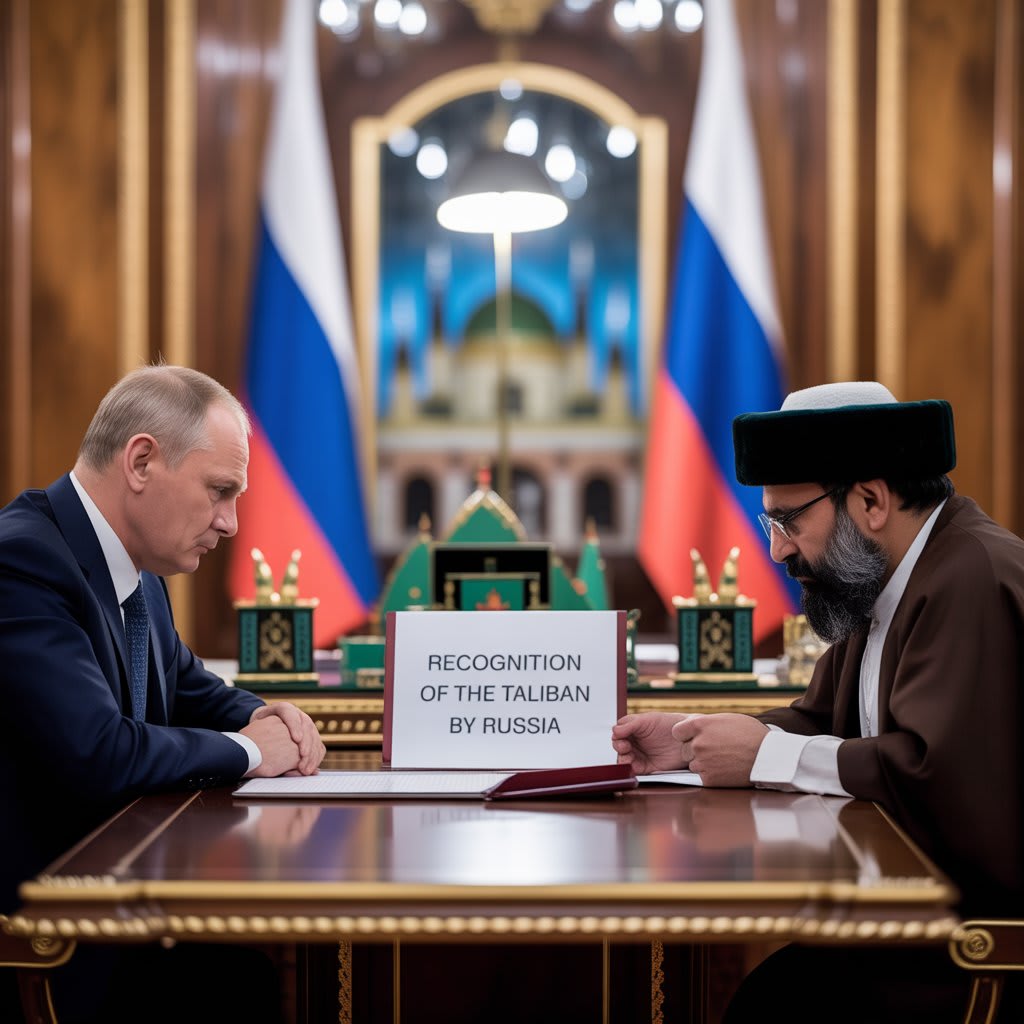
Russia’s evolving relationship with the Taliban government in Afghanistan has profound implications for regional security across Central and South Asia. Driven by pragmatic security concerns and a desire to expand geopolitical influence, Moscow’s cautious engagement with the Taliban could either stabilize its southern flank or sow new seeds of instability. This article analyzes the motives behind Russia’s approach, assesses its impacts on neighboring states and broader Eurasian dynamics, and offers recommendations for mitigating risks associated with this complex relationship.
Recognition of the Taliban by Russia: Implications for Regional Security
How Moscow’s Engagement with Kabul Could Reshape Central Asian Stability
Since the Taliban’s return to power in August 2021, regional powers have been compelled to recalibrate their policies toward Afghanistan. Among them, Russia’s pragmatic engagement stands out. While Moscow has stopped short of formal diplomatic recognition, it has taken significant steps toward normalization—receiving Taliban delegations, accrediting Taliban-appointed diplomats, and exploring economic and security dialogues (Stronski, 2021). This careful approach carries deep implications for regional security in Central and South Asia.
Russia’s Strategic Calculus
Moscow’s outreach to the Taliban is driven primarily by concerns over border security and terrorism. Russia views the potential spillover of extremism from Afghanistan into Central Asia—a region it still considers within its strategic sphere—as a critical threat (Kucera, 2022). ISIS-K’s persistent attacks underline fears that Afghanistan could once again become a launchpad for cross-border militancy. By engaging with the Taliban, Russia hopes to secure guarantees that Afghan territory will not be used against Central Asian republics or Russia itself (Ramani, 2021). At the same time, the withdrawal of U.S. and NATO forces has left a vacuum Moscow is eager to fill. Strengthening ties with the Taliban allows Russia to project influence, position itself as an indispensable regional broker, and align policies with China and Iran under frameworks such as the Shanghai Cooperation Organization (SCO) (Blank, 2022).
Impact on Central Asian Security
Russia’s rapprochement with the Taliban directly affects the security environment in Tajikistan, Uzbekistan, and Turkmenistan. On one hand, Moscow’s engagement might lower the risks of accidental escalations by maintaining communication channels and encouraging the Taliban to prioritize regional stability. Russia’s security guarantees, exercised through the Collective Security Treaty Organization (CSTO), provide an additional buffer. However, this approach carries notable risks. By effectively legitimizing the Taliban without stringent conditions, Moscow could embolden similar radical movements elsewhere (RFE/RL, 2023). Tajikistan, for instance, remains deeply suspicious of the Taliban, wary of potential ethnic repression and the threat posed to Afghan Tajiks. Divergent threat perceptions among CSTO members could strain cohesion and hamper coordinated responses.
Broader Regional and Global Consequences
Russia’s policy also influences broader Eurasian security dynamics. Pakistan has quietly welcomed Moscow’s overtures to the Taliban, which partially validate Islamabad’s historic ties to the group and open new diplomatic avenues. Meanwhile, India—Russia’s longstanding strategic partner—views the Taliban with deep apprehension, complicating Moscow’s balancing act between its traditional ally and its pragmatic overtures to Kabul (Ramani, 2021). Additionally, Russia’s approach weakens Western efforts to isolate the Taliban on issues such as women’s rights and inclusive governance. A fragmented international approach could reduce collective leverage, enabling the Taliban to resist meaningful internal reforms.
The Risk of Miscalculation
Critics warn that Russia may overestimate the Taliban’s control over Afghan territory and their willingness or ability to contain ISIS-K and al-Qaeda remnants. Should Afghanistan once again become a sanctuary for transnational jihadist networks, the consequences could directly threaten Russian and Central Asian security. Internally, Moscow must also navigate the risks of encouraging radical narratives among segments of its own Muslim populations.
Policy Recommendations
To mitigate these risks, Russia and its regional partners should pursue:
Conditional engagement: tying deeper cooperation and aid to Taliban compliance on counterterrorism and human rights benchmarks. Enhanced intelligence sharing: particularly through the SCO and CSTO, to monitor jihadist movements across Afghanistan’s borders. Inclusive regional dialogues: involving India, Iran, and Western stakeholders to avoid fragmented policies that the Taliban could exploit.
Conclusion
Russia’s evolving relationship with the Taliban is a calculated gamble rooted in regional security imperatives and geopolitical aspirations. Whether this engagement will stabilize Central Asia—or sow the seeds of future conflict—depends largely on the Taliban’s behavior and Moscow’s willingness to enforce clear red lines. In this delicate balance lies the future security architecture of Eurasia.
References
Blank, S. (2022). Russia and Central Asia After the Taliban Takeover. Jamestown Foundation.
Kucera, J. (2022). “Russia’s Balancing Act on Afghanistan.” Eurasianet, February.
Ramani, S. (2021). “Russia’s Pragmatic Approach to the Taliban.” The Diplomat, October.
RFE/RL. (2023). “Moscow Hosts Taliban Delegation Amid Security Fears.” Radio Free Europe/Radio Liberty, March.
Stronski, P. (2021). Russia’s Interests in Afghanistan. Carnegie Endowment for International Peace.
About the Creator
Mohammad Alam Amin
• Ph.D. in International Relations, department of International Relations, South Asian University (SAARC), New Delhi, India 2025.
• M.S M-Phil International Relations, South Asian University (SAARC) 2021, New Delhi, India.
Keep reading
More stories from writers in The Swamp and other communities.


Comments
There are no comments for this story
Be the first to respond and start the conversation.