
Global CubeSat Market Size and Forecast 2025–2033
From classroom satellites to commercial constellations: how low-cost space is reshaping research, connectivity, and Earth observation worldwide

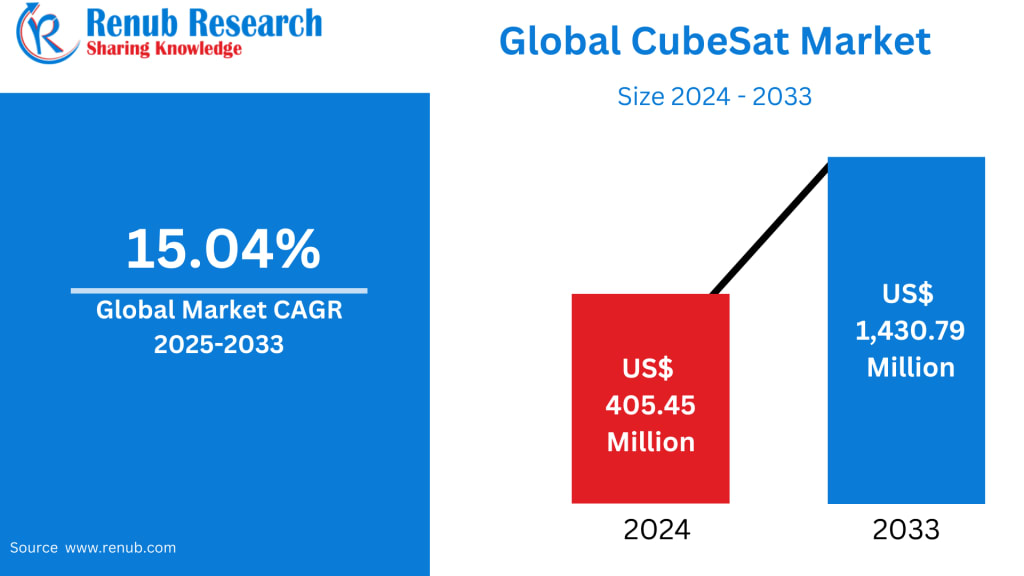
The space economy is no longer reserved for superpowers and billion-dollar missions. A quiet revolution is unfolding above Earth—one measured not in tons, but in centimeters. CubeSats, the standardized, shoebox-sized satellites originally designed for academic experimentation, have grown into one of the most dynamic segments of the global space industry. According to Renub Research, the Global CubeSat Market is expected to expand from US$ 405.45 million in 2024 to US$ 1,430.79 million by 2033, registering a strong CAGR of 15.04% during 2025–2033.
This remarkable growth reflects far more than technological novelty. It signals a structural shift in how satellites are built, launched, and used—democratizing access to orbit, accelerating innovation, and enabling new commercial and scientific frontiers.
Global CubeSat Market Outlook
CubeSats are a class of miniaturized satellites based on a standardized modular design. Each unit—known as “1U”—measures 10 cm × 10 cm × 10 cm and typically weighs around 1.33 kilograms. Multiple units can be stacked to form larger platforms such as 3U, 6U, or 12U satellites, allowing mission designers to scale capabilities without reinventing hardware from scratch.
Originally developed at California Polytechnic State University and Stanford University as educational tools, CubeSats have rapidly evolved. Their low manufacturing cost, shorter development cycles, and compatibility with rideshare launches have made them attractive to universities, startups, government agencies, and established aerospace companies alike.
What began as a training ground for students is now a serious platform for Earth observation, scientific research, telecommunications, technology demonstration, and even interplanetary exploration. Today’s CubeSats can carry miniaturized cameras, atmospheric sensors, software-defined radios, and propulsion modules—capabilities once reserved for much larger satellites.
Growth Drivers in the Global CubeSat Market
Growing Demand for Low-Cost Satellite Launch Programs
Traditional satellites require years of development and budgets that often reach into the hundreds of millions of dollars. CubeSats challenge this paradigm. Their compact size and standardized interfaces dramatically reduce manufacturing time and costs. Most importantly, they can be launched as secondary payloads alongside larger missions or on dedicated small-sat launch vehicles, significantly lowering access-to-orbit expenses.
This affordability has opened space to universities, research institutions, startups, and emerging economies. The result is a broader, more inclusive space ecosystem where experimentation, rapid prototyping, and innovation thrive. A striking example came in April 2023, when the European Space Agency announced plans to send a constellation of 30 CubeSats to study the Sun—demonstrating how even large agencies now rely on small satellites for cost-efficient scientific missions.
Increasing Utilization in Research, Education, and Space Exploration
CubeSats have become indispensable tools for research and education. Universities use them as hands-on platforms to teach aerospace engineering, systems design, and orbital mechanics. For scientists, they offer economical access to space for experiments in microgravity, radiation exposure, and Earth science.
Major agencies such as NASA and ESA actively support CubeSat programs as part of larger missions, enabling small teams to contribute to ambitious projects. The ability to deploy multiple CubeSats in constellations further enhances data accuracy and real-time monitoring. In July 2024, for instance, engineering students at the University of Kansas successfully placed their KUbeSat-1 into orbit through NASA’s ELaNa-43 mission—an example of how education, government, and private launch providers now collaborate in the CubeSat ecosystem.
Expansion of Commercial and Communication Applications
Commercialization is one of the strongest engines behind CubeSat adoption. Companies are launching CubeSats for telecommunications, IoT connectivity, remote sensing, maritime tracking, and data analytics. Constellations of small satellites can deliver global coverage at a fraction of the cost of traditional systems.
Firms such as Planet Labs, Spire Global, and others have proven the business case for CubeSat-based services, from daily Earth imagery to ship and aircraft monitoring. As demand for real-time data grows—particularly in agriculture, logistics, climate monitoring, and disaster management—CubeSats are increasingly seen as the backbone of affordable space-based intelligence.
Challenges in the Global CubeSat Market
Limited Payload Capacity and Power Constraints
CubeSats’ greatest advantage—their small size—also presents technical limitations. Restricted payload volume and onboard power constrain the complexity of instruments and the amount of data that can be transmitted. Solar panel surface area is limited, and battery capacity must be carefully managed, especially for power-hungry sensors or high-bandwidth communications.
While advances in miniaturization, energy storage, and power management are addressing these issues, they can add cost and design complexity. Radiation exposure and thermal fluctuations also pose challenges for long-duration missions.
Space Debris and Orbital Congestion
The rapid increase in CubeSat launches raises concerns about space debris, particularly in low Earth orbit. Many CubeSats lack propulsion or autonomous maneuvering systems, making collision avoidance difficult. Without reliable deorbit mechanisms, inactive satellites can contribute to long-term orbital congestion.
Regulatory bodies and space agencies are responding with stricter guidelines on end-of-life disposal and collision mitigation. However, implementing these measures within the tight budgets of small satellite missions remains a significant challenge.
Market Segmentation Highlights
1 to 3U CubeSat Market
The 1–3U segment is the most widely used, offering an optimal balance between affordability and functionality. These platforms dominate educational projects, technology demonstrations, and basic scientific missions. Advances in sensor miniaturization and standardized deployment systems have significantly expanded their capabilities, making them popular for Earth imaging, atmospheric studies, and weather monitoring.
Science, Technology, and Education (STEM) CubeSat Market
CubeSats have become a cornerstone of STEM education and research. Governments and space agencies actively fund academic CubeSat programs to promote innovation and workforce development. These missions allow students and researchers to conduct experiments in orbit at low cost while testing new technologies before deployment on larger satellites.
Communication CubeSat Market
With rising demand for global connectivity, communication-focused CubeSats are growing rapidly. Constellations provide broadband, IoT data relay, maritime and aviation communication, and emergency services to remote regions. Advances in antennas, inter-satellite links, and software-defined radios have greatly enhanced performance, positioning CubeSats as critical complements to terrestrial networks.
Commercial CubeSat Market
The commercial segment is expanding as private enterprises adopt CubeSats for Earth observation, weather forecasting, maritime tracking, and resource monitoring. Their scalability enables real-time global data collection for agriculture, logistics, and energy. The integration of AI and edge computing is further boosting value by enabling onboard data processing.
Subsystem Markets: EPS and C&DH
Electrical Power Systems (EPS): Efficient power generation, storage, and distribution are essential for CubeSat operations. Advances in high-efficiency solar cells and compact batteries are extending mission lifespans and enabling more demanding payloads.
Command and Data Handling (C&DH): Modern C&DH systems manage telemetry, control, and payload data. Increasingly, they incorporate fault-tolerant designs, AI-based autonomy, and advanced data compression to optimize limited bandwidth.
Regional Insights
United States CubeSat Market
The United States leads the global CubeSat ecosystem, driven by strong government support, a vibrant private sector, and extensive academic participation. Agencies such as NASA and the Department of Defense fund CubeSat programs for Earth observation, defense, and exploration. Commercial innovators—including Planet Labs and Spire Global—have accelerated deployment through cost-effective launch services. The country’s advanced manufacturing, launch infrastructure, and R&D ecosystem make it the world’s most mature CubeSat market.
France CubeSat Market
France’s CubeSat market benefits from close collaboration between academia, government, and industry. The French space agency (CNES) actively promotes small satellite missions, particularly in Earth observation and atmospheric research. Major aerospace firms such as Airbus and Thales Alenia Space provide advanced manufacturing and testing capabilities, while universities drive innovation through educational CubeSat programs.
China CubeSat Market
China is rapidly expanding its CubeSat capabilities through strong government investment, academic participation, and a growing commercial space sector. Universities and research institutions collaborate on CubeSat missions under national space initiatives, while private firms pursue IoT connectivity and remote sensing. In June 2025, China successfully tested its OpenHarmony operating system in orbit aboard the Dalian-1 Lianli CubeSat, highlighting the country’s focus on technological self-reliance.
Saudi Arabia CubeSat Market
Saudi Arabia’s CubeSat market is emerging as part of its Vision 2030 strategy for technological and scientific development. Supported by the Saudi Space Agency and leading universities, CubeSat programs focus on education, Earth observation, environmental monitoring, and national security. In April 2023, KAUST launched a CubeSat in partnership with Spire Global to collect data on terrestrial and marine ecosystems, underscoring the nation’s growing role in space research.
Market Segmentation
By Size:
0.25U–1U | 1–3U | 3U–6U | 6U–12U | 12U and Above
By Application:
Earth Observation & Traffic Monitoring | Science, Technology & Education | Space Observation | Communication | Others
By End User:
Government & Military | Commercial | Others
By Subsystem:
Payloads | Structures | Electrical Power Systems | Command & Data Handling | Propulsion Systems | Attitude Determination & Control Systems | Others
By Country:
North America (U.S., Canada)
Europe (France, Germany, Italy, Spain, U.K., Belgium, Netherlands, Turkey)
Asia Pacific (China, Japan, India, South Korea, Southeast Asia, Australia, New Zealand)
Latin America (Brazil, Mexico, Argentina)
Middle East & Africa (Saudi Arabia, UAE, South Africa)
Competitive Landscape
The global CubeSat market features a diverse mix of aerospace leaders and specialized small-sat innovators. Major players include CU Aerospace, Planet Labs Inc., EnduroSat, Pumpkin Space Systems, Space Inventor, Surrey Satellite Technology Limited (Airbus Group), GomSpace, Innovative Solutions In Space (ISIS), AAC Clyde Space, and L3Harris Technologies.
These companies compete on modular design, subsystem performance, launch integration, and end-to-end mission support. Many provide turnkey CubeSat platforms, payload integration, and data services, enabling customers to focus on applications rather than hardware.
Final Thoughts
CubeSats have transformed from educational curiosities into essential instruments of the modern space economy. As Renub Research projects the market to grow from US$ 405.45 million in 2024 to US$ 1,430.79 million by 2033, it is clear that small satellites will play an outsized role in the future of space.
Their impact extends beyond cost savings. CubeSats are democratizing access to orbit, empowering universities and startups, accelerating commercial innovation, and enabling new approaches to Earth observation, connectivity, and scientific discovery. Challenges remain—particularly in power management, payload capacity, and orbital sustainability—but ongoing technological advances and regulatory frameworks are steadily addressing these concerns.
About the Creator
Diya Dey
Market Analyst
Shock and Anger in Minneapolis: Protests Erupt After Woman Killed by U.S. Immigration Agent
The city of Minneapolis once again found itself at the center of national attention after protests erupted following the fatal shooting of a woman by a U.S. immigration agent. Demonstrators poured into the streets demanding answers, accountability, and justice, as grief and anger spread through communities already sensitive to issues of policing and federal enforcement. The incident has not only shaken the local community but has also reopened broader debates about the role of immigration authorities, the use of force, and the fragile trust between law enforcement and the public in the United States. What Happened? According to preliminary official statements, the woman was shot during an encounter involving a U.S. immigration enforcement officer. Authorities have confirmed her death but have released limited details about the circumstances, citing an ongoing investigation. Witness accounts and early reports vary, contributing to public frustration and suspicion. What is clear, however, is that the involvement of a federal immigration agent — rather than local police — has intensified scrutiny and raised urgent questions about jurisdiction, oversight, and operational conduct. In the hours following the shooting, news of the woman’s death spread rapidly through Minneapolis, triggering spontaneous gatherings that soon grew into organized protests. Protests Fill the Streets By evening, demonstrators had taken to major intersections and public spaces across Minneapolis. Protesters carried signs reading “Justice Now,” “No More Killings,” and “End Violent Enforcement,” while chanting demands for transparency and the release of body-camera footage. Community organizers emphasized that the protests were not only about one incident but about longstanding fears surrounding immigration enforcement practices, particularly in communities of color. While the demonstrations were largely peaceful, the emotional weight was undeniable. For many residents, the shooting reopened wounds left by previous high-profile deaths involving law enforcement in the city. Why Immigration Enforcement Is Under the Spotlight U.S. immigration agencies, such as Immigration and Customs Enforcement (ICE), primarily focus on civil enforcement — detentions, deportations, and investigations related to immigration status. Unlike local police departments, they often operate with less public visibility. Critics argue that this lack of transparency creates dangerous gaps in accountability, especially when enforcement actions intersect with everyday community life. The fatal shooting in Minneapolis has intensified concerns about: Rules governing the use of deadly force by immigration agents Oversight of federal officers operating within cities Coordination — or lack thereof — between federal and local authorities The psychological impact of aggressive enforcement on immigrant communities Supporters of strict enforcement counter that agents face unpredictable and sometimes dangerous situations, but protesters argue that this cannot justify loss of civilian life. A City Shaped by History Minneapolis carries a unique historical context when it comes to police violence and public protest. The city became a global symbol of racial justice movements following the 2020 killing of George Floyd. That history has shaped how residents respond to incidents involving law enforcement. There is deep public sensitivity, a heightened expectation of accountability, and little patience for delayed or incomplete explanations. For many protesters, the shooting by an immigration agent felt like a continuation of a broader pattern, rather than an isolated tragedy. Official Responses and Investigations Federal authorities have stated that the shooting is under investigation and that standard procedures are being followed. Local officials have called for calm while acknowledging the community’s right to protest. Civil rights groups, however, are urging an independent investigation, arguing that internal reviews alone are insufficient to restore public trust. Elected officials at both city and state levels have demanded clarity on: Whether the agent was acting alone or as part of a task force What threat, if any, prompted the use of lethal force Whether body cameras or surveillance footage exist So far, the lack of detailed information has only fueled speculation and anger. Immigration Policy Meets Public Safety The incident arrives at a time when immigration policy remains one of the most divisive issues in American politics. Debates over border security, deportations, and federal enforcement powers dominate national discourse. For immigrant communities, the presence of federal agents is often associated with fear rather than protection. Advocates argue that aggressive enforcement strategies discourage people from cooperating with authorities, even in emergencies. The Minneapolis shooting underscores how immigration enforcement is no longer just a policy issue — it is a public safety issue with real human consequences. Community Voices and Grief Vigils have been held in honor of the woman who was killed, with candles, flowers, and handwritten messages lining sidewalks. Speakers at these gatherings emphasized compassion for the victim’s family and called for systemic change rather than temporary outrage. Faith leaders, activists, and local residents have urged authorities to listen rather than react defensively. “This isn’t just about one woman,” one protester said. “It’s about whether our lives are treated as disposable.” What Comes Next? As investigations continue, the future impact of the shooting remains uncertain. Protests are expected to continue until authorities provide clearer answers and demonstrate accountability. Legal experts note that the case could influence future policy discussions about: Limits on federal enforcement operations in cities Mandatory body cameras for immigration agents Stronger civilian oversight mechanisms Whether meaningful reform follows will depend largely on transparency — and on whether officials respond to public demands with action rather than rhetoric. Final Thoughts The death of a woman at the hands of a U.S. immigration agent has once again forced Minneapolis — and the nation — to confront difficult questions about power, accountability, and human dignity. In a city already shaped by protest and pain, the message from the streets is clear: justice delayed is justice denied. As demonstrators continue to march, one truth remains unavoidable — without trust, enforcement becomes fear, and without accountability, tragedy repeats itself.
By Muhammad Hassan4 days ago in The Swamp


Comments
There are no comments for this story
Be the first to respond and start the conversation.