
Presidential Pardons: A Reflection of Distrust and a Fragile Justice System
How Trump and Biden’s Pardons Reveal Political Divisions and Waning Confidence in Justice

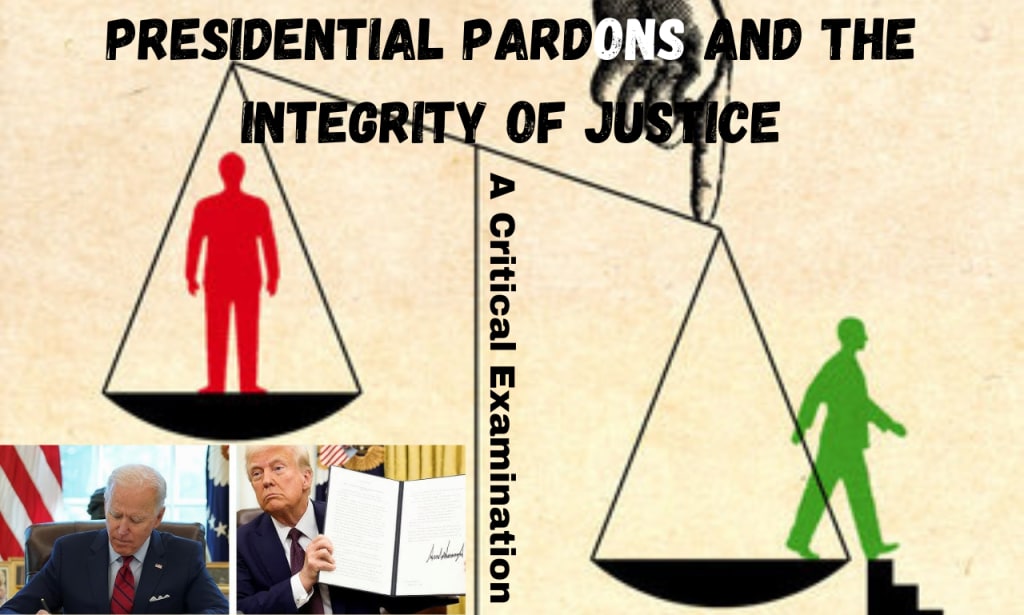
Presidential pardons have always been a powerful tool, allowing leaders to grant clemency, correct legal misjudgments, and, at times, make political statements. However, the recent pardons issued by former President Donald Trump and current President Joe Biden highlight not just their differing political philosophies but also their deep distrust of each other and the fragile state of the U.S. criminal justice system. These pardons raise critical questions about the fairness of justice, political motivations, and the broad powers of the executive branch.
The Political Undertones of Pardons
Presidential pardons have historically served as acts of mercy, providing relief to individuals convicted under federal law. Yet, in modern times, they have become increasingly controversial, often reflecting political alliances, personal loyalties, or attempts to shape historical narratives.
Donald Trump granted a significant number of pardons, many of which benefited his close allies, political supporters, and individuals convicted of crimes related to his administration. High-profile figures like Michael Flynn, Roger Stone, and Paul Manafort—who were involved in legal battles connected to Trump—received pardons, reinforcing claims that his decisions were driven by self-interest rather than justice.
Joe Biden, in contrast, has focused on pardoning individuals convicted of nonviolent drug offenses and those affected by systemic inequalities. His approach aligns with his administration’s stance on criminal justice reform and efforts to reduce racial disparities in sentencing. However, critics argue that Biden’s choices are politically motivated as well, selectively addressing only certain aspects of the justice system while ignoring others.
Despite their contrasting strategies, both presidents’ pardons reveal a broader issue: a growing distrust in the judicial system and a political divide over its fairness.
A Divided Nation’s View on Justice
Trump’s use of pardons was often seen as an extension of his combative political style—rewarding loyalty and challenging institutions he believed were biased against him. For his supporters, these pardons were acts of defiance against what they perceived as a corrupt legal system. To his critics, they represented an abuse of power designed to shield himself and his allies from accountability.
Biden’s approach is aimed at reinforcing his administration’s commitment to criminal justice reform. His pardons, primarily directed at nonviolent drug offenders, seek to address past injustices in sentencing. However, some argue that his focus selectively highlights only the parts of the justice system that fit within his broader political narrative, while ignoring other systemic problems.
As a result, the country remains sharply divided on what justice truly means and whether the legal system can be trusted to operate fairly without political influence.
Undermining Confidence in the Criminal Justice System
While the U.S. Constitution grants presidents the power to issue pardons, the way both Trump and Biden have exercised this authority raises concerns about the judicial system’s credibility. If presidents feel the need to pardon individuals because they were unjustly convicted or excessively sentenced, it raises questions about the system’s ability to deliver impartial justice in the first place.
Trump’s pattern of pardoning political allies and Biden’s targeted approach to criminal justice reform both suggest that justice is not always applied consistently. The selective use of clemency reinforces the idea that legal outcomes can be influenced by political power rather than purely by the rule of law.
Moreover, the increasing expectation that presidents must use pardons to correct legal injustices indicates a deeper issue within the justice system. Ideally, courts and lawmakers should ensure fair sentencing and legal accountability, but when presidential pardons become a primary method of addressing these concerns, it exposes fundamental weaknesses in the judicial process.
The Legacy of Presidential Pardons
As the 2024 election approaches, the pardons issued by Trump and Biden will likely become key political talking points. Trump’s pardons will be criticized as evidence of corruption and cronyism, while Biden’s will be framed as either necessary criminal justice reform or selective political posturing.
Future presidents will also face difficult decisions regarding the use of clemency. Will they continue to leverage pardons as political tools, or will they attempt to restore their original purpose as instruments of true justice? The use of presidential pardons should not be taken lightly, yet history suggests that they will remain a controversial aspect of executive power.
Conclusion
The recent pardons granted by Trump and Biden extend beyond legal decisions; they symbolize a nation grappling with political division and declining trust in its justice system. Trump’s tendency to pardon political allies and Biden’s focus on selective reforms both highlight a deeper problem—the American legal system is increasingly perceived as inconsistent and vulnerable to political influence.
Until the justice system is strengthened to function independently and fairly, presidential pardons will continue to be seen as reflections of political strategy rather than genuine acts of mercy. The challenge ahead is not only in how future presidents use this power but in whether the nation can restore faith in its legal system as a whole.
About the Creator
mureed hussain
Hi, I’m a creative writer passionate about health & wellness, love, longevity, aging, and pet care. With extensive Quora experience, I craft engaging posts, thoughtful questions, and insightful answers.
Find me at>>[email protected]
Keep reading
More stories from mureed hussain and writers in The Swamp and other communities.
Trump 2.0: Can Disruption Deliver a New Era?
Donald Trump, one of the most polarizing figures in modern American history, stands at the dawn of a second term, poised once again to challenge the status quo. His re-election, driven by a combination of his unapologetic style, economic promises, and the unwavering loyalty of his base, signals a renewed commitment to disrupting Washington and reshaping the global order. Yet, while his resolve has only strengthened, questions linger about how far his brand of disruption can go in an increasingly polarized political landscape.
By mureed hussainabout a year ago in The Swamp
The Forsyth House Fire
Since 1851, Forsyth House has stood on the corner of Union Street and Gordon Street in the heart of Glasgow. Its iconic, or was... because on Sunday 8th of March, 2026, a fire broke out in a small, seemingly un-named shop in the building and tore all that history down. As I write, the rubble is still unsettled and the street is still blocked off. Central Station is quiet on the upper level, and around 30 small businesses have quite literally gone up in smoke.
By S. A. Crawford2 days ago in The Swamp
600 Israelis arrive home on two flydubai flights that land in Tel Aviv
Around 600 Israeli citizens returned home on Sunday after two special flights operated by the airline Flydubai landed at Ben Gurion Airport near Tel Aviv. The flights marked one of the first organized efforts to repatriate Israelis who had been stranded abroad following disruptions caused by the escalating conflict in the Middle East.
By Fiaz Ahmed 6 days ago in The Swamp


Comments (1)
So divisive! Great work! Well written!