
On the Brink:
How a Web of Conflicts, Probes and Nuclear Posturing Made 2025 the Year the World Came Closest to a Global War


A convergence of large-scale campaigns, risky military probes, growing authoritarian brinkmanship and eroding diplomatic backstops has created a volatile global landscape — and several flashpoints could cascade into a far larger war.
By late September 2025, the international order looked less like a safety net and more like a set of frayed ropes. From large-scale offensive operations in eastern Europe to intensifying warfare in the Middle East, renewed great-power rivalry across the Taiwan Strait, and faster, riskier missile programs in the Korean Peninsula, multiple theaters are generating incidents and miscalculation risks that could cascade into a wider conflagration. This article maps the major drivers, shows how they interconnect, and explains the channels through which a localized crisis could become global.
Eastern Europe: Russia’s grinding campaign and NATO’s test of resolve
Russia’s multi-year invasion of Ukraine continued to dominate the European security environment in 2025. Persistent offensive operations along several axes, coupled with probing aerial and drone incursions near NATO airspace, have ratcheted up the risk of direct confrontation between Russian forces and NATO member states — either by accident or by escalation in response to perceived attacks. Analysts and military monitors report repeated probing flights and cross-border drone incidents in countries bordering Ukraine and NATO members, evidence the Kremlin may be testing both defenses and political will.
sited: Institute for the Study of War https://understandingwar.org/research/russia-ukraine/russian-offensive-campaign-assessment-september-26-2025/
Why this matters: a misidentified or misattributed strike against NATO territory risks triggering collective defense mechanisms or precipitating large-scale military responses.
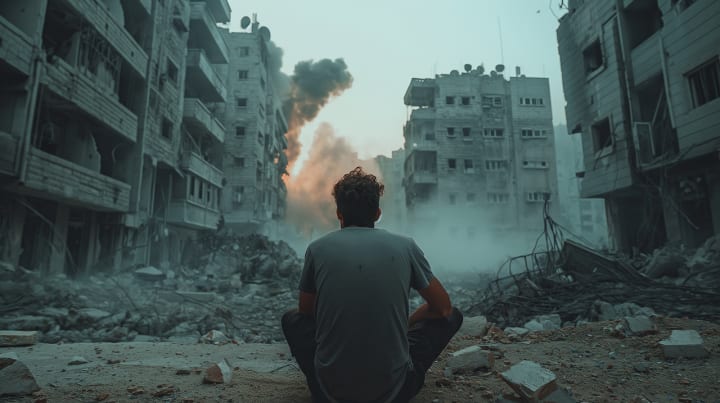
The Middle East: Gaza’s collapse into a wider regional crisis
The Gaza war (continuing from the October 2023 rupture and evolving through 2024–2025) has intensified, with Israel’s ground operations in Gaza City and severe humanitarian collapse prompting international pressure and regional tensions. Aid routes shut down and heavy urban fighting have resulted in mass displacement and large casualty counts; the scale of violence has repeatedly drawn in regional actors and galvanized trans-regional proxy dynamics that could widen the conflict.
AP News sited: https://apnews.com/article/israel-palestinians-hamas-war-news-09-27-2025-680ae7d149ac0b793e42ad46cd9c0db5
Why this matters: when regional powers (state or non-state) increase involvement or retaliatory strikes across borders, the risk grows that neighboring states or allies will be drawn in, making localized war spreadable.
Taiwan Strait: normalization of coercion and declining deterrence
Across the Taiwan Strait, 2025 saw continued pressure from the People’s Republic of China through maritime and air operations, along with large-scale exercises and increasingly sophisticated gray-zone tactics. Taiwan’s own defense posture has shifted, while analysts warn that both sides are operating under narrower and more dangerous margins for incident management. Recent exercises and coast-guard incursions show an environment where a collision, misfire, or blockade attempt could quickly escalate. Global Taiwan Institute sited: Across the Taiwan Strait, 2025 saw continued pressure from the People’s Republic of China through maritime and air operations, along with large-scale exercises and increasingly sophisticated gray-zone tactics. Taiwan’s own defense posture has shifted, while analysts warn that both sides are operating under narrower and more dangerous margins for incident management. Recent exercises and coast-guard incursions show an environment where a collision, misfire, or blockade attempt could quickly escalate. (Global Taiwan Institute)
Across the Taiwan Strait, 2025 saw continued pressure from the People’s Republic of China through maritime and air operations, along with large-scale exercises and increasingly sophisticated gray-zone tactics. Taiwan’s own defense posture has shifted, while analysts warn that both sides are operating under narrower and more dangerous margins for incident management. Recent exercises and coast-guard incursions show an environment where a collision, misfire, or blockade attempt could quickly escalate.
Global Taiwan Institute: https://globaltaiwan.org/
Why this matters: the U.S.-China–Taiwan triangular dynamic carries global stakes. A major kinetic escalation near Taiwan risks drawing the U.S. and allies directly into combat operations.
The Korean Peninsula: faster missile programs and nuclear signaling
North Korea’s weapons program advanced in 2025 with tests and publicly announced engine breakthroughs, drawing alarm about its ability to field longer-range delivery systems more rapidly. Pyongyang’s posture and rhetoric, combined with expanded military exercises by nearby powers, raise the odds that a misinterpreted test or strike could provoke retaliatory action or pre-emptive moves that spiral out of control. (NK News - North Korea News)
Why this matters: new or faster ICBM and solid-fuel technologies compress decision times and complicate political signaling; nuclear-capable states operating under high tension are a classic pathway to miscalculation.
The erosion of crisis diplomacy and norms
Across multiple crises there is a shared pattern: diplomatic channels are weaker, messaging is more adversarial, and the traditional restraints (confidence-building measures, hotlines, multilateral mediation) are frayed or politicized. Where backchannels should exist to manage an incident, they are imperfect or distrusted; public nationalist politics make de-escalation politically costly for leaders. Recent analyses point to explicit nuclear signaling in public rhetoric and indirect pressure campaigns rather than quiet diplomacy — a dangerous mix.
(Institute for the Study of War)
Accident or misattribution: drones or missiles cross or strike neutral or allied territory (examples already reported in 2025), provoking defensive responses that are then interpreted as offensive—rapid escalation follows. (The Guardian)
Proxy widening: regional actors retaliate against perceived sponsors, expanding conflict geography (e.g., attacks from or into third countries near Israel/Gaza or the Iran-Israel shadow war). (AP)
NewsGreat-power miscalculation: limited strikes intended as warning are met with disproportionate responses from rivals, and the alliance commitments of third parties (NATO, U.S. treaty obligations) create a chain reaction. (Institute for the Study of War)
Risk factors that make 2025 uniquely dangerous
Compressed decision cycles (faster missiles, hypersonics, improved targeting) shorten political response time. (NK News - North Korea News)
High domestic political stakes—governments face internal pressure not to appear weak.
Technological opacity—drones, cyberattacks, and clandestine sabotage complicate attribution.
Declining multilateral dispute-settlement—less effective international mediation.
What would reduce the risk (policy levers)
Rapid restoration and public reinforcement of crisis hotlines and incident-management channels between major militaries.
Internationally backed humanitarian pauses and neutral corridors in conflict zones to reduce regional spillover. (Reuters)
Confidence-building steps around sensitive technologies (missile tests, no-fly commitments near contested zones).
Third-party mediation that is clearly independent and able to verify compliance.
Multiple conflicts and confrontations in 2025 are not isolated: they are connected by technology, diplomacy, and the psychology of deterrence. A single misstep — a misfired drone, a ship collision, an ambiguous cyberattack — could ignite a chain reaction across continents. The near-term imperative is to restore the practical, technical means of incident management and rebuild trusted diplomatic channels; without those, the world remains alarmingly close to a cascade that could, in the worst case, become a global war.
Sources (selected reporting and analysis used for the piece)
Institute for the Study of War — Russian Offensive Campaign Assessments (Sept. 2025). (Institute for the Study of War)
The Guardian reporting on Ukraine and Russian probing of NATO airspace (Sept. 27, 2025). (The Guardian)
Reuters and Associated Press on Gaza humanitarian situation and Israeli operations (Sept. 2025). (AP News)
The Diplomat / Global Taiwan coverage and analysis of 2025 Taiwan defense posture and exercises. (The Diplomat)
NK News / Newsweek coverage of North Korea missile engine tests and developments (Sept. 2025).
NK News - North Korea News
About the Creator
The Blacksheepkid Collective by: El Pablo 1x
El Pablo 1x is more than just a name—it’s a movement. As the visionary founder of Black Sheep Kid Music and host of the vibrant Live in the Vault Podcast, El Pablo 1x wears many hats: Read. Vibe. Build. This is just the beginning.
Keep reading
More stories from The Blacksheepkid Collective by: El Pablo 1x and writers in The Swamp and other communities.
Moet Ro$e Is Redefining Hip Hop and Soul on Her Own Terms
Moet Ro$e is more than an artist—she’s a movement in the making. With roots in gospel choirs and a foundation shaped by both discipline and faith, she has crafted a sound that transcends genre lines. Her music fuses the raw honesty of hip hop with the soul-stirring richness of gospel-inspired vocals, creating a style that is at once authentic, ambitious, and deeply resonant. From her early days directing choirs and DJing campus events to building a growing catalog supported by her label, Moet Ro$e has proven that she doesn’t just perform music—she embodies it. Every verse carries her story, every note echo resilience, and every stage she steps on becomes a space for connection.
By The Blacksheepkid Collective by: El Pablo 1x5 months ago in Beat
A Gathering of Evil Bosses
“I’m the queen of chin jutting while I smooth my hair, attacking, insulting, and deflecting to protect my appointer.” “Oh, please, Blondi, my hair is curled, highlighted, and longer than yours. I feature television commercials telling immigrants that we will give them a free plane ride home, and if they voluntarily turn themselves in, they will be allowed to legally apply for re-entry. It runs everywhere, and I look good in it! You can’t compete because of your blond hair. Mine is nicer, and my lips are prettier than yours.”
By Andrea Corwin 13 days ago in The Swamp



Comments
There are no comments for this story
Be the first to respond and start the conversation.