

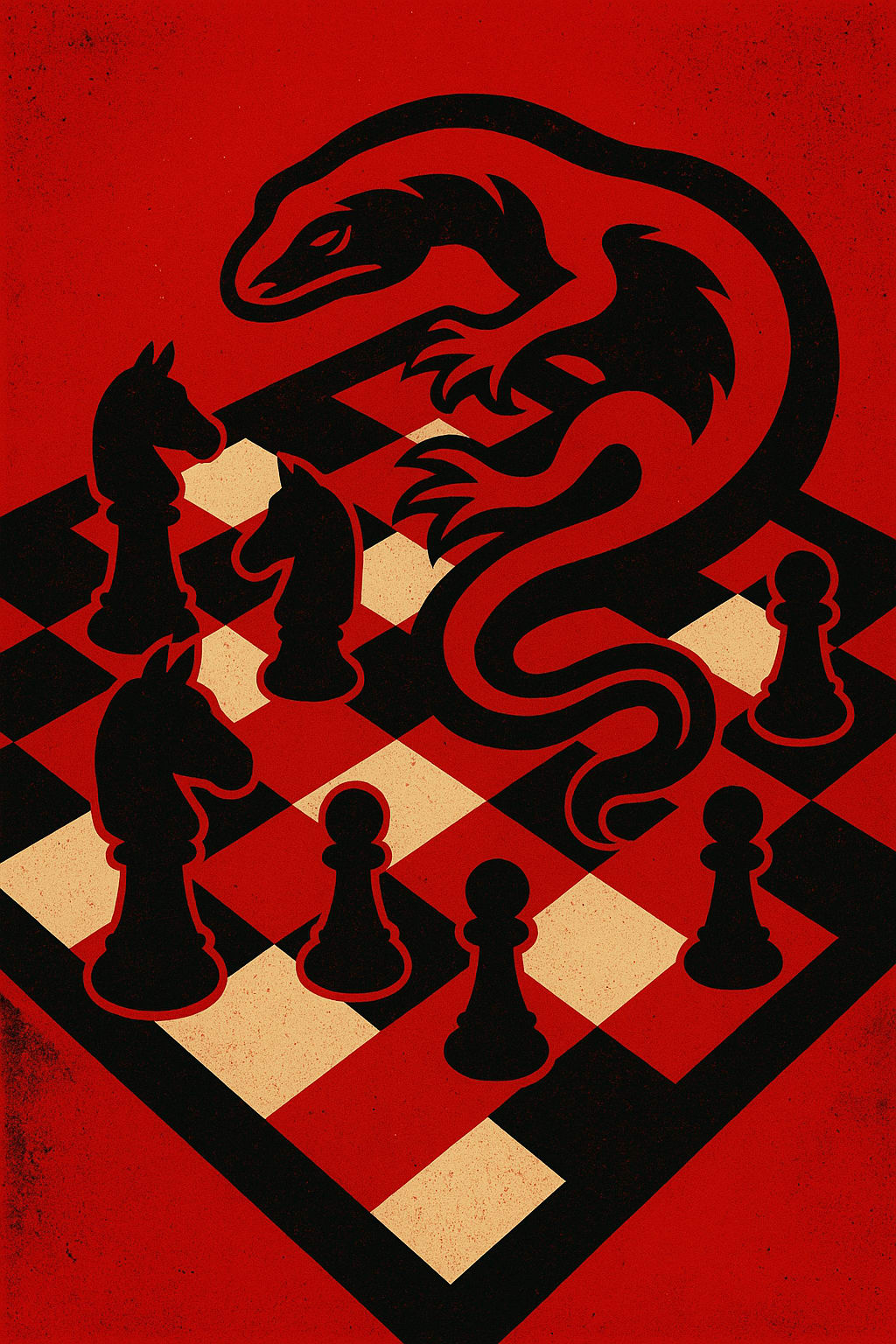
The real failure is not only in the politicians who twist the maps but in the citizens who refuse to learn how the game is played. You carry the internet in your pocket, yet too many choose to marinate in echo chambers, waving red or blue flags while ignoring the machinery of power grinding them down. That is how you end up as a pawn in the salamander chess match between donkeys and elephants. It is exactly the environment in which Madison’s warning in Federalist No. 10 has come true.
The fight over political maps is not a modern trend. It is the predictable behavior of human beings when the rules allow them to secure power without earning it. Madison saw this long before the term “gerrymander” existed. His warning reads less like eighteenth-century theory and more like a diagnosis of our present condition.
In 1787 Madison laid it out plainly: factions — groups united by interests opposed to the rights of others or the common good — are inevitable. You cannot ban them without banning liberty itself. You cannot make people think or want the same things. The only defense is to design a system that forces them to compete on a level field so no one group can dominate. It is a beautiful idea, but it rests on a fragile assumption that those writing the rules will not also rig the field.
That assumption collapsed almost immediately. In 1812 Massachusetts Governor Elbridge Gerry approved a district so contorted it resembled a salamander, giving the English language a new word for political manipulation. Illinois followed in the late nineteenth century with maps that preserved partisan control regardless of the popular vote. Texas was next, and here the historical record breaks the modern partisan script. It was Democrats who drew those early maps for over a century. During the Jim Crow era, they used gerrymandering to protect one-party rule, weaken minority voting strength, and shield incumbents from accountability. Republicans did not invent the playbook. They inherited it.
The bridge from history to now: Fast forward to 2025. PLANC2308 gives Texas Republicans a shot at five more congressional seats. Former President Trump said it outright: “We are entitled to five more seats.” Governor Abbott, riding that momentum, called special sessions while Democratic lawmakers fled the state to block a quorum. The Senate stayed in place, halting the map temporarily. The House stayed out, but Abbott answered by ordering fines and threatening arrests for absent Democrats. Whether you call it democracy or political theater, it is power asserting itself.
Senate Democrats called the process corrupt and argued the legislature should focus on flood relief, not political engineering. Rep. Richard Raymond of Laredo warned that the plan could weaken federal representation for border communities. “Politics picking its voters instead of voters choosing leaders,” is how they summed it up.
Republicans responded with their own certainty. Lt. Gov. Dan Patrick insisted the vote reflected accurate representation. Sen. Phil King claimed there was no legal flaw in the map. Outside Texas, the fight is drawing national attention. California Governor Gavin Newsom warned of a Democratic redistricting counterattack if Trump continues pressing the advantage. Commentators like CNN’s Chuck Todd are already calling it a “cold civil war” over control of the map.
Why this matters now: This is not just history repeating. It is Madison’s nightmare scenario: a faction not just winning elections, but seizing the blueprint of the districts themselves, deciding outcomes before a single vote is cast. That is not a flaw in his theory. It is his worst-case outcome, normalized.
Bernard Lonergan’s Generalized Empirical Method describes knowing as a process: experience, understanding, judgment, and decision. Applied to politics, it means citizens must move beyond the raw experience of hearing a statistic or watching a headline scroll by. You take in the facts, you ask the right questions, you weigh the evidence, and then you decide. Yet in today’s redistricting debates, too many people get stuck at the first stage. They watch a politician speak, nod at what feels right, shake their heads at what feels wrong, maybe add performative gestures like they are snapping along to a beat, and call it engagement. Outrage without judgment is surrender, and judgment without clarity is complicity.
If you carry the internet in your pocket, you are not powerless. The maps, the plans, and the data are public. Examine them. Know the rules. Demand the fairness Madison envisioned. Because if you do not, the map will become your fate long before the first ballot is printed, and you will have surrendered without even knowing the fight happened.
About the Creator
Mike Barvosa
Texas-based educator. Always listening.
I write about what we ignore, where memory fades, systems fail, and silence shouts louder than truth. My stories don’t comfort. They confront.
Read them if you're ready to stop looking away.
Keep reading
More stories from Mike Barvosa and writers in The Swamp and other communities.
The Map, the Myth, and the Math: What Texas’s New District Plan Really Shows
When the public hears racial inequality claims in politics, like Texas Rep. Vince Perez (D, El Paso, District 77) saying “Latino citizens count for one-third, Black citizens for one-fifth, of a white resident,” the words sound urgent and even righteous. But rhetoric without precision is not public service; it is stagecraft. When numbers are presented without the actual mechanics of representation, they do not enlighten anyone. They construct a narrative.
By Mike Barvosa7 months ago in The Swamp
Parallel Protests
I haven't written for quite some time, but I have A LOT of thoughts about yesterday's protest rally against our government's involvement and complicity in America's war on Iran, on the harbourside of my home city Bristol, and I need to put them somewhere. My gorgeous girlfriend is always a loving and listening ear and sharing it all with her will always be a healthy and happy way of processing the mental and emotional weight, but getting it straight in my brain to share means writing it all down in straight lines, so, here we are and thanks for being here.
By Steph Cole6 days ago in The Swamp
The First Casualty Of War Is The Truth
It is often said that in times of war, the first casualty is the truth. When Donald Trump launched Operation Epic Fury, he said that the goal was to stop Iran from developing nuclear weapons. At the same time, when the head of the International Atomic Energy Agency (IAEA), Rafael Grossi, was asked about it, he said that they do not even have access to the sites. Therefore, they have no clear idea about what is happening there, and he appeared somewhat confused.
By Ibrahim Shah 2 days ago in The Swamp


Comments
There are no comments for this story
Be the first to respond and start the conversation.