
Not My Bible: The Rise of Christian Nationalism In Modern American Politics
And how to fight back


What Would Jesus Do? I don’t know, but he definitely would not condone Christian nationalism.
What Is Christian Nationalism?
In a world where the lines between religious beliefs and political governance have become so delightfully blurred, Christian nationalism has entered the stage as the latest buzzword, drawing attention with all the finesse of a bulldozer at a ballet.
But what is this grand spectacle known as Christian nationalism? Well I’m glad you asked! At its core, it’s a cultural attempt to blend national identity with what some might call “Christian values.”
Admittedly, that doesn’t sound so scary with Jesus teaching that you should be kind and love one another, but these “Christians” have chosen to ignore that part. And while crappy, it wouldn’t be so bad, but for the little fact that throughout history, Christian nationalism has been subtly, and not so subtly, intertwined with significant events where ideology has been instrumental in influencing cultural standards and the structures of authority.
But honestly, how bad can it get? Let’s find out together!
A Not-So-Brief Historical Overview
The story of America as a “Christian nation” has changed dramatically, with each era having its unique impact.
But because this article is going to be long enough, let’s start the story in 1920 with the ratification of the 18th Amendment.
Prohibition, which fervent evangelical Christians backed, was an attempt to purify society and bring it back into line with divine permission. While supported by many, the charismatic Billy Sunday was one of the movement’s most prominent figures.
But just who was the conveniently named Billy Sunday?
Born into poverty on November 19, 1862, Sunday became a professional baseball outfielder in his early 20s, playing eight seasons in the National League. He was known for his remarkable speed, daring base running, and agility in the outfield. His upbeat and genuine demeanour won the hearts of fans and fellow players alike.

However, in 1891, Sunday left professional baseball to pursue a calling in Christian ministry after converting to evangelical Christianity. By the early 20th century, he had become the most renowned evangelist in the nation, captivating audiences with his relatable sermons and dynamic delivery style.
But captivating really isn’t the right word; he was gripping, spellbinding, and even seductive in his hold over audiences. He conducted around 300 religious revivals in major American cities, drawing an estimated 100 million attendees — numbers unmatched by any evangelist before the advent of electronic sound systems.
And who can blame them? Unlike the traditional, stiff, boring, humdrum preachers most people were used to, Sunday bounced around the stage like a lemur, used colloquial language, and employed large choirs, bands, and even chorus girls. His sermons were not merely religious messages; they were full-fledged performances.
Despite his widespread popularity, not everyone appreciated Sunday’s methods. A minister from Winchester once remarked that “any cultivated person [should be] terribly revolted by the extreme sensationalism, the coarse jokes, the super-slang… and the dancing dervish contortions of the revivalist, where perspiration seems to be confused with inspiration.”
Now, you might be thinking, ‘Billy seems like an okay chap; why is he included in this biased article about Christian nationalism?’
“At Kansas City, Kansas, before the saloons were closed, they were getting ready to build an addition to the jail. Now the doors swing idly on the hinges and there is nobody to lock in the jails.” — Billy Sunday
Well, he was just one person, but he had enough influence and impact to help pass a whole amendment.
In fact, W.A. Firstenberger, Sunday’s biographer, estimated that by 1915, Sunday had preached to over forty million individuals about the dangers of alcohol. During extended periods, up to 50,000 people gathered daily to hear his sermons, decrying the vices of alcohol. No one else wielded such influence over large audiences — not performers nor heads of state.
Like, the amendment would be repealed in 1933, but Sunday’s efforts had a significant impact, underscoring the lasting influence of Christian nationalism.

By the 1920s and 30s, things were still a bit crappy, what with no booze, Spanish Flu kicking ass, and then the Great Depression decided to take a shit on what was left of American society.
Thankfully, Franklin D. Roosevelt came to the rescue with the New Deal. The New Deal sought to provide crucial support to individuals affected by the Great Depression, tackle corporate excesses, strengthen labour unions, and restore national stability. Nonetheless, business executives, who had flourished under earlier administrations’ tax cuts and hands-off policies, perceived the New Deal as a threat.
In response, they launched a public relations campaign to convince Americans of the benefits of minimal government intervention in business. Unfortunately for the oil tycoons of the day, the years of economic turmoil caused by unchecked capitalism caused the public to be just a tad bit sceptical.
So, what was a steel magnate to do? Why, turn to Jesus, of course!
Well, kinda.
These elite businessmen understood that to sway the American populace against the New Deal, the message had to come from a more trustworthy source, such as the church.
So, with the help of religious leaders like Rev. James Fifield, the New Deal was portrayed as excessive government intervention and a violation of the Ten Commandments, arguing that it idolised the federal government, fostered resentment towards the wealthy, taxed the affluent to support welfare initiatives, and posed a risk to the nation’s core values. With a remarkably straight face, they even argued that Jesus advocated for limited government involvement and the ideals of unrestricted capitalism.

But, of course, one cannot talk about Christian nationalism without mentioning the Ku Klux Klan. After all, the Klan’s resurgence during the early 20th century is a textbook case of how religious imagery and rhetoric can be perverted to justify hateful ideologies. Because nothing says “love thy neighbour” quite like repurposing religious symbols for a bit of casual terror.
For instance, by setting crosses aflame, they claimed to spread the “light of Christ,” yet anyone with half a brain knows that they used this act to instill fear and propagate division.

But how did their message spread so far without the aid of WhatsApp and chainmail? Well, perhaps most disturbingly, many Klan members were not merely churchgoers but ministers and church leaders themselves, using their positions of spiritual leadership to endorse and spread this toxic ideology to the masses.
“If you were recruiting for a white supremacist cause on a Sunday morning, you’d likely have more success hanging out in the parking lot of an average white Christian church […] than approaching whites sitting out services at the local coffee shop.” — Robert P. Jones, the head of the Public Religion Research Institute

By the 1950s, the alignment of Christianity with national identity became more pronounced. President Eisenhower’s decision to adopt “In God We Trust” as the national motto and include “under God” in the Pledge of Allegiance reflected a Cold War-era ethos that sought to embed Christian values in America’s identity. This legislative move further blurred the lines between faith and nation, creating a public narrative that fused patriotism with Christianity while marginalising other religious and secular perspectives.
The Moral Majority
The final decades of the 20th century marked a crucial turning point in American history, starting with the election of Jimmy Carter in 1976. Jimmy stepped into the presidency as a self-identified evangelical Christian, challenging the political landscape of the time. His presidency brought evangelical Christianity into the spotlight of national conversation.
However, this milestone, rather than unifying a nation under shared religious values, would set the stage for a riveting tale of disappointment and division.
Why?
Carter’s policies distinctly diverged from the rising influence of the Moral Majority’s conservative agenda. Carter’s stance was clear: he would not intertwine his personal beliefs with his political actions, setting him apart from the Moral Majority, which sought to integrate religious doctrine into the very essence of national policy.
So, just who and what was the moral majority? In the midst of the social upheaval that characterised the 1960s and ’70s, the Moral Majority surfaced as a reaction to what they viewed as encroachments on conventional moral values.
Founded in 1979 by Baptist minister Jerry Falwell, the Moral Majority emerged as a vocal advocate for traditional social values, actively opposing a range of pesky movements such as civil rights, women’s liberation, and gay rights. They viewed these threats as significant dangers to their vision for the future of America. Because God forbid a gay person should ever feel happy and safe.

The Moral Majority would quickly realise that Carter, with his strange ideas of peace and inclusion, wasn’t quite their saviour. Casting Carter as a “traitor to the South” and questioning his Christian credentials, the Moral Majority threw their money and support behind a more suitable apostle, Ronald Reagan.
“The idea that religion and politics don’t mix was invented by the Devil to keep Christians from running their own country.” — Jerry Falwell
Thus began the golden era of evangelical activism, where Christians were summoned to not just pray but to play politics with righteousness as their campaign banner. The once quiet pew-sitters transformed into candidates and activists, infusing Washington and beyond with their sacred perspectives and solidifying the GOP’s pledge to uphold social conservatism as if it were the eleventh commandment.
Why is it dangerous?
Well, in the grand narrative that frames America as a “Christian nation,” non-Christian citizens and advocates of secular governance find themselves playing the role of the unwelcome guest at a very exclusive dinner party. This isn’t just some quaint belief; after all, one of the most concerning aspects of Christian nationalism is its role in fostering an environment where religious identity can justify exclusion and discrimination.
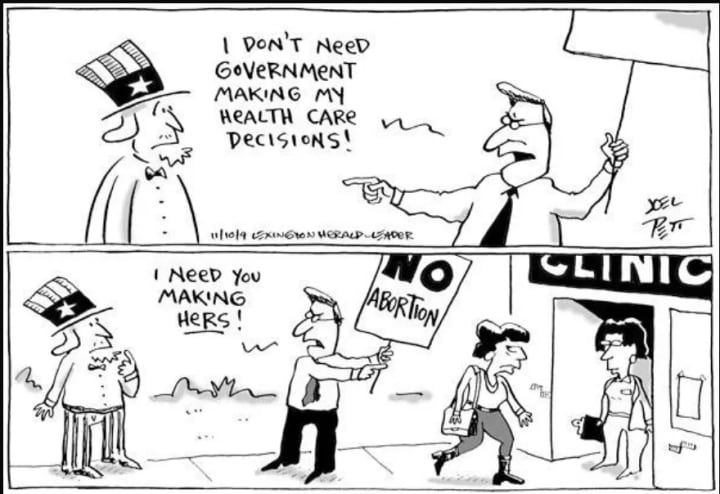
One stellar example of this harmonious discord was the 2014 Supreme Court ruling in favour of Hobby Lobby. This decision allowed private companies to cite religious beliefs and opt out of the contraceptive mandate in the Affordable Care Act. The ruling underscored the tension between corporate religious liberties and women’s access to healthcare, revealing how Christian nationalism can impact fundamental rights.
But why stop at healthcare when you can bring this masterpiece of selective freedom to the marketplace? Enter the Religious Freedom Restoration Acts (RFRAs).
Enacted in various states, these acts allow individuals and businesses to deny services based on personal religious beliefs. Supporters champion these as guardians of religious freedom, while critics, always the party poopers, suggest they might legitimise discrimination, particularly against the LGBTQ+ community. But who needs universal human rights when you can have freedom of choice, right? Especially if that choice excludes others.
Then there was the audacious 2017 debut of President Trump’s travel ban, affectionately dubbed the “Muslim Ban.” Backed by Christian nationalist groups with great enthusiasm, this policy barred travellers from several predominantly Muslim countries, sparking widespread criticism for its discriminatory intent, thus underscoring how Christian nationalism can shape policy to reflect prejudiced worldviews.

And let’s not overlook Christian nationalism’s globe-trotting adventures, particularly in the Israeli-Palestinian conflict. Many U.S. evangelicals offer their unwavering support for Israel, guided by theological convictions about the Holy Land, which can and often does overshadow considerations for Palestinian rights and complicate peace efforts.
This alignment often bears significant implications for U.S. diplomacy, steering it towards religious predilections rather than balanced geopolitical strategies.

But ultimately, it is crucial to distinguish Christian nationalism from mainstream Christian beliefs.
As a hint, Christian nationalism’s principles provide a distinct twist on those antiquated teachings of Jesus Christ. His lessons on compassion for all and welcoming the marginalised? Overrated! Why bother with inclusivity when you can have the divine right to exclude anyone who doesn’t mirror your exact beliefs?
So, what’s the game plan for putting an end to it?
Steps to Combat Christian Nationalism
Education is a powerful ally in the fight against misinformation and in promoting a secular government where the rights of all individuals are protected. By spreading information about the dangers of Christian nationalism through social media, community discussions, and educational campaigns, we can help create a well-informed community ready to stand against exclusionary ideologies.

Secondly, creating alliances among various faith communities is essential for promoting shared understanding and teamwork and combating Christian nationalism.
Interfaith collaborations aren’t just theoretical constructs but practical initiatives that have demonstrated significant impact. For instance, Interfaith America brings people from different religious backgrounds together for community service projects.
Such collaborations strengthen community bonds and build empathy and understanding among participants. Similarly, the U.K.’s Faith & Belief Forum runs projects that connect students, educators, and professionals from various faiths to tackle social issues collectively.
Further, advocating for policies that maintain the separation of church and state is crucial for safeguarding individual rights, regardless of religious beliefs. Legislative advocacy involves vigilant monitoring of proposed legislation that could influence this separation. However, effective advocacy requires a strategic approach.
One can start by staying informed about local and national legislative agendas. Mobilise community support through educational campaigns that explain the importance of these policies. Engaging policymakers by arranging meetings or writing letters can amplify your voice. Remember, collaboration with other civic groups can enhance your impact.
Finally, it is vital to support members within the Christian community who champion a more inclusive and pluralistic approach to Christianity. By providing platforms for these voices, we can counteract exclusionary rhetoric. If you don’t know where to start, organisations such as Christians Against Christian Nationalism exemplify efforts to promote inclusive narratives.
By focusing on these strategies, activists, religious and secular communities, and policymakers can work together to uphold religious freedom, promote the separation of church and state, and foster inclusive narratives in our society.
About the Creator
Chelsea Rose
I never met a problem I couldn't make worst.
Keep reading
More stories from Chelsea Rose and writers in The Swamp and other communities.
Protests Held in Minneapolis After Woman Shot Dead by US Immigration Agent
Protests erupted across Minneapolis after a woman was shot and killed during an encounter with a US immigration enforcement agent, sparking renewed national debate over the use of force, accountability, and immigration policing. Demonstrators gathered near the site of the shooting and outside government buildings, demanding answers, justice, and systemic reform.
By Aarif Lashari4 days ago in The Swamp



Comments
There are no comments for this story
Be the first to respond and start the conversation.