
Nano Fertilizer Market Size and Forecast 2025–2033
Sustainable Nutrition Solutions Reshaping Global Agriculture


Nano Fertilizer Market Outlook: 2025–2033
The global nano fertilizer market is entering a decisive decade of growth as agriculture worldwide adapts to rising food demand, climate stress, and environmental sustainability goals. According to Renub Research, the nano fertilizer market is projected to expand from US$ 3.08 billion in 2024 to US$ 8.77 billion by 2033, registering a strong CAGR of 12.33% during 2025–2033.
This growth trajectory reflects a paradigm shift in crop nutrition—moving away from conventional bulk fertilizers toward precision nutrient delivery systems enabled by nanotechnology. Nano fertilizers are engineered to enhance nutrient absorption, reduce losses from leaching and volatilization, and minimize environmental harm, making them a cornerstone of next-generation sustainable agriculture.
Global Nano Fertilizer Industry Overview
The pressure on global agriculture to increase productivity while reducing ecological impact has never been greater. Traditional fertilizers often suffer from poor nutrient-use efficiency, with a large share lost to soil runoff, groundwater contamination, and greenhouse gas emissions. Nano fertilizers address these inefficiencies by delivering nutrients at the nanoscale, allowing plants to absorb them more effectively and in smaller quantities.
By improving nutrient bioavailability and enabling controlled or stimuli-responsive release, nano fertilizers help maintain soil health and water quality while boosting yields. This innovation aligns with global sustainability frameworks and climate-smart agriculture initiatives. As a result, farmers, agribusinesses, and policymakers increasingly view nano fertilizers as a practical long-term solution rather than a niche technology.
Investment momentum is building. Private agritech companies, public research institutions, and governments are channeling funds into product development, pilot projects, and commercialization efforts. National agricultural programs in several countries now explicitly include nano fertilizers, signaling growing institutional confidence.
The rise of precision farming further strengthens market prospects. When combined with GPS-guided machinery, soil sensors, and data analytics, nano fertilizers enable micro-dosing and crop-specific nutrition—maximizing output while minimizing input costs. Despite regional disparities in regulation, awareness, and affordability, the overall global outlook remains strongly positive.
Food Security Imperatives Driving Adoption
The urgency behind nano fertilizer adoption is underscored by global demographic trends. The Food and Agriculture Organization of the United Nations (FAO) estimates that the world’s population will reach 9.7 billion by 2050, requiring nearly 70% growth in agricultural output to meet food demand.
Nano fertilizers offer a viable pathway to achieve this growth sustainably. Their superior efficiency compared to conventional fertilizers enables higher productivity without proportionally increasing chemical inputs. At the same time, reduced nutrient losses help curb soil degradation and water pollution—two critical challenges linked to decades of intensive fertilizer use.
In essence, nano fertilizers represent a transformative leap: delivering more nutrition with less environmental cost.
Key Factors Driving Nano Fertilizer Market Growth
Sustainable and Efficient Nutrient Delivery
Nano fertilizers are designed to improve nutrient uptake efficiency through enhanced bioavailability and controlled release. This precision significantly reduces overapplication, nutrient runoff, and environmental contamination. Farmers benefit from higher yields using smaller quantities, improving cost efficiency and sustainability simultaneously.
As consumer demand for cleaner, responsibly produced food grows, nano fertilizers align closely with evolving regulatory and market expectations. Both large-scale commercial farms and smallholder farmers are increasingly attracted to these benefits.
Integration with Precision Agriculture
Precision agriculture relies on data-driven decision-making and targeted interventions. Nano fertilizers complement this approach by enabling crop-specific nutrient delivery and micro-dosing. Their compatibility with drones, automated sprayers, and sensor-based soil monitoring systems makes them ideal for modern, tech-enabled farms.
As access to digital farming tools expands—especially in emerging economies—nano fertilizers play a critical role in reducing waste, optimizing inputs, and improving profitability.
Rising Focus on Agricultural Innovation and Food Security
With arable land shrinking and climate volatility increasing, productivity gains must come from innovation. Nano fertilizers support healthier plant growth with fewer resources, making them strategically important for food security.
Governments across Asia, Africa, and the Middle East are exploring nano fertilizers as part of broader agricultural transformation agendas. Their potential to reduce import dependence and strengthen domestic food systems makes them attractive to policymakers and investors alike.
Challenges in the Nano Fertilizer Market
Limited Farmer Awareness and Adoption
Despite clear advantages, awareness of nano fertilizers remains uneven—particularly in rural and underdeveloped regions. Many farmers lack familiarity with application techniques, long-term benefits, and comparative performance versus traditional fertilizers.
Skepticism toward nanotechnology and insufficient extension services further slow adoption. Addressing this challenge requires coordinated efforts, including demonstration trials, training programs, and trust-building initiatives led by governments, agribusinesses, and agricultural extension agencies.
Regulatory and Safety Concerns
Nano fertilizers often fall into regulatory grey areas. Nanomaterials can behave differently from conventional inputs, necessitating rigorous safety assessments related to human health, soil microbiology, and water systems.
Inconsistent or unclear regulations create uncertainty for manufacturers and investors, slowing commercialization. Harmonized international standards, transparent research, and collaboration between regulators and scientists are essential to ensure responsible market growth.
Nano Fertilizer Market Overview by Region
United States Nano Fertilizer Market
The United States market is shaped by advanced agricultural technologies, strong sustainability mandates, and a robust research ecosystem. Farmers are increasingly evaluating nano fertilizers within precision farming systems to improve nutrient efficiency and comply with tightening environmental regulations.
Universities, startups, and agritech firms are actively developing new formulations tailored to diverse crop needs. While regulatory clarity is still evolving, continued investments and pilot programs position the U.S. as a major innovation hub.
Germany Nano Fertilizer Market
Germany’s nano fertilizer market is expanding steadily, driven by strict environmental standards and strong R&D capabilities. Nano-based solutions are being explored to reduce nutrient losses and support organic and high-efficiency farming systems.
However, rigorous safety regulations require extensive testing, slowing commercialization. Adoption remains cautious but is expected to rise as demand for sustainable, high-performance inputs grows.
India Nano Fertilizer Market
India represents one of the fastest-growing markets globally. Government promotion of nano urea and related products—supported by subsidies and awareness campaigns—has accelerated adoption among farmers.
Public-private partnerships, domestic manufacturing, and extensive field trials have built confidence in product performance. Companies such as Indian Farmers Fertiliser Cooperative Ltd. (IFFCO) are central to this expansion. While awareness gaps persist in remote regions, nano fertilizers are set to play a key role in India’s sustainable agriculture and food security strategy.
United Arab Emirates Nano Fertilizer Market
With limited arable land and water scarcity, the UAE is embracing advanced agricultural technologies. Nano fertilizers align well with precision farming, hydroponics, and controlled-environment agriculture initiatives supported by the government.
Although the market is still nascent, partnerships between international suppliers and research institutions are laying the groundwork for broader adoption. Regulatory clarity and education will be crucial for scaling.
Recent Developments in the Nano Fertilizer Industry
May 2025: Indian Farmers Fertiliser Cooperative Ltd. inaugurated a new nano urea plant in Kandla, Gujarat, increasing annual capacity to 2.5 billion bottles.
December 2024: Coromandel International Ltd. partnered with the Indian Agricultural Research Institute to commercialize rice-husk-based nanocarriers.
November 2024: Geolife Agritech India Pvt. Ltd. introduced NanoGel, a hydrogel nano fertilizer shown to reduce irrigation needs by 25% in vegetable trials.
Market Segmentation Snapshot
By Raw Material:
Nitrogen, Silver, Carbon, Zinc, Other Raw Materials
By Application Method:
Foliar Spray, Soil Treatment, Seed/Root Dipping, Fertigation
By Crop Type:
Cereals & Grains, Oilseeds & Pulses, Fruits & Vegetables, Plantation & Cash Crops
By Formulation Form:
Liquid, Powder & Granule, Gel & Hydrogel
By Release Mechanism:
Conventional Nano-Suspension, Controlled-Release Nanoshell, Stimuli-Responsive Smart Nano-Carrier
Key Companies Covered
Indian Farmers Fertiliser Cooperative Ltd.
Lazuriton Nano Biotechnology Co., Ltd.
EuroChem Group
AG CHEMI GROUP s.r.o.
Aqua-Yield Operations LLC
Geolife Agritech India Pvt. Ltd.
Indogulf BioAg LLC
Coromandel International Ltd.
Ray Nano Fertilizer
Shan Maw Myae Co., Ltd.
Final Thoughts
The nano fertilizer market stands at the intersection of food security, environmental stewardship, and technological innovation. With a projected valuation of US$ 8.77 billion by 2033, the sector is poised to become a critical pillar of global agriculture.
While challenges related to awareness, regulation, and safety remain, continued investment, supportive policies, and farmer education are steadily unlocking the market’s potential. As agriculture transitions toward smarter and more sustainable systems, nano fertilizers are no longer experimental—they are emerging as essential tools for feeding the future responsibly.
About the Creator
Renub Research
Renub Research is a Market Research and Consulting Company. We have more than 15 years of experience especially in international Business-to-Business Researches, Surveys and Consulting. Call Us : +1-478-202-3244
Keep reading
More stories from Renub Research and writers in The Swamp and other communities.
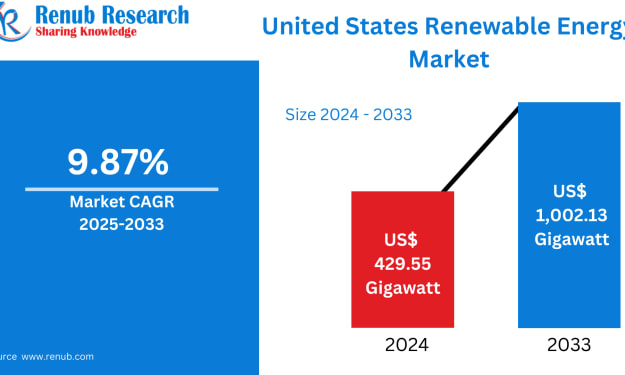
United States Renewable Energy Market Size and Forecast 2025–2033
United States Renewable Energy Market Outlook The United States Renewable Energy Market is entering a decisive decade of expansion, driven by climate commitments, rapid technological innovation, and strong policy backing. According to Renub Research, the market is expected to reach 1,002.13 Gigawatt by 2033, rising from 429.55 Gigawatt in 2024, at a CAGR of 3.64% from 2025 to 2033.
By Renub Research12 days ago in The Swamp
In Pictures: Protests Held in US Cities After Woman Shot Dead by Immigration Agent
Across the United States, protests have erupted in multiple cities following the fatal shooting of a woman by a US immigration enforcement agent. From Minneapolis to Los Angeles, demonstrators have gathered in streets, parks, and public squares, holding candles, placards, and photographs as they demand justice, transparency, and accountability.
By Aarif Lashari3 days ago in The Swamp



Comments
There are no comments for this story
Be the first to respond and start the conversation.