
“Munir’s Threats Won’t Succeed: Counter-Drone, Air Defence in Place,” Air Marshal Dixit Warns Pakistan
India asserts full preparedness as tensions rise, with senior IAF official saying New Delhi will not be intimidated by Pakistan’s rhetoric.

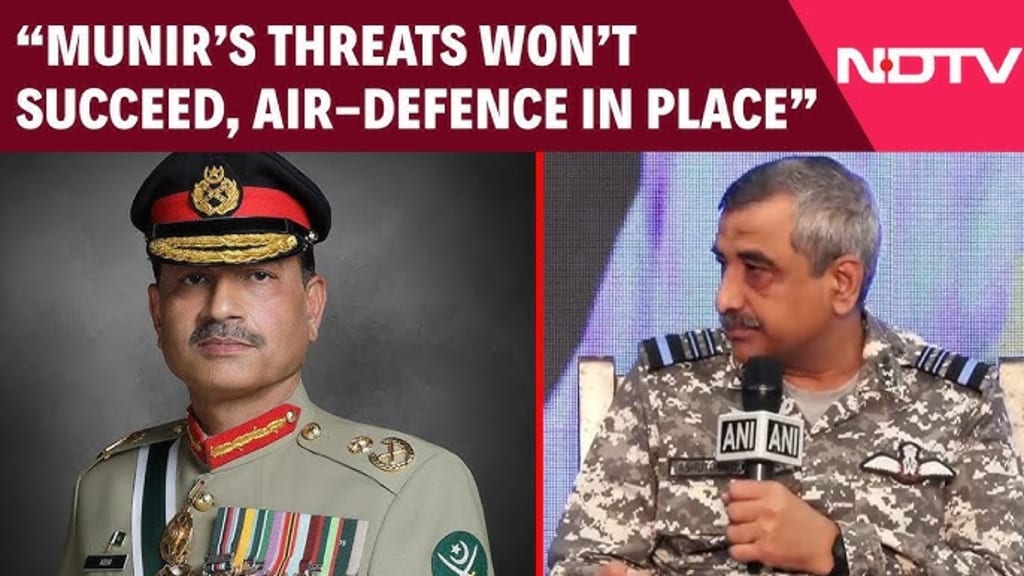
Rising tensions between India and Pakistan have once again captured headlines, this time after Air Marshal Dixit delivered a strong warning in response to statements made by Pakistan Army Chief General Asim Munir. With both nations already navigating a fragile relationship, Dixit’s remarks underscore India’s commitment to safeguarding its borders, strengthening its defence systems, and refusing to bow to external pressure. His message is clear: India is prepared, alert, and far more capable than many recognise.
General Munir’s recent warnings, which were widely interpreted as an attempt to project military dominance, drew immediate attention in the region. But Air Marshal Dixit’s response shows India is not only unfazed—it is fortified. Speaking at a strategic affairs forum, he stated that “threats won’t succeed” and emphasised that India has invested heavily in strengthening vital defence systems, particularly its counter-drone technology and layered air-defence grid, which have been upgraded significantly over the last few years.
Counter-Drone Capabilities: India’s New Battlefield Advantage
Drones have emerged as one of the most critical tools in modern warfare. From surveillance to targeted attacks, they can shift military dynamics with speed and stealth. Pakistan-based terrorist groups have previously used drones to drop weapons across the border into India, raising serious security concerns.
But Dixit’s message reveals how India has quietly advanced its defence readiness. The Indian Air Force and DRDO have jointly developed an extensive anti-drone architecture, capable of detecting, tracking, and neutralising hostile drones within seconds. These systems can jam communication links, intercept aerial routes, and even physically destroy incoming threats.
Dixit highlighted that India’s counter-drone network is active not just on border outposts, but also around critical military bases, airports, and strategic installations, ensuring broader national security. This development sends a clear signal: India will not allow its airspace to be violated.
A Robust Air-Defence Shield
In addition to drone defence, Dixit detailed India’s multi-layered air-defence setup, which includes advanced systems such as the S-400, Akash missile batteries, and Indo-Israeli joint-developed systems. These capabilities provide India with formidable protection against aircraft, missiles, and UAVs.
He noted that the IAF has undergone major modernisation in the last decade. New radar networks cover remote terrains, high-altitude zones, and previously hard-to-monitor sectors. This makes surprise attacks or stealth intrusions far less likely to succeed.
“Our air-defence response time is faster than ever. Any misadventure will be met with decisive action,” Dixit affirmed.
De-Escalation or Pressure? India Chooses Strength
While Pakistan’s leadership continues to make assertive statements, India has largely adopted a stance of stability and strategic restraint. However, Dixit’s comments show that restraint must not be mistaken for weakness.
Experts believe Pakistan’s increasing rhetoric may be influenced by internal political and economic pressures, as well as attempts to appeal to domestic audiences. But India’s defence establishment is focused on preparedness rather than posturing.
Strategic observers noted that Dixit’s direct response acts both as a deterrent and a reassurance. It tells Pakistan that India will not tolerate provocations, and it assures Indian citizens that their nation is protected.
The Reality Behind the Rhetoric
General Munir’s warnings were not the first of their kind. Over the years, Pakistan’s military leadership has often issued strong statements, especially during periods of regional tension. But India’s defence capabilities have grown dramatically—technologically, strategically, and structurally.
From indigenous fighter aircraft like the Tejas, to sophisticated surveillance systems and powerful missile networks, India is no longer the country it was decades ago. Dixit’s remarks remind the region that India now stands among the world’s most capable defence forces.
A Message of Confidence and Control
Air Marshal Dixit’s tone throughout his address was measured but firm. He made it clear that India prefers peace but will not hesitate to defend its sovereignty. He also emphasised that sustained investments in new technologies reflect India’s goal of staying ahead of evolving threats.
“We are alert, we are prepared, and we are confident,” he concluded.
Conclusion
The exchange of warnings comes at a time when South Asia already faces complex challenges—from border issues to shifting geopolitical relations. Yet Dixit’s statement highlights India’s balanced approach: calm, prepared, but unyielding. As drone warfare and air-defence systems redefine modern conflict, India’s advancements offer both security and strategic deterrence.
For now, one message is clear: India will not be intimidated, and any threats from across the border will be met with technology, resilience, and decisive response.
About the Creator
Fiaz Ahmed Brohi
I am a passionate writer with a love for exploring and creating content on trending topics. Always curious, always sharing stories that engage and inspire.
Keep reading
More stories from Fiaz Ahmed Brohi and writers in The Swamp and other communities.
Britain Says Talks to Join EU Defence Fund Have Broken Down
A major setback in post-Brexit security cooperation For months, the United Kingdom and the European Union have tried to build a new foundation for defence cooperation. Both sides hoped that, even after Brexit, they could still work together on issues that affect the entire continent—security, technology, and military readiness. But this hope took a serious hit when Britain officially announced that talks to join the EU Defence Fund had broken down.
By Fiaz Ahmed Brohi2 months ago in The Swamp
Miss Persephone's Manual to a Seemingly Ordinary Life
Miss Persephone was found at the dining table, her blue eyes swollen, her tears arriving and retreating like the tides of the ocean. Earlier that day, her family had visited her in the retirement home where she had lived for eight years. It was her eightieth birthday.
By Imola Tóth4 days ago in Fiction



Comments
There are no comments for this story
Be the first to respond and start the conversation.