
🇸🇦🇮🇱🇮🇷 Middle East Power Shift: A New Era of Alliances and Ambitions
Middle East power shift, Saudi Arabia Iran relations, BRICS expansion, China diplomacy, U.S. influence decline, Israel Arab normalization, de-dollarization, global realignment, regional diplomacy, geopolitical transformation

🕊️ The Changing Landscape of the Middle East
For decades, the Middle East has been defined by instability, wars, and foreign interference. However, the recent years have marked a significant power shift — one that is reshaping not just the region, but the global balance of influence itself.
Nations once divided by deep ideological and sectarian lines — such as Saudi Arabia, Iran, and even Israel — are now showing signals of strategic realignments that few could have imagined a decade ago.
💡 From Division to Diplomacy
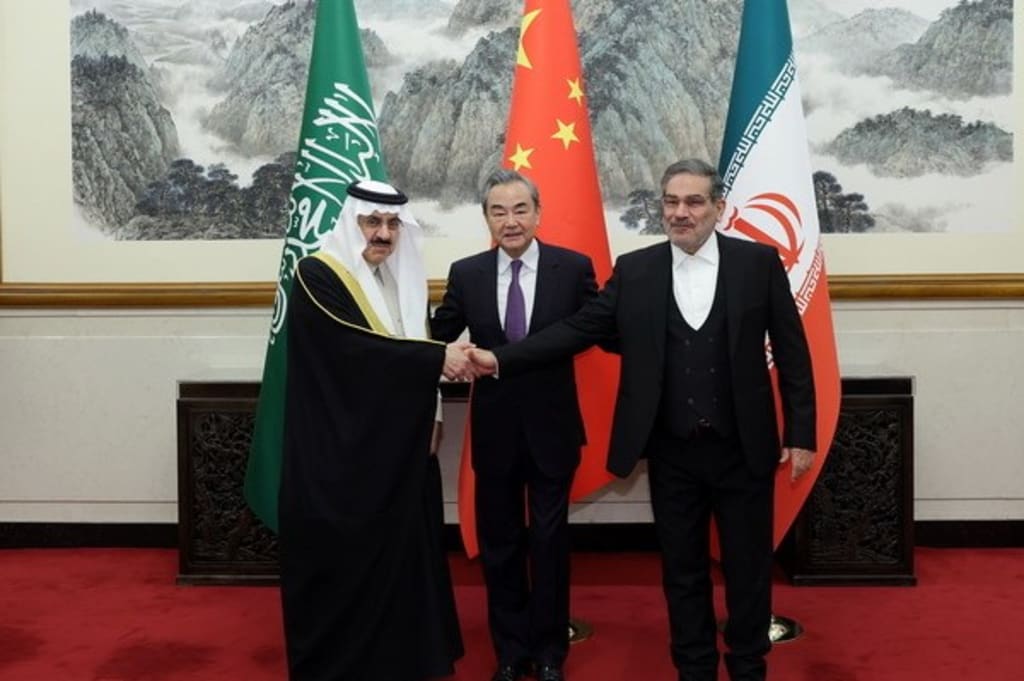
The turning point came when Saudi Arabia and Iran restored diplomatic ties under China’s mediation. This unexpected move challenged the long-standing notion that peace in the region could only come through Western intervention.
Now, the same countries that once stood on opposite ends of geopolitical conflicts are cautiously exploring mutual economic and security interests.
At the same time, Israel’s normalization talks with Arab nations, though fragile, indicate a growing realization: economic cooperation may succeed where political conflicts failed.
⚙️ The Role of Superpowers
The global players — particularly the United States, Russia, and China — are all recalibrating their strategies in response.
China is positioning itself as the new peace broker, using economic diplomacy to gain trust.
Russia, entangled in Ukraine, sees the Middle East as a key space to sustain its global presence.
The U.S., once the dominant force in the region, now faces a challenge to maintain relevance amidst declining influence.
This tug-of-war among superpowers is not only about politics — it’s about control over energy, trade routes, and military influence.
🌍 Economic Shifts and the BRICS Effect
Another defining factor of this power transition is the growing influence of BRICS nations (Brazil, Russia, India, China, South Africa — and now Saudi Arabia, Iran, and Egypt).
The de-dollarization trend and the idea of energy trade in local currencies represent a direct challenge to Western financial dominance.
If sustained, this could transform the Middle East into a multi-polar hub — no longer dependent on the U.S. or Europe for economic security.
🔥 The Silent Competition: Ideology vs. Pragmatism
What makes this shift unique is the balance between ideology and pragmatism.
While leaders still claim to defend religious or national values, their policies are increasingly economically driven.
Instead of endless wars, nations are competing in technology, trade, and infrastructure — a silent but powerful form of modern rivalry.
🧠 Personal Opinion: A Hopeful Yet Fragile Transformation
From my perspective, this transformation is both promising and risky.
Promising — because it suggests that the Middle East is finally learning to solve its problems internally, without always depending on outside powers.
Risky — because old rivalries and foreign interests still lurk beneath the surface.
Peace may be on the horizon, but trust is still fragile.
If these nations can prioritize mutual benefit over ego, this could mark the beginning of a stable and self-reliant Middle East.
❓Final Reflection:
Will this new wave of cooperation bring lasting peace — or is the Middle East merely entering another phase of controlled rivalry under new global masters?
Only time will tell whether this power shift leads to unity… or another cycle of ambition and conflict.
About the Creator
Filmon Ke Raaz | Movie Mysteries Explained
Filmon Ke Raaz is a storytelling platform where movies are explained in a simple and engaging way. We uncover hidden meanings, untold facts, and deep mysteries behind thriller, horror, and mystery films.
Keep reading
More stories from Filmon Ke Raaz | Movie Mysteries Explained and writers in The Swamp and other communities.
🇷🇺 Russia–Ukraine War Developments: What It Means for NATO and Global Security
🕊️ Introduction The Russia–Ukraine conflict, now entering its prolonged phase, has reshaped the entire geopolitical landscape of the 21st century. What began in 2022 as a localized invasion has evolved into a global confrontation — testing the strength, unity, and strategy of NATO and raising deep questions about the future of international security.
By Filmon Ke Raaz | Movie Mysteries Explained2 months ago in The Swamp
Daniel Ives: Trump’s Electricity Policy Could Be a ‘Bottleneck’ for Data Centers
If you’ve been following the AI boom lately, you know that it’s not just about clever algorithms or smart apps—it’s also about massive amounts of electricity. And according to Wall Street analyst Daniel Ives, the electricity policies being pushed by the Trump administration could become a serious bottleneck for U.S. data centers, the massive facilities that power everything from cloud storage to AI models like ChatGPT. Ives warns that while the administration wants to protect consumers from higher electricity bills—which is understandable—the way these policies are being implemented may slow down the very infrastructure needed for America to stay competitive in AI and tech innovation. Data Centers: More Than Just Big Computers Think of a data center as a giant brain for the internet. These facilities run thousands of servers 24/7, processing the data behind social media, streaming video, cloud apps, and artificial intelligence. Unlike your laptop or phone, data centers never power down, which means they use an incredible amount of electricity. In 2023, U.S. data centers used about 4.4% of all electricity in the country—roughly the same as major cities like New York or Chicago. And with AI becoming a bigger part of business and daily life, demand for power is expected to double or triple by 2030. So when policies affect electricity pricing or availability, it hits data centers directly—and fast. Trump’s Electricity Policy Explained President Trump’s administration has been clear: Americans shouldn’t pay higher utility bills because of data centers. The plan encourages Big Tech to cover their own energy costs instead of relying on electricity rates that might indirectly affect households and small businesses. In response, companies like Microsoft have pledged to pay more for electricity and make their operations more efficient. While this helps protect consumers, Daniel Ives says it could also slow down the growth of new data centers if companies decide the costs are too high or too uncertain. Why Daniel Ives Calls It a Bottleneck Ives calls this situation a “bottleneck” for several reasons: Rising Costs for Tech Firms: If companies have to pay more for electricity, building new data centers becomes more expensive. That can slow expansion. Infrastructure Limits: Many regions of the U.S. grid weren’t designed for the current surge in AI-powered data centers. Limited power availability can delay or block projects. Global Competition: Ives warns that if U.S. policies make data center growth harder, other countries—like China—might pull ahead in AI infrastructure. In short, protecting consumers is important, but it needs to be balanced with ensuring America can scale its AI and cloud capabilities quickly. The Reality of Power Demands This isn’t just about politics—it’s about practical energy challenges. The U.S. grid is already under pressure from data centers, electric vehicles, and growing industrial demand. In some hotspots, developers wait years just to get a power hookup. Without careful planning, the electricity needed for AI innovation could hit a hard limit, delaying projects or pushing companies to relocate where energy is cheaper or more abundant. Balancing Innovation and Consumer Protection The Trump administration’s approach tries to strike a balance: protect household electricity bills while allowing tech growth. But Daniel Ives argues that if the balance isn’t right, it could unintentionally discourage investment and slow AI infrastructure development. Companies are trying to adapt. Microsoft, for instance, has promised to cover energy costs and invest in efficiency. Utilities and lawmakers are also revisiting subsidies and incentives for energy-intensive projects, trying to find a way that keeps everyone happy. Why This Matters for AI The bottleneck isn’t just about data centers or corporate profits—it’s about the speed of AI development in the U.S. AI doesn’t just need processing power; it needs continuous, reliable electricity. If supply is limited or policies make energy too expensive, AI projects could slow down, affecting everything from business innovation to national competitiveness. Ives’ warning is clear: electricity policy isn’t a small detail. It’s a strategic factor that could shape the future of AI in America. Conclusion: Watching the Power Flow Daniel Ives’ perspective highlights a key lesson: tech innovation depends on energy policy just as much as it does on talent or investment. The U.S. needs policies that protect consumers but also allow data centers—and the AI revolution—to grow. Otherwise, we could see delays in AI infrastructure just as the world is racing to adopt new technologies. For policymakers, companies, and consumers, the takeaway is clear: energy policy isn’t just about rates; it’s about the future of American technology. The next few years will show whether Washington can balance consumer protection with the energy needs of AI—or if Daniel Ives’ bottleneck warning becomes reality.
By Muhammad Hassan3 days ago in The Swamp



Comments
There are no comments for this story
Be the first to respond and start the conversation.