
May 28th: How Pakistan’s Nuclear Test Redefined Regional Power Balance
"A Game-Changer in South Asia’s Strategic Dynamics"

Introduction
May 28th stands as a defining date in the history of South Asia, marking Pakistan’s emergence as a nuclear-armed state and fundamentally reshaping the regional power balance. On this day in 1998, Pakistan conducted its first public nuclear weapons test, sending shockwaves through the geopolitical landscape of South Asia and the wider international community. This act was not merely a demonstration of military capability but a bold assertion of strategic autonomy, directly challenging the long-standing nuclear dominance of India. The May 28th nuclear test underscored Pakistan’s resolve to safeguard its national security in a highly volatile regional environment and introduced a new dimension to the Pakistan India nuclear rivalry.
This article explores the Pakistan nuclear test within its historical context, examines the immediate reactions, and delves into the enduring geopolitical consequences that continue to influence the regional power balance in South Asia. Through this analysis, readers will gain insight into how nuclear weapons have become central to nuclear deterrence in South Asia, impacting diplomacy, military strategy, and regional stability.
Historical Background
Pakistan’s journey toward becoming a nuclear power was shaped by decades of geopolitical tensions, especially with its neighbor India. The Pakistan nuclear program history dates back to the 1950s, initiated with civilian nuclear research. However, the 1971 Indo-Pak war and the subsequent independence of Bangladesh (formerly East Pakistan) served as pivotal events that accelerated Pakistan’s pursuit of nuclear weapons. The defeat underscored Pakistan’s strategic vulnerabilities and motivated its leadership to seek a credible deterrent.
The program gained significant momentum under Prime Minister Zulfikar Ali Bhutto in the 1970s, who famously vowed that Pakistanis would “eat grass” if necessary to develop a nuclear bomb. This determination was largely driven by India’s nuclear ambitions. India’s first nuclear test in 1974, codenamed “Smiling Buddha,” was a watershed moment that altered the South Asia nuclear balance. India’s demonstrated nuclear capability posed a direct threat to Pakistan, fueling an arms race in the region.
Throughout the 1980s and early 1990s, Pakistan pursued clandestine efforts to develop nuclear weapons, supported by scientists such as Abdul Qadeer Khan, who played a crucial role in acquiring nuclear technology. The regional security environment was fraught with tension, punctuated by intermittent conflicts and increasing militarization. The 1990s saw an escalation in hostilities, particularly over Kashmir, and India’s decision to carry out nuclear tests in May 1998—known as Pokhran-II—signaled a new strategic challenge.
In response to India’s nuclear tests, Pakistan faced mounting pressure to assert its own nuclear capabilities openly. The stage was set for a dramatic shift in South Asia’s strategic landscape, culminating in Pakistan’s historic nuclear weapons test Pakistan on May 28th, 1998.
The Nuclear Test: May 28th Event
On May 28th, 1998, Pakistan officially announced the successful detonation of six nuclear devices in the Chagai Hills of Balochistan province. These tests followed two initial detonations on May 28th and four more on May 30th, collectively demonstrating Pakistan’s capability to produce both fission and fusion bombs. The tests were conducted under the direction of then-Prime Minister Nawaz Sharif, who sought to showcase Pakistan’s technological and strategic parity with India.
The nuclear tests were meticulously planned and kept secret until the moment of their public announcement, signaling a pivotal moment in the geopolitical impact of Pakistan nuclear test. The successful detonation sent a clear message to the world that Pakistan had joined the exclusive club of nuclear-armed states and would not allow itself to be strategically sidelined.
Pakistan’s official statement emphasized the defensive nature of the tests, asserting that the country’s nuclear program was aimed solely at deterring aggression and maintaining regional peace. Nawaz Sharif famously declared, “We have achieved the ultimate goal of our national security.” The tests not only boosted national pride but also redefined Pakistan’s position on the global stage.
Internationally, the reaction was swift and predominantly critical. Western nations, including the United States and members of the United Nations Security Council, condemned the tests and imposed economic sanctions on Pakistan. However, Pakistan’s government remained resolute, framing the tests as a necessary step in ensuring its sovereignty and survival amid persistent security threats.
Immediate Regional Reactions
India’s response to Pakistan’s nuclear test was one of stern condemnation mixed with strategic recalibration. New Delhi viewed Pakistan’s tests as a dangerous escalation in the already volatile Pakistan India nuclear rivalry, potentially triggering a regional arms race. However, India also understood that Pakistan’s nuclear capability introduced a new deterrence factor, forcing a more cautious approach in their bilateral relations.
The international community, particularly Western powers and global non-proliferation advocates, expressed grave concern. Economic sanctions were swiftly enacted against Pakistan, targeting trade, aid, and military assistance. The tests disrupted diplomatic relations and intensified calls for nuclear disarmament and non-proliferation, although these efforts achieved limited success in the region.
Despite the external pressures, the tests had a unifying effect within Pakistan. Public sentiment rallied around the government’s decision, seeing it as a necessary demonstration of strength and self-reliance. However, the tests also intensified fears of a destabilizing arms race in South Asia, raising questions about the risk of nuclear conflict.
The immediate aftermath highlighted the fragile security environment, with heightened military alertness and increased international diplomatic efforts to reduce tensions. The tests underscored the importance of nuclear deterrence in South Asia but also highlighted the precariousness of peace in a region marked by historical animosities and territorial disputes.
Long-Term Geopolitical Impact
The May 28th nuclear test fundamentally altered the strategic calculus of South Asia, cementing Pakistan’s status as a nuclear power and reshaping the regional power balance in South Asia. The tests created a formal nuclear deterrent that Pakistan’s military and political leadership believed would prevent large-scale conventional wars with India, based on the principle of mutually assured destruction.

The nuclear capability intensified the Pakistan India nuclear rivalry, with both countries investing heavily in maintaining credible deterrence. This rivalry influenced multiple conflicts and crises in subsequent years, most notably the Kargil conflict of 1999, which tested the limits of conventional warfare under nuclear shadow. The presence of nuclear weapons complicated diplomatic negotiations but also introduced a grim stability predicated on the fear of escalation.
Pakistan’s nuclear tests also affected its international relations and strategic alliances. While sanctions initially isolated Pakistan economically, its nuclear status compelled major powers, especially China and the United States, to engage more pragmatically. Over time, Pakistan’s nuclear program became a significant factor in foreign aid, military cooperation, and diplomatic engagement.
Moreover, the tests forced South Asia’s neighboring countries to reassess their security policies, contributing to a broader regional focus on nuclear deterrence and strategic balance. The nuclearization of Pakistan underscored the complex security environment where conventional conflicts and nuclear threats coexist.
The long-term geopolitical impact of Pakistan nuclear test continues to resonate. While nuclear weapons have arguably prevented full-scale wars between India and Pakistan, they have not resolved the underlying political disputes, particularly over Kashmir. The nuclear tests remain a powerful symbol of sovereignty and security for Pakistan, while continuing to influence South Asia’s delicate equilibrium.
Conclusion
The May 28th nuclear test by Pakistan marked a historic turning point in the security dynamics of South Asia, fundamentally redefining the regional power balance. Emerging as a nuclear state, Pakistan asserted its strategic independence and introduced a potent deterrent into the volatile Pakistan-India relationship. The tests deepened the nuclear rivalry, shaped military strategies, and drew the world’s attention to the complex challenges of nuclear proliferation in the region.
While the immediate aftermath involved sanctions and diplomatic isolation, the long-term impact has been an uneasy but persistent nuclear deterrence that has arguably maintained a fragile peace. The legacy of May 28th underscores how nuclear weapons continue to influence South Asia’s geopolitics, serving as both a shield against large-scale conflict and a constant reminder of the region’s unresolved tensions.
As South Asia moves forward, the lessons of Pakistan’s nuclear test remain vital for policymakers, diplomats, and analysts committed to ensuring stability and preventing escalation in one of the world’s most challenging security environments.
About the Creator
Shamshair Khan Hasan Zai
I share content on health, business, travel, motivation, and simple ways to earn money—focused on hope growth, and practical advice to help you live a better, more successful life.
Keep reading
More stories from Shamshair Khan Hasan Zai and writers in The Swamp and other communities.
Youm-e-Takbeer: Pakistan’s Peaceful Rise as a Responsible Nuclear Power
Youm-e-Takbeer: Pakistan’s Peaceful Nuclear Milestone :Explore the history and significance of Youm-e-Takbeer, Pakistan’s peaceful rise as a responsible nuclear power and symbol of strategic stability.
By Shamshair Khan Hasan Zai10 months ago in The Swamp
Parallel Protests
I haven't written for quite some time, but I have A LOT of thoughts about yesterday's protest rally against our government's involvement and complicity in America's war on Iran, on the harbourside of my home city Bristol, and I need to put them somewhere. My gorgeous girlfriend is always a loving and listening ear and sharing it all with her will always be a healthy and happy way of processing the mental and emotional weight, but getting it straight in my brain to share means writing it all down in straight lines, so, here we are and thanks for being here.
By Steph Cole10 days ago in The Swamp
For Israel’s Netanyahu, Trump grants wishes, but his support carries risks
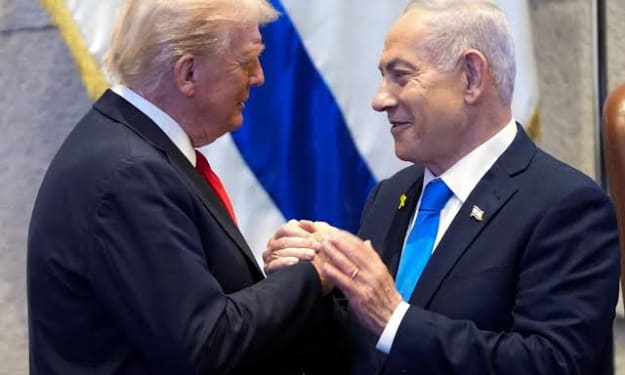
In the long and complex alliance between Benjamin Netanyahu and Donald Trump, the U.S. leader has delivered some of the most significant policy victories the Israeli premier has pursued for years. Yet while these achievements have reshaped the Middle East and bolstered Netanyahu’s standing with many supporters, they also carry risks that could have lasting political and diplomatic consequences. Over the past five years, Trump has granted a string of Netanyahu’s long‑standing strategic wishes, starting with symbolic but consequential decisions early in his presidency. Trump moved the U.S. Embassy to Jerusalem, a step long demanded by Israeli leaders and supporters; formally recognised Israeli sovereignty over the Golan Heights, territory captured from Syria in 1967; withdrew the United States from the international nuclear agreement with Iran; and significantly cut U.N. funding for Palestinian refugees. But none of these moves compares in scale to Trump’s recent embrace of the joint military campaign against Iran—a campaign that Netanyahu long sought and which represents the most consequential gamble of their partnership yet. What began as deepening tensions with Tehran has escalated into a full‑scale conflict involving U.S. forces alongside Israeli operations. For Netanyahu, this intervention is more than just a strategic victory—it is a political lifeline. A Strategic Bet in an Election Year Netanyahu, trailing in polls and facing persistent legal challenges at home, is betting that the war—with Trump’s backing—can rekindle a surge of nationalist support that might secure his political survival. Experts say the prime minister is likely to capitalise on the ongoing conflict to call early elections, hoping that a wave of patriotic sentiment will carry him back into a stronger parliamentary position. Israel must hold elections by late October this year, and many analysts believe Netanyahu sees an immediate wartime context as his best opportunity to salvage his political career. Political scientist Gayil Talshir of Hebrew University summed up the situation by pointing to the existential nature of the conflict. “Everything else can be forgotten because this is the big one,” she said, referring to the military campaign against Iran as the defining issue of Netanyahu’s era. But linking domestic political fortunes to an ongoing war carries real dangers—particularly when it involves another major power like the United States, whose own domestic politics may not align with Netanyahu’s expectations. Risks for Trump’s Base and U.S. Politics For Trump, the alliance has helped cement his image among many conservative voters, especially those inclined toward strong American support for Israel. In Israel itself, Trump enjoys extraordinary popularity; some polls show his approval within the country exceeding that among key voter blocs in the United States. Yet Trump’s support for an increasingly controversial and protracted conflict has also strained his political base in the U.S. Many Republicans who favour a more isolationist posture question a deepening military involvement, while Democrats and independents have grown critical of the human cost and strategic ambiguity of the war. Rising fuel prices and extended American casualties only amplify these political pressures. The war’s unpredictability complicates Trump’s broader political ambitions. An over‑reliance on Netanyahu’s strategic priorities could alienate portions of the Republican base and temper voter enthusiasm in key demographics—particularly among younger voters and communities more sympathetic to a diplomatic resolution or concerned about humanitarian impact. Strains and Strategic Tension Despite the strong partnership between the two leaders, their relationship has not been without tension. Trump has occasionally pushed back against some of Netanyahu’s policies, such as annexation efforts in the West Bank, and has encouraged moves toward a future pathway to Palestinian self‑determination—proposals that Netanyahu historically resisted. These moments illustrate the fragile balance between unconditional support and strategic disagreement. EWN Moreover, Trump’s public calls for Isaac Herzog to pardon Netanyahu from longstanding corruption charges underscore the political entanglement of foreign policy with domestic Israel politics. Trump’s pressure for Herzog to grant clemency—even as the nation remains at war—highlights how external advocacy can complicate Israel’s internal legal and political processes. Long‑Term Consequences for the Alliance Internationally, the deepening U.S.–Israel partnership could affect broader diplomatic alignments. Allies in Europe and across the Middle East may be wary of being drawn into a conflict that seems increasingly personalised around the political fortunes of two leaders. Analysts suggest that if the war doesn’t achieve a clear strategic outcome, the blame may return to both Netanyahu and Trump, with potential fallout in regional diplomacy and future peace negotiations. Ultimately, the political calculus that has driven Netanyahu and Trump together in pursuit of mutual goals may prove double‑edged. The military campaign against Iran may be the strategic high point of their partnership—but it also carries deep risks that extend well beyond battlefield victories. For Netanyahu, it could be the defining gamble of his political life; for Trump, it may shape his legacy in ways that reverberate long after the conflict has subsided.
By Fiaz Ahmed 5 days ago in The Swamp



Comments (2)
*"If you liked my story, kindly tap the heart (❤) button. Your support keeps me inspired to write more!"*
The 1998 Pakistan nuclear test was a game-changer. It was a bold move in a tense region. I can only imagine the shockwaves it sent. It makes me wonder how different things would be if this hadn't happened. How has it really affected the day-to-day relations between Pakistan and India? And what's the long-term outlook for nuclear deterrence in the region?