
Kim Jong Un: North Korea Pushes Missile Production as ‘War Deterrent’
Kim Jong Un Accelerates Missile Production, Claiming Defense and Deterrence as Tensions Rise in Asia

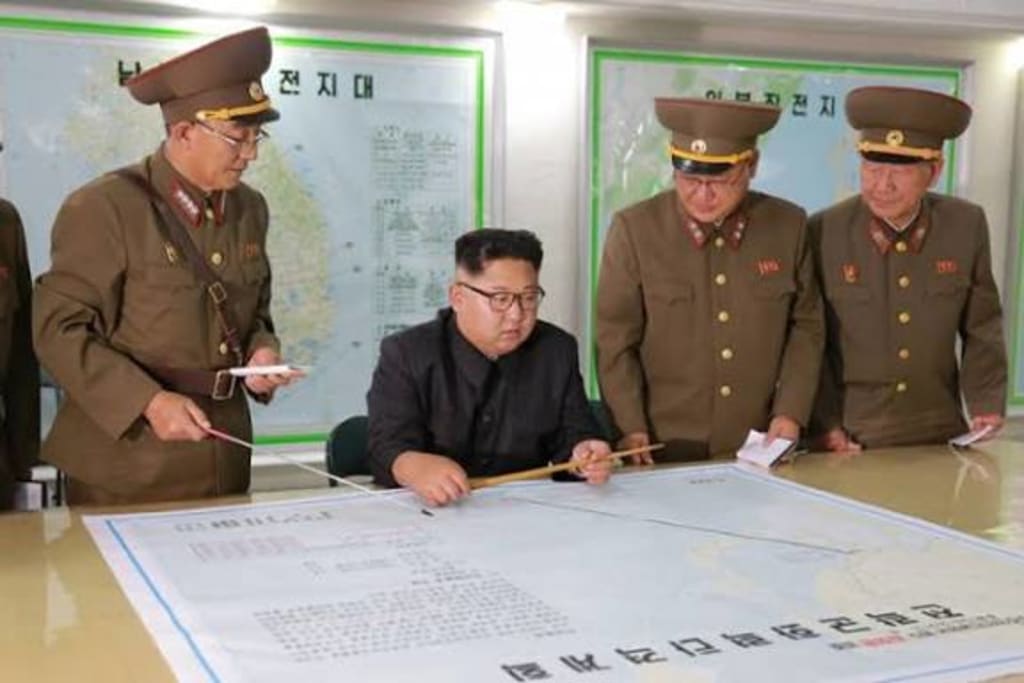
North Korea’s leader, Kim Jong Un, has once again drawn global attention with his nation’s accelerated missile production program. Citing national security and the need for a “credible war deterrent,” Kim has ordered the rapid expansion of North Korea’s ballistic missile capabilities, a move that analysts say could heighten tensions in the Asia-Pacific region.
In recent statements carried by North Korean state media, Kim emphasized the importance of strengthening the country’s military arsenal. He framed the expansion not as a tool for aggression but as a necessary step to safeguard sovereignty. “A powerful deterrent ensures peace for our nation and security for our people,” he reportedly said during a meeting with top military officials.
This latest development follows a series of missile tests conducted earlier this year, which included short-range and medium-range ballistic missiles. Experts view the escalation as a signal that Pyongyang is increasingly confident in its technological capabilities and seeks to assert its influence amid ongoing diplomatic stalemates with the United States, South Korea, and Japan.
The Strategic Rationale
North Korea’s leadership has historically justified missile development as a defensive measure. Kim Jong Un’s government consistently frames these weapons as a safeguard against perceived threats, particularly from the United States, which maintains a significant military presence in South Korea and Japan. Analysts argue that the focus on missile production serves a dual purpose: deterring foreign intervention while reinforcing domestic legitimacy.
“The regime uses the rhetoric of deterrence to maintain both internal control and regional leverage,” explains Dr. Laura Chen, an expert on East Asian security. “Missiles are as much about politics at home as they are about strategic security abroad.”
Implications for the Region
The ramped-up missile program is expected to draw strong reactions from neighboring countries. South Korea and Japan have both expressed concerns over Pyongyang’s increasing capabilities, warning that missile proliferation in the region could trigger an arms race. Both countries have maintained close military coordination with the United States, including missile defense systems designed to intercept potential threats from the North.
“The expansion of North Korea’s missile program is a destabilizing factor,” said a spokesperson from Seoul’s Ministry of National Defense. “It challenges regional security frameworks and complicates efforts for dialogue.”
The United States has similarly condemned North Korea’s accelerated production. American officials have reiterated that the administration remains committed to a combination of diplomacy and pressure to curb Pyongyang’s weapons programs. Yet, Washington also acknowledges the limits of engagement without significant concessions from the North Korean regime.
Global Response and Diplomacy
International responses to North Korea’s missile development have been varied. The United Nations has long imposed sanctions targeting North Korea’s military exports and economic activities related to weapons development. While these sanctions aim to limit the country’s resources for missile production, enforcement remains inconsistent, and North Korea continues to find ways to circumvent restrictions.
China and Russia, key players in regional stability, have traditionally advocated for dialogue over punitive measures. Both countries encourage multilateral discussions to prevent escalation while avoiding actions that could push North Korea toward further provocations.
Domestic Messaging and Political Control
Within North Korea, missile production carries symbolic weight beyond military strategy. State media consistently portrays these efforts as a testament to Kim Jong Un’s leadership and vision for a self-reliant, strong nation. By highlighting military achievements, the regime reinforces national pride and the narrative of resilience in the face of international pressure.
Observers note that this messaging is crucial in maintaining domestic stability. North Korea faces ongoing economic challenges, including sanctions, natural disasters, and global market disruptions. In this context, showcasing military progress serves as a tool to unify the population under a common cause and bolster confidence in leadership.
The Road Ahead
The expansion of missile capabilities by North Korea signals a complex interplay of deterrence, domestic politics, and regional posturing. Analysts predict that missile production will remain a central focus for Pyongyang, with potential implications for arms negotiations, diplomatic relations, and security arrangements in East Asia.
While Kim Jong Un frames these actions as defensive, neighboring countries and international observers continue to view them with suspicion. The challenge for the global community will be to balance deterrence with diplomacy, seeking pathways to reduce tensions while addressing North Korea’s persistent security concerns.
In the months ahead, the world will closely watch North Korea’s next steps, particularly any missile tests or policy announcements. The region remains on alert, and the international community faces the ongoing challenge of ensuring stability amid an increasingly assertive North Korean military posture.
About the Creator
Fiaz Ahmed Brohi
I am a passionate writer with a love for exploring and creating content on trending topics. Always curious, always sharing stories that engage and inspire.
Keep reading
More stories from Fiaz Ahmed Brohi and writers in The Swamp and other communities.
Ukraine Accepts a Demilitarised Zone to End the Russia War — But Do DMZs Really Work?
After years of relentless conflict, mounting casualties, and economic exhaustion, Ukraine’s reported acceptance of a proposed demilitarised zone (DMZ) has sparked cautious global attention. The idea is being discussed as a potential pathway to de-escalation in the brutal war with Russia. Yet history urges restraint. While demilitarised zones have, in some cases, frozen conflicts and prevented immediate bloodshed, they have also failed spectacularly in others. The question now facing Ukraine — and the world — is simple but profound: can a DMZ actually deliver lasting peace, or will it merely pause the fighting? A demilitarised zone is a buffer area where military forces, heavy weapons, and fortifications are prohibited. Typically monitored by international observers or peacekeeping forces, DMZs aim to reduce accidental clashes, create space for diplomacy, and protect civilians caught between hostile armies. On paper, the concept appears logical. In practice, it is deeply complex. For Ukraine, the acceptance of a DMZ reflects both strategic realism and humanitarian urgency. After prolonged battles, infrastructure devastation, and civilian displacement, Kyiv faces immense pressure to stabilize frontlines without formally conceding territory. A DMZ offers a compromise: halting active hostilities while avoiding explicit recognition of Russian territorial gains. It is not a peace treaty, but it may be a ceasefire mechanism with guardrails. Supporters of the proposal argue that a demilitarised zone could save thousands of lives almost immediately. Reduced shelling would allow aid deliveries, reconstruction of essential services, and the return of displaced families. It could also create diplomatic breathing room, enabling talks on prisoner exchanges, economic recovery, and longer-term security guarantees. For war-weary civilians, even an imperfect pause in violence could feel like relief. However, critics warn that DMZs often freeze conflicts rather than resolve them. The Korean Peninsula offers the most famous example. The Korean DMZ has prevented full-scale war since 1953, yet it has not produced peace. Tensions remain high, families divided, and military readiness constant. While the guns are largely silent, the conflict itself is unresolved decades later. Another cautionary tale lies in Cyprus, where a UN-monitored buffer zone has separated Greek and Turkish Cypriots since 1974. Though large-scale violence has been avoided, political reconciliation has stagnated. The island remains divided, demonstrating how DMZs can institutionalize separation instead of healing it. In Ukraine’s case, skepticism is amplified by Russia’s past behavior. Multiple ceasefires since 2014 — particularly after the annexation of Crimea and during fighting in eastern Ukraine — were repeatedly violated. Ukrainian officials and analysts fear that a DMZ could be exploited by Moscow to regroup, resupply, and later resume military operations from a stronger position. Without robust enforcement, a buffer zone risks becoming a strategic pause rather than a path to peace. Enforcement is the heart of the issue. A demilitarised zone only works if violations carry real consequences. That typically requires credible international oversight, clear rules of engagement, and political unity among guarantor states. If monitoring forces lack authority or backing, a DMZ can quickly become symbolic rather than protective. For Ukraine, trust in enforcement mechanisms will be crucial — and hard-earned. Another challenge is sovereignty. Even a temporary DMZ may limit Ukraine’s ability to deploy forces on its own territory. Critics argue this could normalize restricted sovereignty and weaken Kyiv’s long-term security posture. Accepting a DMZ may be tactically wise, but strategically risky if it constrains Ukraine more than Russia. Yet it is equally true that endless war carries its own risks. Prolonged fighting drains economies, radicalizes politics, and devastates future generations. From that perspective, a DMZ could function as a necessary first step — not the destination, but the bridge. If paired with sustained diplomacy, reconstruction funding, and binding security guarantees, it might help convert a battlefield stalemate into a political process. Ultimately, demilitarised zones are neither miracle solutions nor guaranteed failures. They are tools — and like any tool, their effectiveness depends on how, where, and why they are used. For Ukraine, accepting a DMZ does not mean surrendering its goals, but it does mean betting that restraint can open doors violence has slammed shut. Whether this gamble pays off will depend less on maps and buffer lines, and more on political will, international unity, and the credibility of enforcement. History shows that DMZs can stop wars from getting worse — but stopping a war is not the same as ending it. The world now watches to see whether this pause becomes a platform for peace, or merely another chapter in a conflict that refuses to fade.
By Fiaz Ahmed Brohi3 months ago in The Swamp
The Forsyth House Fire
Since 1851, Forsyth House has stood on the corner of Union Street and Gordon Street in the heart of Glasgow. Its iconic, or was... because on Sunday 8th of March, 2026, a fire broke out in a small, seemingly un-named shop in the building and tore all that history down. As I write, the rubble is still unsettled and the street is still blocked off. Central Station is quiet on the upper level, and around 30 small businesses have quite literally gone up in smoke.
By S. A. Crawford3 days ago in The Swamp



Comments
There are no comments for this story
Be the first to respond and start the conversation.