
IVF Conception 2025: The Next Reproductive Battle for Women?
How assisted reproduction is becoming the dark twin of abortion


At first glance, IVF and abortion may seem like opposites: one is done to create a pregnancy, while the other is performed to terminate one. They are linked, however, due to the legal and moral debates surrounding the status of a fertilized egg in the context of reproductive healthcare. Both procedures involve the manipulation of fertilized eggs at an early stage of development — and in certain legal frameworks — especially those that consider “personhood” to begin at conception — both procedures could be impacted by legislation meant to restrict access because they both involve the potential to discard fertilized eggs or embryos. With the current political climate, the discussion around both procedures is becoming more complex, especially for women.
Is This Actual Change?
On February 18, 2025, President Trump signed an executive order to protect IVF access while substantially reducing out-of-pocket costs for the procedure. While campaigning, Trump called himself “the father of IVF” and promised to make the treatment less expensive to Americans by obliging either the government or insurance companies to pick up much of the tab.
Others were not convinced, believing this order to be more of a glorified press release than an actual step to help infertile couples. While the wording of the order shows empathy for families struggling with infertility, there are no specifics contained in the order and no actual commitments to act. The office of Illinois Democratic Senator Tammy Duckworth, who helped lead the congressional efforts to guarantee nationwide access to IVF, called it “overly vague” and “toothless.”
“Don’t be fooled. Donald Trump’s executive order does nothing to expand access to IVF. In fact, he’s the reason IVF is at risk in the first place. But if he is actually serious about taking real action to accomplish his own campaign promise to make IVF free for everyone, there’s a simple way he can prove it: He can call on Senate Republicans to immediately back my Right to IVF Act that would require insurance plans to cover IVF Otherwise, it’s all just lip-service from a known liar.” ~ Tammy Duckworth
What Project 2025 States
While President Trump may herald himself as a proponent of IVF technology, Project 2025 presents a far more draconian approach to assisted reproductive technology. The document includes language that propagates the belief that life begins at the moment of conception. “Personhood” is the key word that threatens not only abortion, but IVF treatments (p.455, 461, 483–485, Project 2025).
Some states have already enacted laws pertaining to IVF. On February 16, 2023, the Alabama Supreme Court ruled that embryos created through IVF will be considered children. To determine this definition, the Court referenced the general meaning of “minor” in a law originally enacted in 1872, called the Wrongful Death of a Minor Act. According to that language, all children, born and unborn, regardless of their location, including in utero, have personhood. This premise was relied on to determine that embryos held in a lab are, indeed, children.
Following that line of thinking, destruction of embryos help in IVF facilities could lead to criminal charges. Most couples have several embryos on hand to ensure there are more to implant if a round fails. But if a round is successful and there are additional embryos left? This creates a difficult bioethical situation. In an attempt to create life, they may have to destroy or abandon the other lives that they began. They could be donated to other infertile couples, or they could continue to be stored, but they cannot be destroyed, at least not in Alabama.
As of now, only the state of Alabama has such strict regulations regarding frozen embryos which they term “extrauterine children”. Whether or not other states will follow Alabama’s lead is not certain. Sonia Suter, a legal professor and bioethicist at George Washington University, stated, "It’s always difficult to predict what will happen in other states, there are other states that are very, very conservative that have strong evangelical leanings. You worry about it happening in those states.”
With over a third of states currently considering fetuses to be people at some point during pregnancy, any one of them could easily follow Alabama’s lead. Many of these states now have strict abortion laws, and predictably anti-abortion proponents are against IVF. Lila Rose, the leader of the anti-abortion group Live Action stated, “IVF turns children into a product to be created, sold, and discarded — violating their basic human rights.”
Opaqueness with Fertility Treatment Disasters
Activists opposed to IVF point to a lack of transparency regarding mistakes that are made at IVF centers. Even when litigation is pursued, the settlements generally have nondisclosure agreements that keep the errors from public view. Other cases are settled before lawsuits can be filed.When a storage tank at a reproductive center in San Francisco collapsed, four thousand human eggs and embryos were damaged or killed. Although the center was accused, a jury subsequently determined that a manufacturing flaw was primarily responsible for the catastrophe. The lab director had silenced 128 alerts that indicated problems by unplugging a broken computer. When the computer malfunctioned, lab staff failed to move the vessel’s contents to a backup tank. Furthermore, there is no proof that any repairs were made during the 13 days that passed between these initial issues and the implosion.
Only because a lawsuit and civil trial in 2021 provided a unique window into the closed world of fertility care in the United States were the mistakes made public. Experts claim that in the rapidly growing, mostly self-policing fertility sector, mistakes and mishaps are frequently overlooked. Despite a code of ethics that specifically states practitioners should promptly inform patients about lost or destroyed genetic material, it is not required to disclose erroneous incidents to the government, the public, any professional association, or even patients.
Without data on errors, it is impossible to measure the quality of U.S. reproductive care. ~ The Washington Post
“In other areas of health care, states require hospitals to monitor and report major avoidable errors, things like mismatched blood transfusions or surgery on the wrong body part,” said Dov Fox, a law professor and director of the Center for Health Law Policy and Bioethics at the University of San Diego, who studies the fertility industry. “They call these ‘never events’ because these are things that just shouldn’t happen. No agency or authority tracks or polices what might be called ‘reproductive never events.’”
Mishaps can be evident even after a child is born via IVF. In May 2023, Krystena Murray of Georgia became pregnant following IVF therapy at the Coastal Fertility Center in her home state. However, once Ms. Murray gave birth to a son who was not of the same ethnicity as either her or the sperm donor she had selected, it became evident that the embryo she had been carrying actually belonged to another couple. Ms. Murray raised the child for several months until the biological parents were given custody because she wanted to retain the child despite the mix up.
“To carry a baby, fall in love with him, deliver him, and build the unique special bond between mother and baby, all to have him taken away. I’ll never fully recover from this.” ~ Krystena Murray
Of course, she knew immediately that the child was not biologically related to her. In an effort to keep the boy, Murray did not post photos of the baby, and she did not allow friends or family to see him.
After breastfeeding the child and taking him to doctor’s appointments, Murray was devastated when the child was taken. The baby was five months old when the courts forced her to surrender him.
The question of where Murray’s original embryo is still remains a mystery. Costal Fertility Specialists do not know if it was implanted into another woman or not. Part of the complaint states that Murray “…does not know if her biologically related child is being raised by anyone else.”
Coastal Fertility Specialists has admitted the mistake, and in a statement to CBS News, they stated, in part, “This was an isolated event with no further patients affected. The same day this error was discovered, we immediately conducted an in-depth review and put additional safeguards in place to further protect patients and to ensure that such an incident does not happen again.”
Murray did not put up a fight after her legal team advised her that she had no chance of prevailing. Though traumatized, Murray voluntarily gave up custody. The boy is now living with his biological parents in a new state with a new name. Murray has not seen the baby since that day.
Where This Leaves Women
With the reversal of Roe, some anti-abortion organizations are now changing the language of what it is they want to protect. Formerly crusading for the rights of the “unborn” they are now beginning to say they are advocates for “personhood” protections. They are campaigning on the idea that with IVF’s inevitable “extra-uterine children” or unused embryos, the life of an unborn child is ending.
Emboldened by the Roe reversal, some anti-abortion groups have now evolved into pro-personhood activists, campaigning on the concept that IVF also ends an unborn child’s life when it comes to the disposal of unused embryos.
With greater advancements in technique and technology, the science of IVF may be advancing, but whether women will be able to access those advancements is not at all clear. In 2024, more than a dozen bills have been introduced regarding prenatal personhood have been introduced. For parents-in-waiting, none of them envisions good news.
About the Creator
Anne Spollen
I haunt New York City, the Jersey Shore, and the Hudson Valley. I write a lot, and I read a lot. Working on two new novels (writing them, not reading them) because I haven't published a new novel in quite some time ~ but I'm back now.
Keep reading
More stories from Anne Spollen and writers in The Swamp and other communities.
Trump Seized the Populist Comfort of Nostalgia to Win
In 1980, I remember celebrating my mother’s birthday just before leaving to go back to college. We watched this segment of Trump and Tom Brokaw when it was new and when Trump was known as a “rich guy” married to an Eastern European Olympic contender. They were part of the New York elite scene, people distant from us but people who frequently appeared in the news or magazines.
By Anne Spollenabout a year ago in The Swamp
The Forsyth House Fire
Since 1851, Forsyth House has stood on the corner of Union Street and Gordon Street in the heart of Glasgow. Its iconic, or was... because on Sunday 8th of March, 2026, a fire broke out in a small, seemingly un-named shop in the building and tore all that history down. As I write, the rubble is still unsettled and the street is still blocked off. Central Station is quiet on the upper level, and around 30 small businesses have quite literally gone up in smoke.
By S. A. Crawforda day ago in The Swamp
In the Gulf, a Cruise Line Steps Up to Get Stranded Passengers Home
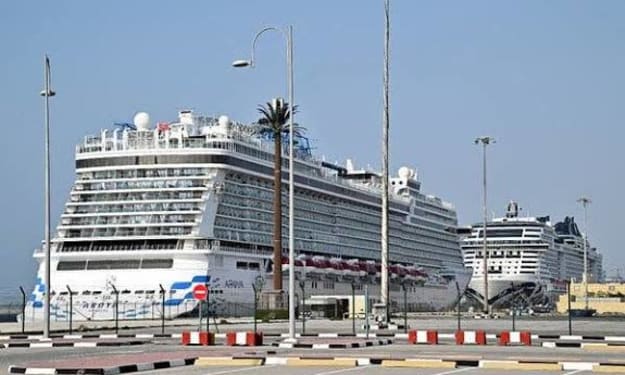
As conflict and airspace closures disrupt commercial flights across parts of the Middle East, a major cruise company has stepped in to help hundreds of stranded travelers find a way home. With airports overwhelmed and airlines canceling routes, the unusual rescue effort has transformed a leisure cruise ship into an emergency transport vessel for passengers unable to leave the region. The situation escalated after rising tensions between Iran and Israel led several governments to issue security warnings and restrict flights over parts of the Gulf. Major airlines quickly began rerouting aircraft or suspending services entirely, leaving thousands of international travelers stranded in cities across the region. Among those affected were tourists, business travelers and families who had been visiting countries such as the United Arab Emirates and Qatar. Many suddenly found themselves unable to return home as flight schedules collapsed with little notice. In response, Royal Caribbean Group announced that one of its vessels operating in the region would offer additional sailings designed specifically to transport stranded passengers to ports where flights remain operational. The ship, already scheduled for leisure voyages in the Gulf, quickly became part of an improvised evacuation network. Cruise officials coordinated with port authorities and foreign embassies to identify travelers in urgent need of transportation. Extra cabins were opened and departure schedules were adjusted to accommodate the unexpected demand. Passengers boarding the emergency voyage described scenes of relief and exhaustion. Many had spent days trying unsuccessfully to rebook flights or secure land transport to neighboring countries. For some families traveling with children, the uncertainty had become increasingly stressful. “Once we heard there was a ship leaving the Gulf that could take us somewhere flights were still running, we booked immediately,” said one passenger who had been stranded in Dubai for several days. The cruise route was adjusted to sail toward safer ports such as Muscat and Doha, where international airports remain open and functioning. From there, passengers could continue their journeys home on commercial flights. Government officials praised the cruise operator’s decision to assist. Diplomats said private-sector support can play an important role during regional crises, particularly when traditional transportation networks are disrupted. Cruise companies typically focus on leisure travel, but maritime vessels can sometimes provide alternative evacuation routes during emergencies. Ships are not constrained by the same airspace restrictions that affect aviation, allowing them to operate even when flight corridors are closed. Security analysts say the incident highlights how geopolitical tensions in the Gulf can rapidly affect global travel. Several airlines had already begun avoiding parts of Middle Eastern airspace due to safety concerns. For the passengers boarding the cruise ship, however, the journey was less about geopolitics and more about getting home. Crew members welcomed the unexpected travelers aboard, offering meals, temporary accommodations and assistance arranging onward travel plans. For many, the ship represented a rare moment of stability during a chaotic travel situation. As the vessel departed the Gulf waters carrying hundreds of relieved passengers, it symbolized an unusual but effective response to a modern travel crisis—where a cruise liner became a lifeline for those stranded far from home.Crew members onboard worked around the clock to accommodate the unexpected surge of passengers, providing meals, temporary lodging, and assistance with travel documentation. The ship sailed toward ports such as Muscat, where airports continued operating and travelers could reconnect with international flights. Diplomats from several countries praised the effort, noting that private companies can play a crucial role during travel emergencies. Analysts say the incident demonstrates how maritime transport can provide an alternative when aviation networks break down. For many stranded travelers, the cruise ship offered more than transportation—it provided reassurance and a safe path home during a deeply uncertain moment.
By Fiaz Ahmed 7 days ago in The Swamp
Writing To Succeed
If you want to find something that will help readers find your writing, possibly expand your audience, and maybe even get you noticed for other things, then you’re not alone. But how can you get it done in a world full of want-to-be writers? Look less at what you’re writing now, and more at what other writers have used to boost their views and reads.
By Jason Ray Morton 7 days ago in Writers



Comments
There are no comments for this story
Be the first to respond and start the conversation.