
Italian Eurofighters Intercept Rare Russian Navy Be-200 Flying Boat Over the Baltic
A routine NATO air-policing mission turns into a rare Cold War–style encounter in European skies.
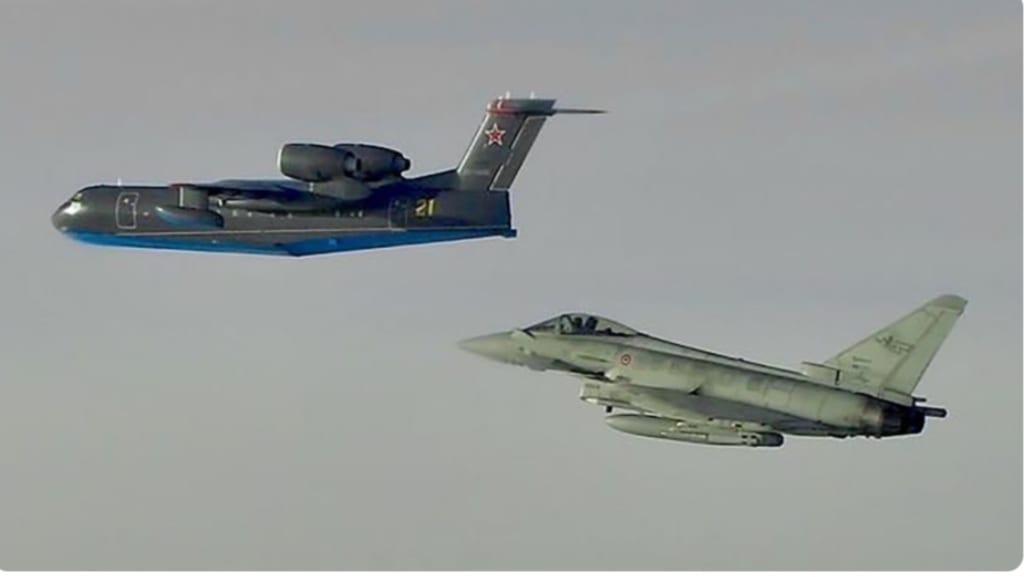
European airspace witnessed an unusual and symbolically charged moment when Italian Air Force Eurofighter Typhoons intercepted a rare Russian Navy Be-200 amphibious aircraft over the Baltic Sea. While intercepts between NATO jets and Russian military aircraft are not uncommon, this particular incident stood out due to the type of aircraft involved and the broader geopolitical context surrounding Europe’s eastern flank.
The encounter has drawn attention not only from military analysts but also from policymakers, as it highlights the evolving nature of air and maritime operations in one of the world’s most strategically sensitive regions.
A Rare Aircraft in a Familiar Theater
The aircraft intercepted was a Beriev Be-200, a multipurpose amphibious flying boat operated by the Russian Navy. Unlike the more frequently encountered Russian bombers or reconnaissance planes, the Be-200 is a rare sight in NATO-monitored airspace.
Originally designed for firefighting, search and rescue, and maritime patrol missions, the Be-200 is capable of both conventional runway operations and water landings. Its presence over the Baltic immediately raised questions about the nature of the mission, as well as Russia’s intentions in deploying such an aircraft in a heavily monitored area.
According to NATO sources, the Russian aircraft was flying without proper transponder signals and did not respond to standard radio communications, prompting the interception.
Italy’s Role in NATO Air Policing
Italy’s involvement underscores the collective nature of NATO’s air defense strategy. Italian Eurofighters were deployed as part of NATO’s Baltic Air Policing mission, a rotational operation designed to protect the airspace of member states that do not have their own fighter jets.
Since its inception, the mission has become increasingly important amid rising tensions between NATO and Russia. Italian pilots regularly operate from forward bases in the region, ready to scramble at short notice to identify and escort unknown or non-cooperative aircraft.
In this case, Italian Eurofighters were launched to visually identify the Be-200, monitor its flight path, and ensure it did not violate sovereign airspace.
What Happens During an Intercept
Military intercepts are governed by strict international protocols. Contrary to dramatic portrayals, such encounters are usually professional and controlled.
Once airborne, the Eurofighters approached the Russian aircraft at a safe distance, visually confirmed its type and markings, and escorted it while remaining within international airspace. The objective was not confrontation but identification and deterrence, ensuring the safety of civilian and military aviation in the region.
NATO officials emphasized that the interaction was conducted safely and that the Russian aircraft eventually left the area without incident.
Why the Baltic Sea Matters
The Baltic Sea has become one of Europe’s most strategically sensitive regions. Bordered by multiple NATO countries and Russia’s Kaliningrad exclave, it serves as a critical corridor for trade, energy infrastructure, and military movement.
Regular Russian military flights near NATO airspace are seen by the alliance as a way for Moscow to test response times, readiness, and coordination. Each intercept, therefore, is both a defensive action and a data-gathering exercise.
The appearance of a Be-200 adds a new layer of complexity, as it suggests Russia may be expanding or diversifying the types of aircraft it deploys in the region.
Strategic Significance of the Be-200
Although not a combat aircraft, the Be-200’s capabilities make it strategically relevant. Its long range, maritime surveillance potential, and ability to operate from water give it unique flexibility.
Analysts suggest that its deployment over the Baltic could serve multiple purposes:
Training and familiarization with NATO response patterns
Maritime monitoring in a contested region
Symbolic signaling, demonstrating Russia’s operational reach
The incident reinforces the idea that modern military signaling is not always aggressive in nature but can be subtle and multifaceted.
Rising Tensions, Measured Responses
The interception comes at a time of heightened tension between NATO and Russia, marked by increased military exercises, sanctions, and diplomatic strain. Despite this backdrop, both sides have largely maintained measured behavior during aerial encounters to avoid escalation.
European defense officials continue to stress that NATO’s posture is defensive. Air policing missions are designed to protect airspace, reassure allies, and uphold international aviation standards rather than provoke confrontation.
Italy’s role in the incident has been widely praised within the alliance as an example of shared responsibility and professionalism.
Public and Political Reactions
News of the intercept sparked renewed debate across Europe about defense readiness and the cost of sustained military vigilance. Supporters argue that such missions are essential for maintaining security and deterrence, while critics question whether constant interceptions risk normalization of tension.
In Italy, defense officials highlighted the professionalism of the pilots and reaffirmed the country’s commitment to NATO obligations. The incident has also been used as an example of how European nations contribute collectively to regional security.
A Snapshot of Modern European Security
While no laws were broken and no airspace violated, the interception serves as a reminder of how fragile and complex European security dynamics have become. A single flight by a rarely seen aircraft was enough to trigger a coordinated military response involving multiple nations.
Such encounters are unlikely to disappear. As long as geopolitical tensions persist, NATO air-policing missions will remain a visible and necessary feature of Europe’s security landscape.
Conclusion
The interception of a Russian Navy Be-200 by Italian Eurofighters over the Baltic Sea may not have involved dramatic maneuvers or hostile exchanges, but its significance lies in what it represents. It highlights NATO’s vigilance, Italy’s active role in collective defense, and the evolving methods through which military powers signal presence and intent.
In an era where confrontation often takes place just short of conflict, moments like these offer a clear picture of how deterrence, professionalism, and preparedness shape modern European airspace — quietly, constantly, and with global implications.
About the Creator
Keep reading
More stories from Aarif Lashari and writers in The Swamp and other communities.
Syria Agrees Ceasefire With Kurdish-Led Forces After Two Weeks of Clashes
After two weeks of intense clashes that displaced civilians and reignited long-simmering tensions, the Syrian government has agreed to a ceasefire with Kurdish-led forces in the country’s north and northeast. The deal, announced following indirect negotiations, aims to halt fighting that has left dozens dead and destabilized an already fragile region struggling with economic hardship, insecurity, and the lingering aftermath of years of war.
By Aarif Lashariabout 9 hours ago in The Swamp
Plug-in Hybrid Electric Vehicle Market Outlook 2025–2033
Introduction The global automotive industry is undergoing its most transformative phase in over a century. Rising environmental concerns, tightening emission regulations, and shifting consumer preferences are accelerating the adoption of cleaner mobility solutions. Among the various electrification pathways, Plug-in Hybrid Electric Vehicles (PHEVs) have emerged as a powerful bridge between traditional internal combustion engine vehicles and fully electric cars. By combining electric-only driving capability with the flexibility of a conventional engine, PHEVs offer a pragmatic solution for consumers who seek lower emissions without sacrificing range or convenience.
By Janine Root 7 days ago in The Swamp


Comments
There are no comments for this story
Be the first to respond and start the conversation.