
Issue Brief on “Nuclear Year 2025 in Review”
A year of rising tensions, fragile treaties, and renewed global concern over nuclear security

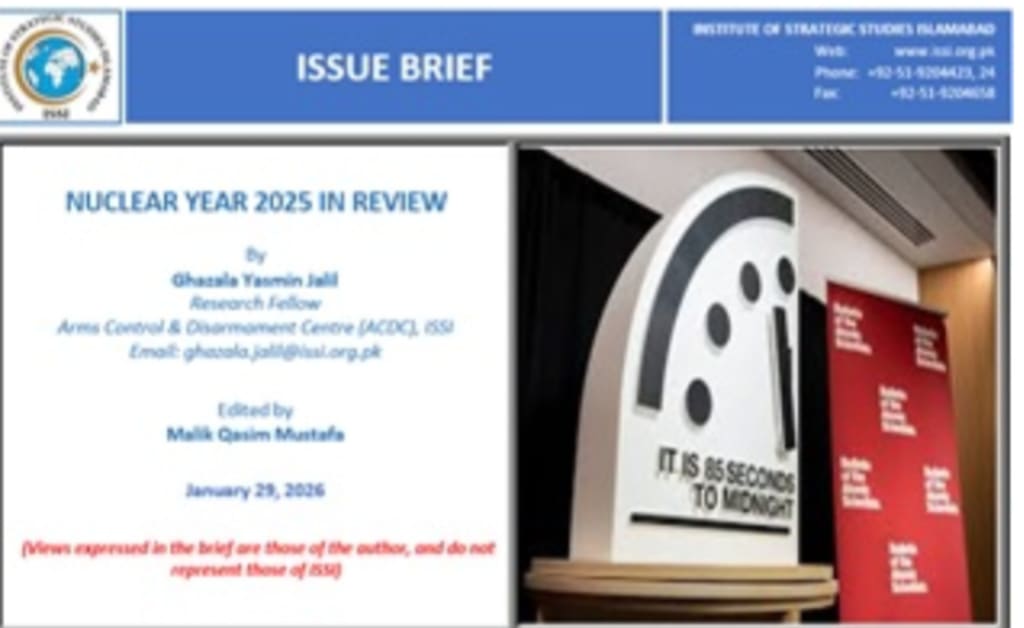
The year 2025 will be remembered as a turning point in global nuclear politics. Marked by growing geopolitical rivalries, stalled arms control agreements, and renewed nuclear threats, the world witnessed both alarming setbacks and cautious diplomatic efforts. From escalating tensions among nuclear-armed states to debates over modernization and disarmament, nuclear issues once again dominated international security discussions.
As nations reassess their strategies and alliances, the events of 2025 reveal how fragile the global nuclear order has become—and how urgently cooperation is needed to prevent catastrophe.
A Return to Nuclear Rhetoric
One of the defining features of 2025 was the return of openly confrontational nuclear rhetoric. Political leaders in several nuclear-armed countries made statements that signaled a willingness to use nuclear deterrence as a primary diplomatic tool rather than a last resort. This shift reflected broader instability in international relations, particularly as conflicts and rivalries intensified in Eastern Europe, the Middle East, and the Indo-Pacific region.
Instead of focusing on arms reduction, governments increasingly emphasized military preparedness and modernization of nuclear arsenals. For many analysts, this signaled a departure from decades of gradual progress toward restraint.
Arms Control Under Pressure
Arms control frameworks faced serious challenges throughout the year. Existing agreements struggled to adapt to new technologies such as hypersonic weapons, cyber warfare capabilities, and artificial intelligence systems that intersect with nuclear command and control.
Negotiations between major nuclear powers remained slow and fragile. Distrust, accusations of treaty violations, and political polarization at home weakened the momentum for renewal of past agreements. In several cases, talks were postponed or stalled entirely, leaving the future of arms limitation uncertain.
At the same time, non-nuclear states expressed frustration that nuclear powers were not fulfilling their commitments to reduce stockpiles under international treaties. This tension highlighted the widening gap between promises and practice in global disarmament efforts.
Modernization of Nuclear Forces
While diplomacy struggled, modernization moved forward rapidly. Major nuclear powers invested heavily in upgrading warheads, delivery systems, and defense infrastructure. New missile systems, submarine fleets, and strategic bombers were announced or deployed in 2025, reinforcing the idea that nuclear weapons remain central to national defense strategies.
Supporters of modernization argued that these updates were necessary to ensure safety, reliability, and deterrence. Critics, however, warned that such investments encourage arms races and undermine long-term stability. The expansion of nuclear capabilities by emerging powers also added complexity to an already crowded strategic landscape.
Regional Flashpoints
Several regional conflicts in 2025 raised nuclear concerns:
Eastern Europe
Ongoing instability kept nuclear deterrence at the forefront of security planning. Military exercises and strategic warnings increased fears of miscalculation.
Middle East
Nuclear negotiations remained tense amid rising hostility and domestic unrest in key countries. International efforts to prevent nuclear proliferation continued, but progress was uneven and fragile.
Indo-Pacific
Rivalries between major powers and expanding missile programs elevated anxieties about accidental escalation and strategic competition.
These flashpoints showed how nuclear risks are no longer confined to traditional Cold War rivalries but are now embedded in multiple global regions.
The Human and Environmental Dimension
Beyond politics and strategy, 2025 also renewed attention to the humanitarian impact of nuclear weapons. International organizations and civil society groups emphasized the catastrophic consequences of any nuclear detonation, whether intentional or accidental.
Campaigns advocating for nuclear disarmament gained momentum, especially among younger generations. Conferences and forums highlighted the long-term environmental damage caused by nuclear testing and the disproportionate effects on vulnerable communities.
The debate increasingly shifted from abstract deterrence theory to real-world consequences, underscoring that nuclear weapons are not merely political tools but existential threats.
Technology and New Risks
Technology emerged as a double-edged sword in 2025. Advances in artificial intelligence and cyber capabilities raised serious concerns about the security of nuclear command systems. Experts warned that hacking, misinformation, or system failures could lead to false alarms or unintended launches.
The integration of automated systems into military decision-making sparked ethical debates about whether machines should ever influence nuclear choices. These discussions added a new layer of complexity to already sensitive policy decisions.
Signs of Hope
Despite the challenges, 2025 was not without positive developments. Several countries reaffirmed commitments to non-proliferation and participated in dialogue forums aimed at reducing risks. Track-two diplomacy—informal discussions between experts and former officials—helped keep communication channels open even when official negotiations stalled.
Youth movements and international advocacy groups continued to push for transparency and accountability, reminding governments that public opinion increasingly favors de-escalation over confrontation.
Lessons from 2025
The events of 2025 highlight several key lessons:
Deterrence alone is not enough. Without diplomacy and trust-building, nuclear stability becomes fragile.
Technology increases risk as much as it increases security. Cyber and AI tools demand new safeguards.
Public engagement matters. Grassroots movements are reshaping how nuclear policy is discussed globally.
Multilateral cooperation is essential. No nation can manage nuclear risks in isolation.
Looking Ahead
As the world moves into 2026, the legacy of 2025 is one of warning and opportunity. The warning is clear: rising tensions and unchecked modernization could lead to dangerous miscalculations. The opportunity lies in renewed dialogue, innovative arms control frameworks, and stronger global cooperation.
“Nuclear Year 2025 in Review” serves as a reminder that nuclear weapons remain one of humanity’s greatest challenges. Whether the coming years bring progress or peril will depend on the willingness of world leaders to choose restraint over rivalry and cooperation over conflict.
In a time defined by uncertainty, the lessons of 2025 must guide future action—because the stakes could not be higher.
About the Creator
Sajida Sikandar
Hi, I’m Sajida Sikandar, a passionate blogger with 3 years of experience in crafting engaging and insightful content. Join me as I share my thoughts, stories, and ideas on a variety of topics that matter to you.
Keep reading
More stories from Sajida Sikandar and writers in The Swamp and other communities.
Is America About to Attack Iran?
In recent weeks, the world has been watching closely as tensions between the United States and Iran reach a new boiling point. Military movements, sharp political rhetoric, and reports of possible airstrikes have fueled a pressing question: Is America about to attack Iran?
By Sajida Sikandarabout 24 hours ago in The Swamp
Trump’s Bold Threat: 100% Tariffs on Canada Over Possible Deal with China
Introduction: In a new and alarming development on the international trade front, former U.S. President Donald Trump has threatened to impose 100% tariffs on all imports from Canada if the country proceeds with making a trade deal with China. The statement, which came as a part of Trump’s ongoing commentary on U.S.-Canada relations, has raised eyebrows across North America and the global economic landscape. Trump's harsh warning could have significant consequences not only for the U.S. and Canada but also for the broader geopolitical balance involving China.
By Ayesha Lashari5 days ago in The Swamp
Trump Vows ‘Big Retaliation’ as ‘Sell America’ List Grows
Former U.S. President Donald Trump has once again made headlines by promising a “big retaliation” in response to growing criticism and scrutiny over what he calls the “Sell America” list. The list reportedly tracks companies, executives, and organizations that Trump perceives as harming U.S. economic interests, and his remarks have sparked debate across political, business, and social circles.
By Muhammad Hassan7 days ago in The Swamp


Comments
There are no comments for this story
Be the first to respond and start the conversation.