
Israel vs Iran: The Shadow War Edging Toward Global Catastrophe
Missiles, Drones, and Proxy Militias: A New Phase

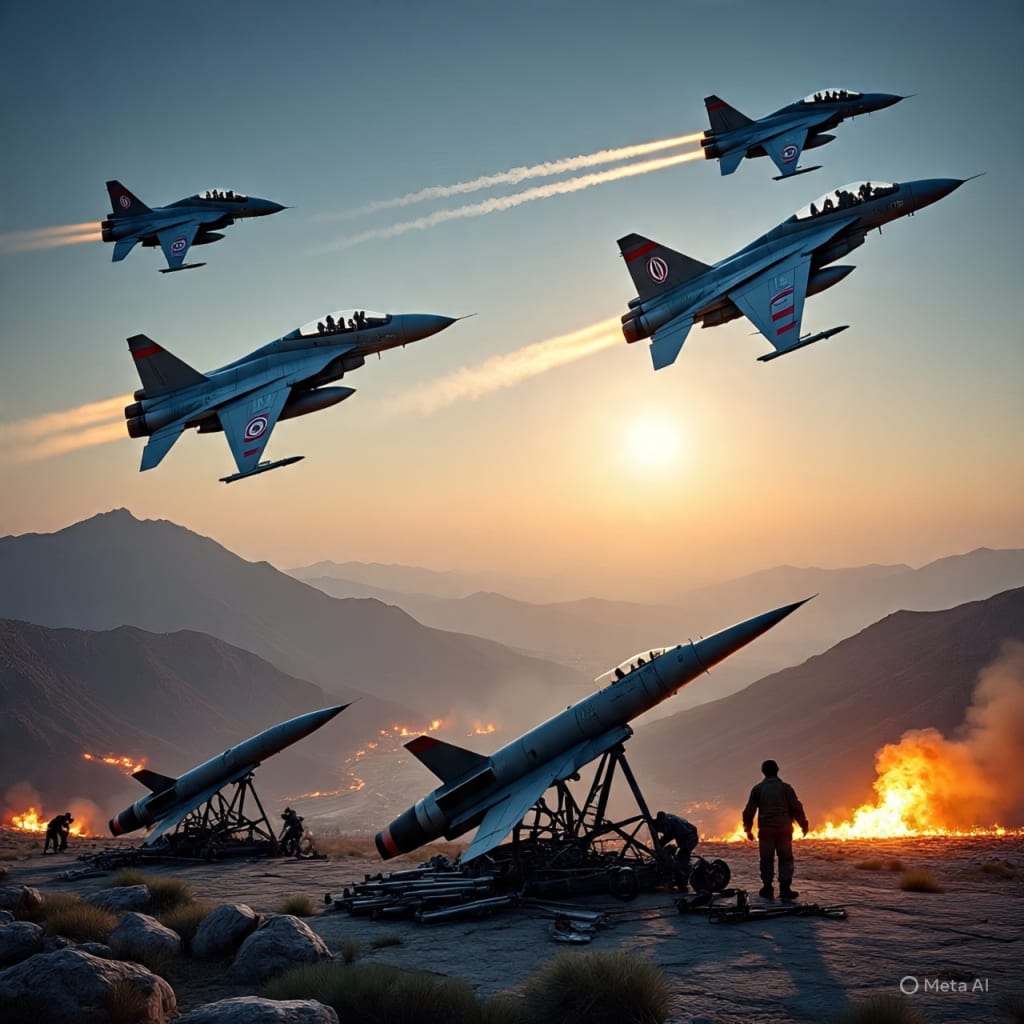
Start writing...Introduction: Beyond Borders, Beyond Control
For over four decades, Israel and Iran have been engaged in a deadly rivalry—one that has never fully erupted into declared war, but has never truly been at peace. What began as diplomatic hostility has mutated into a sprawling and chaotic conflict, fought through hackers, spies, militias, and missiles. Today, the situation is no longer about ideology or even territory—it's about survival. And the fuse is dangerously short.
---
Historical Roots of a Bitter Enmity
The animosity began with Iran’s 1979 Islamic Revolution, which replaced a Western-aligned monarchy with a hardline anti-Israel theocracy. Iran quickly branded Israel as an “illegitimate Zionist regime,” while Israel, in turn, identified Iran as the greatest long-term threat to its existence.
Over the years, these two states have supported opposite sides in nearly every regional conflict—from Syria’s civil war to Lebanon’s internal struggles. What makes this conflict unique is its asymmetrical nature: Israel is a highly advanced military power with covert Western alliances, while Iran relies on regional proxies, ideology, and long-term strategy.
---
The Cyber and Espionage War
In the digital age, war doesn’t need tanks. Israel and Iran have taken the battlefield to cyberspace and beyond. In 2010, the infamous Stuxnet worm, allegedly developed by Israel and the United States, crippled Iran’s nuclear centrifuges. It was the first instance of cyber warfare affecting physical infrastructure.
In response, Iranian hackers launched numerous cyberattacks on Israeli water systems, hospitals, and financial institutions. Israeli intelligence, particularly Mossad, has been blamed for the assassination of multiple Iranian nuclear scientists in operations straight out of a spy thriller.
These silent skirmishes rarely make headlines—but they push both nations closer to red lines neither wants to cross, yet neither is willing to avoid.
---
Missiles, Drones, and Proxy Militias: A New Phase
The last five years have seen a terrifying transformation: the silent war is turning loud.
Iran has armed Hezbollah and Palestinian Islamic Jihad with thousands of rockets, aimed at Israeli cities.
Israel has launched hundreds of airstrikes in Syria, targeting Iranian Revolutionary Guard Corps (IRGC) bases and weapon shipments.
Iranian drones have struck Israeli-owned ships, while Israel has retaliated with precision strikes deep within Iranian territory.
In April 2025, Iran allegedly supplied advanced missiles to Hezbollah, prompting an unprecedented Israeli bombing campaign near the Syrian-Lebanese border. Civilians were caught in the crossfire. The situation spiraled into an international diplomatic emergency.
---
The Nuclear Wildcard
Israel is widely believed to possess over 80 nuclear warheads, though it follows a policy of ambiguity. Iran denies it is building a nuclear bomb but continues to enrich uranium at levels that exceed limits set in the defunct JCPOA agreement.
The possibility of a pre-emptive Israeli strike on Iran’s nuclear facilities is growing more likely by the day. If that happens, Iran has promised to retaliate with full-scale war, unleashing Hezbollah, launching missile attacks, and possibly closing the Strait of Hormuz, a crucial oil route. The global economy would be shaken instantly.
---
Civilian Lives in the Crossfire
It is easy to talk about military strategy and geopolitics. But beneath every headline are the stories of millions of civilians—from Gaza and Tel Aviv to Tehran and Beirut—who live in daily fear.
Families in southern Israel run to bomb shelters during rocket sirens. Syrian and Lebanese villages are caught between Israeli jets and Iranian-backed militias. Inside Iran, dissenters who oppose war are silenced or jailed. War has become normal, and that is perhaps the greatest tragedy of all.
---
International Response: Ineffective or Indifferent?
The international community has largely failed to defuse this ticking time bomb. The United States, once a stabilizing influence, is increasingly inward-focused. Russia and China have stepped in as arms suppliers and political allies—fueling the fire instead of dousing it.
The United Nations issues statements, but lacks the teeth to enforce peace. Regional players like Qatar, Oman, and Turkey try backchannel diplomacy, but without much success. Everyone fears the consequences but no one has the power—or will—to stop the coming explosion.
---
What the Future Holds: A Grim Outlook
As things stand in mid-2025, war is no longer a question of if—it is a question of how big.
Will it be a limited missile exchange?
Will it involve nuclear weapons?
Will global powers get dragged into a regional firestorm?
What is certain is this: every month of inaction brings us closer to irreversible devastation. The shadow war is no longer in the shadows. And if diplomacy doesn’t act fast, the cost will be measured in lives, economies, and global stability.
---
Conclusion: The World Cannot Afford to Look Away
Israel and Iran are more than just two nations at odds—they are symbols of deeper global fault lines: religion vs. secularism, democracy vs. theocracy, and nationalism vs. revolution. As their conflict grows louder, the silence of the international community becomes more dangerous. The world must decide—will it intervene now, or wait until the smoke of missiles replaces the fog of diplomacy?
About the Creator
Keep reading
More stories from Abid Ali Khan and writers in The Swamp and other communities.
Charlie Kirk The Rise Controversy and Influence Behind Americas Viral Conservative Voice
American politics has always moved fast, but sometimes a personality appears that rises far more quickly than the usual pace. In recent years, Charlie Kirk has become one of those names that suddenly enter the national conversation and refuse to leave it. Whether people agree with him or strongly oppose him, one fact is undeniable. Charlie Kirk has become one of the most talked about and most searched conservative figures in the United States.
By Abid Ali Khanabout a month ago in The Swamp


Comments
There are no comments for this story
Be the first to respond and start the conversation.