
Ink on Paper: Why Print Media is Resurfacing in a Digital World.
As Americans tire of endless scrolling and AI-powered feeds, print publications and brands are rediscovering the power of solid storytelling.

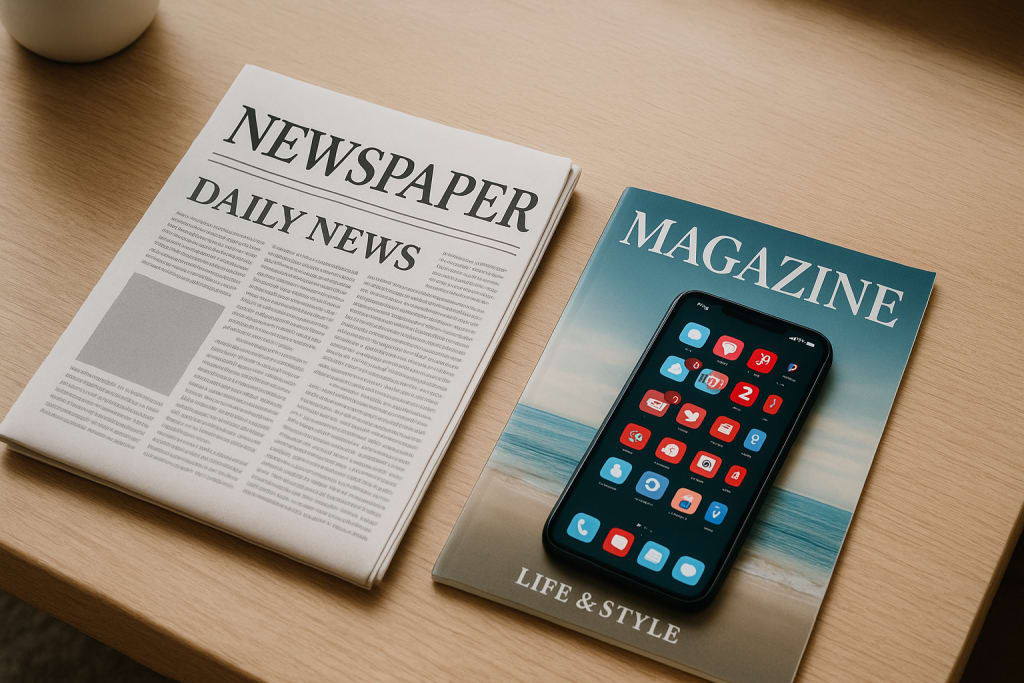
For more than two decades, the narrative seemed set in stone: print was dying, digital was king, and the future of media belonged solely to glowing screens. Newsstands closed, newspapers shrank, and magazines that once shaped culture folded one after another. Yet in 2025, a strange reversal is taking place across America. Print — once written off as obsolete — is quietly making a comeback.
The revival of print media isn’t just nostalgia. It’s a response to cultural fatigue. Americans, overwhelmed by fragmented attention spans, algorithm-driven feeds, and the artificial tone of so much online content, are once again reaching for something solid, authentic, and real. The Spectator, the Financial Times, and Us Weekly are expanding their print offerings. Even corporate giants like Microsoft and Costco are experimenting with physical publications to engage audiences more deeply than an Instagram reel or TikTok scroll could ever do.
The Problem of Digital Overload
The internet was meant to make life easier, but instead, it often overwhelms. Endless notifications, algorithmic rabbit holes, and AI-generated fluff bombard users daily. What should feel like convenience often feels like noise. Studies show rising levels of “digital burnout” — a phenomenon where people, especially Gen Z and millennials, experience exhaustion from excessive online media consumption.
This fatigue has created an appetite for slower, more deliberate consumption. Print offers exactly that. A magazine doesn’t ping you with ads. A newspaper doesn’t demand you swipe up or click next. It exists to be read, digested, and sometimes even saved. In a world where content disappears as quickly as it appears, print certainly feels permanent.
Why print still works.
Part of print’s renewed appeal is psychological. Holding something physical creates a sense of value. Readers are more likely to recall and trust information they read in print than online, where misinformation is rampant. Print publications are curated by human editors, giving them authority in an age where AI is second only to producing articles.
For advertisers, print offers unique advantages. A glossy magazine spread or a carefully designed catalog banner carries more weight than an ad that consumers scroll through in less than two seconds. Costco’s decision to revive its Costco Connection magazine in expanded format is proof of that. Consumers not only flip through its pages but also use it as a practical resource, influencing real-world purchasing decisions.
The Unexpected Role of Gen Z
Ironically, one of the biggest drivers of print’s revival is the generation most connected to digital culture — Gen Z. Book Tok (a TikTok subculture focused on reading) has helped drive record book sales in recent years. College students are rediscovering the joys of annotated magazines and collectible zines. Vinyl records, Polaroids, and now print publications appeal to Gen Z’s desire for authenticity in a world filled with digital filters.
When Us Weekly expanded its print run this year, it wasn’t just catering to older readers — it was acquiring a younger demographic curious about “retro” media experiences. For many, print isn’t old; it’s refreshingly new.
Human Touch vs. AI Content
The explosion of AI-generated content has paradoxically strengthened the case for print. While AI can generate endless blog posts, social captions, and even fake news, readers are beginning to crave human-authored, thoughtfully edited work. Print carries with it the unspoken assurance that real people have spent time selecting stories.
A print newspaper can’t update every second, but that’s its strength. Instead of chasing clicks, print offers thoughtful, contextual journalism. In an age where truth can feel elusive, the permanence of ink on paper signals trustworthiness.
Not a replacement, but a balance
None of this means that digital is disappearing — far from it. Online media remains the dominant force, and print’s resurgence is unlikely to reach the circulation heights of its 1980s golden age. Instead, what’s happening is a balance. People are learning that an all-digital diet leaves them far more stimulated, while a mix of print and digital provides a richer, healthier media experience.
Microsoft’s recent experiment with a limited-run print journal for tech leaders illustrates this balance. The company isn’t abandoning digital. It’s simply recognizing that some messages land more effectively when they’re delivered physically.
What the future holds.
The revival of print isn’t about turning back time — it’s about moving forward with greater intention. As trust in algorithms wanes and digital noise grows louder, print’s quiet authority has new relevance. Expect to see more niche magazines, branded print products, and newspapers that lean into their role as curated, trusted voices rather than competing with the speed of Twitter (now X).
The media landscape in 2025 is hybrid. Screens dominate, but the tactile presence of print fills a void that digital simply can’t. Print, once deemed obsolete, has become a symbol of authenticity in an age of artificiality. And perhaps that’s why ink on paper feels revolutionary again.
About the Creator
Echoes of Life
I’m a storyteller and lifelong learner who writes about history, human experiences, animals, and motivational lessons that spark change. Through true stories, thoughtful advice, and reflections on life.
Keep reading
More stories from Echoes of Life and writers in The Swamp and other communities.
Military recruitment is impressive.
Introduction: The new front line is online. The U.S. military has always adapted to the cultural tides of American life — from the iconic Uncle Sam “I want you” posters of World War I to the cinematic Super Bowl commercials that tug at patriotic hearts. But now, a different battleground has emerged: social media. With Gen-Z spending an estimated 5-7 hours a day on platforms like TikTok, Instagram, and YouTube, the military’s recruitment efforts are going where the eye can see.
By Echoes of Life7 months ago in The Swamp
The Forsyth House Fire
Since 1851, Forsyth House has stood on the corner of Union Street and Gordon Street in the heart of Glasgow. Its iconic, or was... because on Sunday 8th of March, 2026, a fire broke out in a small, seemingly un-named shop in the building and tore all that history down. As I write, the rubble is still unsettled and the street is still blocked off. Central Station is quiet on the upper level, and around 30 small businesses have quite literally gone up in smoke.
By S. A. Crawford3 days ago in The Swamp



Comments
There are no comments for this story
Be the first to respond and start the conversation.