
Identification, Authoritarianism, and the Moral Costs of Enduring Support
You’re still supporting? On a visceral level your soul is rotting

A common explanation for continued support for Donald Trump is informational deficit, the assumption that supporters do not know (or do not fully understand) his record, his rhetoric, or the downstream consequences of policies carried out in his name. That explanation is psychologically comforting because it implies a clean solution; more facts, more exposure and more education.
Political psychology and historical precedent suggest something harder in many cases, the problem is not absence of information; but psychological identification. Trump’s rule-breaking, contempt for oversight, and hierarchical framing of social life are not incidental flaws his supporters “overlook.” For a portion of the coalition, these are precisely the features that feel gratifying because they signal restored dominance, reasserted status boundaries, and permission to treat empathy as optional.
When allegiance is rooted in identity rather than ignorance, information can backfire. Facts do not necessarily produce reconsideration; they can produce defensive consolidation…a tightening of loyalty, because the leader’s transgression is experienced as the group’s transgression, and accountability is reframed as persecution. It is not as difficult as some may try to make it seem, especially sine my 15 year old niece understood the implications of supporting a man like that the first time he was in the office and now; and if she understood through her own observations, identity, morality with 10 more years to go for a full frontal lobe development then what excuse do those who are older than have?
Authoritarian alignment, Submission upward, aggression downward
Classic work on authoritarianism describes a durable psychological pattern: submission to a perceived strong leader, aggression toward sanctioned targets, and a preference for rigid social order. In this orientation, social hierarchy is not merely tolerated; it is moralized. Authority is experienced as protective, dissent as corrosive, and equality as destabilizing rather than democratic.
This is not simply “liking tough talk.” It is a worldview organized around rank, obedience, and boundary policing who belongs, who deserves, who should be punished, and who must be “put back in their place.” Under this logic, institutions meant to constrain power (courts, oversight bodies, a free press, civil rights enforcement) are recast as illegitimate obstacles, especially when they defend marginalized groups or impose accountability on the leader. What democratic cultures treat as guardrails, authoritarian-aligned cultures often treat as sabotage.
This framework helps explain a central paradox of Trump-era politics: why open cruelty, legal scandal, and norm violations do not reliably disqualify him. In authoritarian-aligned psychology, norm-breaking can be interpreted as proof of strength; a demonstration that the leader is powerful enough to ignore constraints that “shouldn’t apply” to him. The more he is criticized, the more his supporters may experience criticism as an attack on their identity and status, reinforcing loyalty through grievance and perceived persecution.
Where this becomes socially combustible is in the coupling of authoritarian submission with out-group targeting. Once a leader successfully defines a population as a threat, criminal, diseased, invasive, un-American harm becomes not only permissible but righteous. The public is not merely asked to accept cruelty; it is invited to experience cruelty as the restoration of order. This is how enforcement becomes spectacle, how punishment becomes politics, and how empathy becomes framed as weakness rather than as the minimum requirement of civic life.
A key rhetorical move in authoritarian politics is the inversion of victimhood, members of a historically dominant group are framed as the true victims of systems designed to address inequality. This inversion does not function as neutral commentary; it works as a moral permission structure. If the dominant group is suffering unjustly, then rolling back civil rights protections can be narrated not as regression, but as “fairness.”
Reuters recently reported criticism from the NAACP after Trump suggested civil rights-era protections produced “reverse discrimination” against white people. In a New York Times interview, he was quoted as saying, “White people were very badly treated, where they did extremely well and they were not invited to go into a university to college,” in an apparent reference to affirmative action in college admissions. He also reportedly stated that the Civil Rights Act “accomplished some very wonderful things,” but “hurt a lot of people,” adding: “people that deserve to go to a college or deserve to get a job were unable to get a job… It was a reverse discrimination.”
This language is not merely historically disputed; it is psychologically and politically functional. It reframes civil rights as an illegitimate intrusion into a natural hierarchy; an “attack” on those who allegedly “deserve” opportunity. The implication is that equality measures are not remedies for structural exclusion, but punishments imposed on competent, deserving people.
From the standpoint of authoritarian alignment, this argument does two things at once:
- It legitimizes hierarchy by treating inequality as the expected outcome of merit, and
- It authorizes resentment by presenting the dominant group as injured by fairness.
Reuters notes that NAACP President Derrick Johnson responded by arguing that Trump’s framing is intentionally deceptive, stating that “deception is the point,” and emphasizing there is “zero evidence” that the civil rights movement harmed white people. The point, then, is not simply whether the claim is true; the point is how such claims mobilize emotional energy like anger, grievance, moral entitlement and toward dismantling protections for marginalized groups while preserving a self-image of righteousness.
In an authoritarian moral economy, civil rights become rebranded as favoritism, inclusion becomes rebranded as exclusion, and accountability becomes rebranded as persecution. That is the mechanism of invert reality, moralize resentment, and then treat rollback as justice. Where was all of that favoritism when Black Wall Street was burned down (https://www.pbs.org/newshour/show/how-a-racist-white-mob-ruined-black-wall-street-100-years-ago) ? When Seneca Village became Central Park (https://www.centralparknyc.org/articles/seneca-village) ? The Tulsa Massacre (https://www.cnn.com/interactive/2021/05/us/whitewashing-of-america-racism/) ? Morrisonville, Louisiana?

Or when Black Codes that followed the Civil War, Southern states enacted a series of statutes known collectively as the Black Codes, designed to preserve racial hierarchy after the formal abolition of slavery. While emancipation eliminated chattel bondage in name, the Black Codes functioned as a legal infrastructure of control regulating labor, movement, political participation, and family life in ways that reproduced subjugation through law rather than ownership. These statutes established patterns of racial governance that were later formalized under Jim Crow and whose legacies continue to shape contemporary disparities.
The Black Codes curtailed political agency by restricting property ownership, barring entry into certain trades, requiring passes for movement, and excluding Black people from civic participation. These restrictions ensured that freedom did not translate into power. Contemporary voter ID laws, restrictions on mail-in voting, felony disenfranchisement, and the historical use of poll taxes and literacy tests echo these earlier barriers limiting ballot access and diluting political influence under the language of administrative regulation. Although Congress passed the Civil Rights Act of 1866 to counteract the Black Codes, granting Black Americans the right to contract, own or rent property, and access courts; the legislation stopped short of voting rights. Crucially, President Andrew Johnson vetoed the bill, preventing Black Americans from fully benefiting from its protections and reinforcing the gap between formal freedom and lived reality (https://www.thoughtco.com/the-black-codes-4125744 )
The Black Codes demonstrate how legal frameworks can reproduce racial domination without explicit reference to slavery. By embedding control within labor law, criminal statutes, and civic regulation, these systems normalized inequality while preserving a veneer of legality. Jim Crow did not represent a departure from the Black Codes but their expansion. Understanding this lineage is essential when evaluating modern claims that enforcement, exclusion, or disenfranchisement are merely neutral applications of law. History shows that law has often been the instrument, not the antidote, of racial hierarchy and that vigilance is required to prevent its repetition under new names. I guess that’s the favoritism they are talking about.
Moral disengagement on how cruelty becomes “just enforcement”
Albert Bandura’s theory of moral disengagement describes how ordinary people participate in, excuse, or ignore harm while preserving a self-image of decency. The mechanisms are well documented euphemistic language, displacement of responsibility (“just doing my job”), diffusion of accountability, and dehumanization of targets.
This framework maps cleanly onto contemporary enforcement rhetoric:
- people are not abducted; they are “processed”
- families are not terrorized; “the law is enforced”
- fear is not the point; it is “collateral”
- detention is not punishment; it is “administrative”
In Minnesota this month, AP reporting describes militarized immigration enforcement actions, including armed agents and forcible home entry, generating public alarm and legal challenges about the constitutional adequacy of warrants used in raids. The shock many people feel watching these scenes the screaming, the confusion, the sense of being hunted; is precisely the kind of moral friction moral disengagement is designed to neutralize.
The psychological pivot is subtle: supporters may insist they are not endorsing cruelty only “order.” But “order” is one of history’s most flexible justifications. A society can normalize almost anything if it is narrated as necessary governance rather than human harm.
Social dominance and the promise of protected status
Another crucial psychological construct relevant to the endurance of authoritarian support is social dominance orientation (SDO)—the preference for group-based hierarchy and a belief that inequality is natural, desirable, or deserved. Individuals high in SDO tend to resist policies that redistribute power or challenge established privileges, and they are more willing to accept aggressive enforcement actions against groups perceived as “outsiders” or threats.
In political contexts, this orientation supports the belief that some groups deserve protection while others deserve punishment. This is where the “it won’t happen to me” assumption becomes politically potent: when enforcement and restrictions on rights are seen as directed at a defined other as criminals, undocumented immigrants, or people of color; those who identify with the dominant group may tolerate or even endorse harm on the assumption that their own status shields them.
This assumption is both psychologically and historically unstable. Once expanded powers are normalized, the boundaries of “deserving targets” can shift rapidly. What begins as enforcement against an out-group can extend into actions against citizens, activists, journalists, and even people who had no initial connection to the policy’s purported aim. This dynamic is not hypothetical; it plays out in the highly visible national response to the fatal shooting of Renee Nicole Good by a U.S. Immigration and Customs Enforcement (ICE) agent in Minneapolis on January 7, 2026. Good, a 37-year-old mother of three and U.S. citizen, was shot and killed during an encounter with federal immigration officers deployed as part of a broader enforcement operation. Federal officials claimed the ICE agent acted in self-defense, while local authorities and community members disputed that narrative. The incident sparked widespread protests, political polarization, and debate over the legitimacy of the federal enforcement operation. Thousands rallied in Minneapolis and other cities, and local leaders called for the withdrawal of ICE agents from the state following the shooting.

The outcry over Good’s death exemplifies how normalizing expanded enforcement against a legally defined “threat” can bleed into encounters with citizens who are not the original policy targets. Public opinion polling indicates a sharp partisan divide in how the incident is perceived: while majorities of Democrats and independents say the shooting was unjustified and that ICE operations make cities less safe, large majorities of Republicans defend the use of force and support ongoing enforcement activity. This polarization reflects how the “protected status” assumption…rooted in social dominance and a sense of group entitlement; can shield aggressive power from moral scrutiny.
In other words, the belief that harm will only affect the “other” becomes most dangerous when it blinds people to the historical tendency of state power to expand. Systems that begin as targeted enforcement; in this case, immigration raids conducted under the banner of border control or crime reduction can escalate into broader exercises of force that affect citizens, residents, and bystanders alike. A structure once justified as protecting “us” from “them” can quickly transform into a mechanism that threatens civil liberties and human life across communities.
This expansion is not unique to immigration enforcement. History shows that once legal authority to use force is normalized against one group, it can be redirected or enlarged without requiring new moral justification. The Detroit police deployment of National Guard in the 1960s, FBI COINTELPRO operations against political dissidents, or post-9/11 surveillance programs all began with targeted rationales that later extended into broader populations. The shift from protecting to policing illustrates the volatility of the dominant group’s belief in its own safety and the fragility of moral boundaries when enforcement becomes synonymous with identity preservation.
Historical continuity of enforcement as radicalized control
The United States did not invent radicalized enforcement in the Trump era. Mechanisms of surveillance and coercion have long been used to stabilize hierarchy; whether through slavery-era patrol systems, Jim Crow enforcement, or discriminatory immigration regimes.
A recent Defender Network/Word In Black piece makes this continuity explicit, arguing that contemporary ICE raids function as an evolved form of earlier racial control systems and describing modern raids as “the evolution of slave patrols.” Whether a reader agrees with every element of that analogy, the article underscores a historically grounded point on enforcement institutions do not operate in a social vacuum. They inherit assumptions about who is suspicious, who is “out of place,” and whose fear is politically expendable.
And once a public acclimates to masked, militarized, hard-to-identify agents using force in civilian spaces, the democratic concern is not only what is being done, but how rapidly it becomes normal.
Why Mein Kampf still matters academically…not prophecy, but mechanism
Responsible comparison is not “today equals Nazi Germany.” The academically useful move is to compare mechanisms on how leaders cultivate attachment, how propaganda works, how out-groups are constructed, and how public conscience is managed.
In Mein Kampf, Hitler describes propaganda in terms that are chilling precisely because they are explicit. In a widely used excerpt from Ralph Manheim’s translation, propaganda is framed as popular simplification calibrated to “the most limited intelligence,” emphasizing mass emotion rather than deliberation. He also argues that effective propaganda “must be limited to a very few points” and repeated in slogans until the audience retains the message.
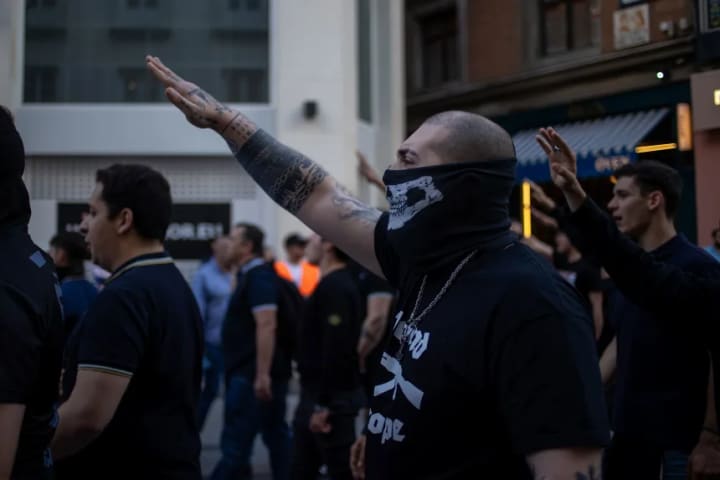
Those claims align with what we now understand about political communication in high-polarization environments repetition, identity cues, and simplified moral binaries outperform nuance; especially when fear is activated and the world is framed as existential threat.
This is not to say modern supporters are just Nazis, or that the United States is fated to replay the 1930s. It is to say that authoritarian persuasion has recurring tools, and the tools work best when a population is primed to accept hierarchy and to emotionally disengage from the suffering of designated “others” based on a visceral hatred of them; whether they admit it or not.
“They weren’t insane”?! what Nuremberg psychology adds
A common temptation in confronting mass political cruelty is to treat it as pathology to assume that only “crazy,” irrational, or psychologically broken people could endorse or excuse such behavior. This framing offers emotional distance and moral comfort: if the perpetrators or their supporters are aberrant, then the rest of society is absolved.
The Jewish Review of Books’ examination of psychological evaluations conducted during the Nuremberg trials disrupts that comfort. Psychologists such as Douglas Kelley and Gustave Gilbert found that many Nazi leaders were not clinically insane. They were cognitively intact, socially functional, and often highly intelligent. Their actions were not driven by psychosis, but by ideological commitment, social reinforcement, and what can be described as a profound moral reorganization; a restructuring of ethical boundaries that allowed cruelty to coexist with a stable self-image.
This distinction matters now. It reframes the central question away from intelligence, education, or mental health. The issue is not whether supporters are incapable of understanding facts or reality. The issue is whether a political culture can make harmful beliefs feel righteous, such that individuals can maintain a sense of decency while endorsing or excusing dehumanization.
That dynamic is visible in contemporary responses to revelations about Donald Trump’s inclusion in materials related to Jeffrey Epstein. For many supporters, the reaction is not moral reckoning but deflection. The most common responses are familiar: dismissal (“it doesn’t matter”), equivalence (“Democrats are in the files too”), or strategic silence. What is striking is not disagreement over evidence, but the absence of ethical engagement. The existence of sexual exploitation, abuse, and coercion—documented realities of Epstein’s operation is treated as secondary, irrelevant, or politically inconvenient.
This is moral disengagement at work; is the hatred of others that much more important to you that you still see yourself in a person like that. I understand how he originally rose to power…
Rather than confronting the implications of association with a system of abuse, supporters reframe the issue as partisan warfare. Responsibility is displaced (“others did it too”), diluted (“everyone is corrupt”), or nullified through tribal comparison. Crucially, what is not articulated often not even internally is an explicit acknowledgment that such crimes are intolerable regardless of political alignment. Silence functions as consent, not because supporters actively endorse abuse, but because acknowledging it would threaten the moral coherence of their identity and allegiance.
Here, the Nuremberg lesson becomes uncomfortably relevant. The psychologists did not find monsters detached from humanity; they found individuals who had learned to compartmentalize, to subordinate ethical judgment to ideological loyalty, and to redefine morality in ways that preserved self-regard. Evil did not require madness. It required permission socially, politically and psychologically to stop seeing certain harms as disqualifying.
In the Trump era, that permission is often granted through partisan moral relativism. When wrongdoing by a favored leader is reframed as acceptable because “the other side is worse,” the moral baseline collapses. Abuse becomes negotiable. Accountability becomes optional. The question shifts from Is this wrong? to Does this hurt my side?
What emerges is not ignorance, but ethical erosion. Supporters do not need to deny facts outright; they only need to deny their significance. In doing so, they preserve a self-concept of being reasonable, loyal, and pragmatic while quietly accepting conditions they would otherwise condemn.
The danger, as history shows, is not that people lose their capacity for moral judgment altogether. It is that moral judgment becomes selective, contingent on identity rather than principle. When loyalty overrides conscience, and power overrides protection of the vulnerable, cruelty no longer requires justification. It simply requires alignment.
That is the warning embedded in the Nuremberg psychologists’ findings and it is why contemporary political complicity cannot be dismissed as irrationality or ignorance. It is the product of systems that reward obedience, normalize disengagement, and teach people how to live comfortably with contradictions that should haunt them.
Policy consequence: the institutionalization of loyalty and force
Even if a reader wants to keep the conversation at the level of psychology, politics does not stay psychological. It becomes administrative.
And administration reaches into every dimension of daily life. Politics does not confine itself to elections or ideology; it governs material conditions. It shapes the cost of groceries and fuel, the price and availability of food staples such as eggs, the wages one can earn, and whether those wages are sufficient to pay rent or service debt. It determines access to employment, the ability to open and maintain a bank account, to secure credit, to own property, and to retain or forfeit the means of self-defense. It dictates what is taught in schools, what histories are emphasized or erased, what children are permitted to learn about themselves and others, and which resources are made available…or deliberately withheld from communities.
In this sense, politics is not optional, nor is it neutral. It operates regardless of one’s age, race, or willingness to engage with it. The only variable is visibility. Those most insulated from its consequences may experience politics as abstract or psychological; those most exposed encounter it as policy, enforcement, and constraint. To insist that politics remain “just psychological” is therefore a privilege afforded only to those whose lives are not routinely shaped by administrative decisions. Everyone else lives within the tangible outcomes of those decisions; outcomes that determine not only present survival, but which futures and dreams are considered legitimate, permissible, or worth protecting, unless a society prefers its citizens disengaged, compliant, and asleep.
The “Project 2025” ecosystem is one example of how ideological alignment can be translated into institutional power, a plan to reshape agencies, reclassify civil servants, and reduce internal resistance by replacing professional independence with loyalty. The House-hosted subject-by-subject breakdown explicitly describes “purging the civil service,” imposing “loyalty tests,” and “weaponizing the justice system” by ending independence of DOJ and FBI functions.
Separately, civil-rights advocates have warned that federal directives can weaken discrimination enforcement by deprioritizing disparate-impact approaches; effectively narrowing how civil-rights protections are applied. The through-line is not abstract, when institutions become instruments of grievance and punishment, targeted communities experience law not as protection but as exposure.
But I’m not into politics
The claim “I’m not really into politics” is not a neutral position; it is a declaration of insulation. It is made possible only when the most harmful consequences of policy economic precarity, legal vulnerability, restricted mobility, educational erasure, or bodily risk are experienced by someone else. Disengagement is not evidence of objectivity or balance, but of distance. To be able to treat politics as optional requires a degree of structural protection that shields one from its immediate effects. In the United States, that protection is unevenly distributed and historically concentrated among specific groups. What is often framed as apathy is, in practice, a failure of civic responsibility and, more critically, of moral imagination: an inability or unwillingness to recognize that decisions dismissed as “political” govern the lives, safety, and futures of others. To declare disinterest, then, is not to stand outside politics, but to quietly benefit from a system whose burdens fall elsewhere. By playing that card; you’ve already chosen a side.
When you're accustomed to privilege, equality feels like oppression; The ethical rupture
At a certain point, this stops being a debate about “policy preferences” and becomes a boundary about moral orientation.
I understand political disagreement. I do not understand watching human beings pulled from homes, hearing fear in the voices of families, and feeling nothing except satisfaction that the “right people” are being hurt. When a movement requires the public to ration empathy by race, origin, or proximity to power, it is not simply partisan. It is corrosive.
The familiar civil-rights principle, judge people by the content of their character, not by the color of their skin; has never been a sentimental slogan. It is a democratic requirement. When large numbers of citizens abandon it to preserve hierarchy, the costs are not confined to one group. They metastasize rights shrink, enforcement expands, and the nation’s moral language becomes unrecognizable.
Trump’s endurance is not best explained by misunderstanding. It is better explained by recognition many supporters see something in him they find affirming about dominance, immunity, and whose pain “counts.” Until that dynamic is named honestly, the country will keep prescribing “more facts” for what is, at its core, a crisis of identification and conscience.
And remember, whatever you allow your government to do to others, they will eventually do to you.
References
Black, W. I. (2025, November 24). Slave patrols by another name: Making america white again. DefenderNetwork.com. https://defendernetwork.com/news/national/ice-raids-modern-slave-patrols/
Adorno, T. W., Frenkel-Brunswik, E., Levinson, D. J., & Sanford, R. N. (1950). The authoritarian personality. Harper & Row.
Alexander, M. (2010). The New Jim Crow: Mass incarceration in the age of colorblindness. The New Press.
Arendt, H. (1951). The origins of totalitarianism. Harcourt, Brace & Company.
Bandura, A. (1999). Moral disengagement in the perpetration of inhumanities. Personality and Social Psychology Review, 3(3), 193–209.
Maccoby, M. (2000). Narcissistic leaders: The incredible pros, the inevitable cons. Harvard Business Review.
Sidanius, J., & Pratto, F. (1999). Social dominance: An intergroup theory of social hierarchy and oppression. Cambridge University Press.
Hitler, A., & Manheim, R. (1970, January 1). Mein Kampf : Manheim. Internet Archive. https://archive.org/details/in.ernet.dli.2015.54153
Project 2025 https://lofgren.house.gov/sites/evo-subsites/lofgren.house.gov/files/evo-media-document/Stop Project 2025 Task Force's Project 2025 Subject-by-Subject Breakdown_7.26.2024.docx-compressed.pdf
Fiedler, R. (2025). Project 2025: A blueprint for transforming Donald Trump’s ... PROJECT 2025: A BLUEPRINT FOR TRANSFORMING DONALD TRUMP’S ADMINISTRATION 2.0. https://www.jomswsge.com/pdf-215087-133805?filename=Project-2025--A-Blueprint.pdf
Nicholson, I. (2016). Psychologist of the Nazi mind. Monitor on psychology. https://www.apa.org/monitor/2016/05/nazi-mind
Singh, K. (2026). NAACP says Trump being deceptive about history after reverse discrimination remark | Reuters. NAACP says Trump being deceptive about history after reverse discrimination remark. https://www.reuters.com/world/us/naacp-says-trump-being-deceptive-about-history-after-reverse-discrimination-2026-01-13/
P news, A. (2026, January 14). Video shows ice raid on minneapolis home. AP News. https://apnews.com/video/video-shows-ice-raid-on-minneapolis-home-44638d6e81114b48add0ea981e77e56e?utm_source=chatgpt.com
Gedeon, J. (2025, April 24). Civil Rights Advocates Say Trump Order Guts protections against discrimination. The Guardian. https://www.theguardian.com/us-news/2025/apr/24/civil-rights-trump-order
Rothstein, A. (2016, November 5). Psychology at Nuremberg. Jewish Review of Books. https://jewishreviewofbooks.com/articles/2276/psychology-at-nuremberg/
About the Creator
Cadma
A sweetie pie with fire in her eyes
Instagram @CurlyCadma
TikTok @Cadmania
Www.YouTube.com/bittenappletv
Reader insights
Outstanding
Excellent work. Looking forward to reading more!
Top insights
Expert insights and opinions
Arguments were carefully researched and presented
Eye opening
Niche topic & fresh perspectives
Forgiveness Is Not a Prerequisite for Healing
There is a persistent cultural belief often framed as callow wisdom that forgiveness is necessary for healing. Survivors are told that to move forward, they must “let go,” “make peace,” or forgive those who have harmed them. This belief is not only inaccurate; for many survivors but it is also actively harmful.
By CadmaExclusive • about a month ago
Parallel Protests
I haven't written for quite some time, but I have A LOT of thoughts about yesterday's protest rally against our government's involvement and complicity in America's war on Iran, on the harbourside of my home city Bristol, and I need to put them somewhere. My gorgeous girlfriend is always a loving and listening ear and sharing it all with her will always be a healthy and happy way of processing the mental and emotional weight, but getting it straight in my brain to share means writing it all down in straight lines, so, here we are and thanks for being here.
By Steph Cole10 days ago in The Swamp
THE FREE PRESS
The $35 Sentence: How Predatory Hospice Schemes Silence Seniors By Vicki Lawana Trusselli For years, I worked in the film and music industries in LA and Austin—I know a script when I see one. But the script being handed to seniors in Riverside and other cities today is not just fiction; it is federal fraud.
By Vicki Lawana Trusselli 2 days ago in The Swamp
Worth the Wait: Puerto Viejo, Costa Rica
Beach bumming in a small Caribbean beach town sounded like a perfect way to end our 6-month trip through Mexico and Central America. Or so we thought. The foul, fishy stench of rotten seaweed hit our nostrils as we stepped from the cramped bus and looked out at a rather depressing, empty, and underwhelming black sand beach. It was pouring with rain, and we had to quickly fish out our ponchos. We thought, this couldn’t be it, could it?
By Sh*t Happens - Lost Girl Travel7 days ago in Wander



Comments (3)
Excellent write up, your bolder headlines are so crisp, and the article as a whole is absolutely accurate, Well said and I’m glad you said it
It’s funny but the phrases I never expected to hear in America were Just Doing My Job Papers? Well put together
This is brilliant. Very thought compelling. The incident with Renee Good just caused me to be righteously enraged. I had to step away from discussing it. Over the years, I've learned the hard way that some political debates aren't just pointless, they are bad for my soul. But I'm so easily drawn in. Especially because I have many old friends who support Trump. Genuinely good people who are brainwashed. I keep replaying arguments in my head and most are versions are "how can just justify ___?" It's pointless. And everything you mention rings true to me. I often talk to these old friends, particularly religious ones, about the Epstein files. Almost invariably what comes out of their mouth first is "Bill Clinton..." And the harder you press, the more you can just feel them squirming through IMs. They can't admit they are wrong. But that's a human thing. No one likes to admit they are wrong. Some will kill because they are convinced of their righteousness, like the current Administration. And 'we' they elected a 34-time convicted felon. If they can believe he's not guilty of all those crimes, they aren't going to believe any truths. We saw MAGA try to overthrow the government when Trump lost to Biden. They wanted to hang Mike Pence. And then they suckle on Fox News or Newsmax. I watch a lot of the late night comedians, Colbert and Kimmel especially. They simply play long clips of what Trump actually said and did. He comes across as an egotistical moron. It's astonishing how transparently narcissistic and vengeful he is. Right-wing propaganda 'news' never shows them Trump's daily ignorance. The ludicrous has been normalized. And young Republicans, men-- dudes amped up on testosterone and beer at keg parties-- they think its hilarious when he calls women "piggy" or flips off reporters or does things no President has ever done. MEANWHILE... it seems the left is riddled with "I'm not really into politics" into just so many different insidious ways. I loathe the electoral college. Ranks right up their with slavery and not allowing a woman to vote as one of our forefathers' worst ideas. It disenfranchises voters. I live in Indiana. Red Republican Red. My young Democrat friends say, "My vote doesn't matter." They claim to *be* Democrats but they are what helped to put Trump in office because they wouldn't vote. People didn't sit on their asses in the 1960s just because they thought their action didn't matter (which is what I told my 33-yr-old black gay friend, who still wouldn't vote.) And just this last week, in regards to Renee Good... A friend (in his 30s!) was saying he'd commented on FB about that horrible murder and a person on the left said he didn't go **far enough** by wishing ICE would die. He was like, "This is why I can't be a part of any political party." And I basically said the actions of extremist doesn't define an entire group/party... and that not allying himself made him an ally of Trump. I'm 64. I'm a progressive through and through. I totally understand why so many of the younger generation are so terribly disillusioned with politics. Totally. Get. It. But I argue that the solution is definitely not to distance themselves but to do exactly the opposite. Work within the system and change it. It's impossible to blow the whole thing up and start from scratch. And unneeded. The framework is there. It just takes Collective Intention to forge something new. Tax the rich. Feed the poor. Restore order. Limit the amount of $$ made by Congress and the Supreme Court. Embrace innovators like Zohran Mamdani and Corey Booker. Younger is actually better, IMO, when innovation is solely needed. Oh, and learn from the current situation, so maybe do away with Presidential Pardons. Amending the Constitution isn't easy but it could be fun! It's not been done since, what, the 1950s? 😉 I'm rambling. I thoroughly enjoyed this story. I was planning on writing my own story about recent events but I've gravitated to other stories: contest entries. I can't even watch TV right now because when they describe Renee Good as a domestic terrorist, it makes my blood burn. Blessings to You and Yours, Cadma. Captivating writing. ⚡ 💙 Bill ⚡