
Hydroponics Market Size & Forecast 2026–2034
Sustainable Farming Takes Root as Hydroponics Market Set to Reach US$ 16.9 Billion by 2034

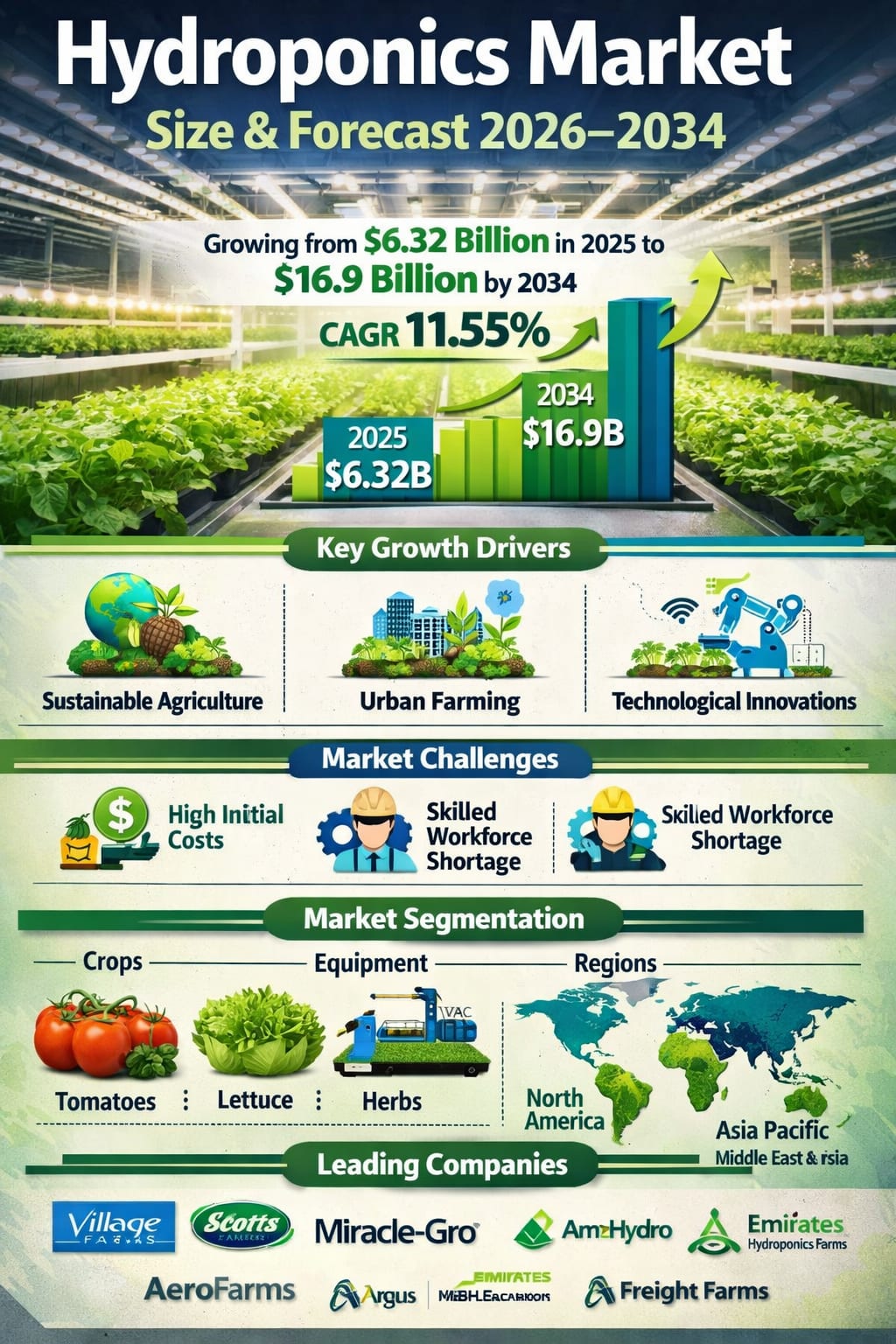
The global agricultural landscape is undergoing a quiet yet transformative revolution. As climate pressures intensify, arable land shrinks, and urban populations swell, hydroponics is emerging as one of the most promising solutions to ensure sustainable and resilient food production.
According to Renub Research, the Hydroponics Market is projected to grow from US$ 6.32 billion in 2025 to US$ 16.9 billion by 2034, expanding at a compound annual growth rate (CAGR) of 11.55% during 2026–2034. This strong trajectory reflects growing investments in controlled environment agriculture (CEA), technological advancements, and the global urgency to optimize water and resource use.
Hydroponics represents an advanced cultivation technique that eliminates soil from the equation. Instead, plants are grown in nutrient-rich water solutions, often supported by inert media such as coco coir, perlite, vermiculite, or rockwool. In some systems, roots are directly submerged in circulating water.
The advantages are compelling:
Faster plant growth
Higher yields per square meter
Reduced water consumption (up to 90% less than conventional farming)
Year-round production capability
Lower pesticide dependency
Hydroponics is widely used to cultivate vegetables, fruits, herbs, and specialty crops. As food security becomes a strategic priority worldwide, hydroponics offers a controlled, scalable, and climate-resilient alternative to soil-based farming.
Rising urbanization and climate volatility have amplified the need for localized food production systems. From rooftop farms to warehouse-based vertical facilities, hydroponics is redefining how and where food is grown.
Key Growth Drivers of the Global Hydroponics Market
1. Rising Demand for Sustainable and Resource-Efficient Agriculture
Traditional farming consumes vast amounts of water, land, and chemical inputs. With water scarcity intensifying across regions, hydroponics has gained attention as a highly water-efficient solution.
The system enables precise nutrient control, reducing fertilizer runoff and minimizing environmental pollution. Additionally, it supports year-round cultivation, mitigating seasonal disruptions and stabilizing supply chains.
Governments and institutions are increasingly promoting sustainable agricultural models. For example, in April 2025, the Ministry of Tourism, Economic Affairs, Transport, and Telecommunications (TEATT) launched the Hydroponics Train the Trainers Pilot Project in schools across Sint Maarten, supported by the European Union and Expertise France. The initiative aims to enhance food security and climate resilience through hydroponic installations.
As sustainability becomes central to agricultural policies, hydroponics is positioned as a key enabler of eco-friendly food production.
2. Rapid Urbanization and Growth of Controlled Environment Agriculture (CEA)
Urbanization is disconnecting food production from consumption centers. Megacities require fresh produce daily, yet transporting crops over long distances increases carbon emissions and reduces freshness.
Hydroponics supports controlled environment agriculture, enabling cultivation inside warehouses, greenhouses, and vertical farms located near urban consumers.
Key advantages include:
Standardized crop quality
Reduced exposure to pests and contaminants
Shorter supply chains
Fresher, locally grown produce
The integration of hydroponics with vertical farming and intelligent greenhouse systems has accelerated adoption. Consumers increasingly demand pesticide-free and locally grown food, further fueling growth.
3. Technological Advancements and Automation
Innovation has significantly enhanced hydroponics scalability and efficiency.
Modern systems incorporate:
LED grow lighting
Automated nutrient dosing systems
IoT-based climate monitoring
AI-driven crop optimization
Data analytics for yield prediction
Automation reduces labor dependency and human error while improving crop consistency.
In January 2025, Aerospring Hydroponics launched its second commercial farming project in Sharjah, UAE, aiming to increase yield per square meter by 400% while improving water efficiency. Such initiatives highlight the increasing role of agritech in transforming food systems.
As smart farming technologies become more affordable, hydroponics adoption is expected to expand across both small-scale and commercial operations.
Challenges in the Global Hydroponics Market
High Initial Capital Investment
Despite long-term profitability, hydroponic farms require substantial upfront investment. Infrastructure costs include:
Greenhouse or indoor facility construction
HVAC systems
LED lighting
Irrigation systems
Monitoring and automation equipment
Energy costs remain a major concern, particularly in regions with high electricity tariffs. Limited access to financing and insufficient subsidies can further hinder adoption, especially among small-scale farmers.
Technical Complexity and Skilled Workforce Shortage
Hydroponics demands precise management of pH levels, nutrient concentration, and environmental variables. Minor imbalances can significantly affect crop performance.
In developing markets, the lack of trained professionals and technical knowledge presents a barrier. The learning curve for transitioning from soil-based farming to hydroponics can be steep, limiting widespread adoption.
Segment Insights
Aggregate Systems Market
Aggregate hydroponic systems use inert growing media such as perlite, coco coir, and expanded clay pellets to support plant roots. These systems provide enhanced oxygenation and nutrient control.
They are widely used for high-value crops such as tomatoes, cucumbers, peppers, and strawberries. Eco-friendly substrates like coco coir are gaining traction due to sustainability considerations.
The rising popularity of greenhouse farming globally is strengthening the aggregate systems segment.
Tomatoes Hydroponics Market
Tomatoes represent one of the most commercially successful hydroponic crops. Rising global demand for fresh, high-quality tomatoes supports market expansion.
Hydroponic cultivation ensures consistent quality regardless of climate conditions. Reduced pest exposure and optimized water usage enhance productivity.
Urban vertical farms and greenhouse operators increasingly rely on hydroponic tomato production to meet year-round demand.
Hydroponics HVAC Equipment Market
Climate control is crucial in hydroponic farming. HVAC systems regulate temperature, humidity, and airflow to maintain optimal plant growth conditions.
The expansion of indoor and vertical farming facilities has increased demand for energy-efficient HVAC systems equipped with advanced sensors and automation features.
As hydroponics grows in regions with extreme climatic conditions, HVAC solutions remain central to operational success.
Hydroponics Irrigation Systems Market
Efficient irrigation systems ensure optimal nutrient delivery and water conservation. Automated drip and recirculation systems improve crop yield while minimizing waste.
With global water scarcity intensifying, hydroponic irrigation systems are becoming essential for sustainable production.
Regional Insights
United States Hydroponics Market
The U.S. hydroponics market is maturing rapidly. Commercial growers and retailers are scaling indoor and greenhouse operations to meet year-round demand.
Investments in automation, LED lighting, and climate control technologies are improving yield per square foot. Retailer partnerships and direct-to-consumer models are expanding.
In November 2024, GrowGeneration Corp introduced three new premium product lines across lighting, accessories, and growing media for indoor and greenhouse hydroponics.
Despite challenges such as energy costs and capital intensity, consolidation and technological integration are shaping the market’s evolution.
United Kingdom Hydroponics Market
The UK’s reliance on food imports and growing focus on urban food security are driving hydroponics adoption.
In February 2025, the European Union approved hydroponic farming methods for organic product certification. This regulatory shift created new opportunities for hydroponics technology providers.
Urban greenhouse farms are supplying lettuce, herbs, and vegetables year-round, reducing seasonal dependence.
India Hydroponics Market
India’s hydroponics market is in an early growth stage but holds significant potential. Rapid urbanization, shrinking farmland near cities, and water scarcity support future expansion.
In December 2024, the Indian Government proposed including hydroponics, aquaponics, vertical farming, and precision farming under the MIDH list, with revised operational guidelines and a reported 20% cost increment—the first amendment since 2014.
Startups and educational institutions are experimenting with hydroponics projects, signaling long-term opportunity.
Saudi Arabia Hydroponics Market
Saudi Arabia’s arid climate and limited arable land make hydroponics strategically important. Government-backed initiatives promote protected cultivation to enhance food security.
In May 2025, Saudi agritech startup Arable secured US$ 2.55 million in seed funding to scale hydroponic systems designed for arid environments.
While energy consumption and cooling costs pose challenges, investment momentum remains strong.
Market Segmentation
By Type:
Aggregate Systems
Liquid Systems
By Crops:
Tomatoes
Herbs
Lettuce
Cucumbers
Peppers
Others
By Equipment:
HVAC
LED Grow Light
Irrigation Systems
Material Handling
Control Systems
Others
By Region:
North America, Europe, Asia Pacific, Latin America, Middle East & Africa
Competitive Landscape
Major companies operating in the hydroponics market include:
Village Farms International Inc.
Scotts-Miracle-Gro
AeroFarms
AmHydro
Argus Control Systems Limited
Emirates Hydroponics Farms
Freight Farms Inc.
BrightFarms
Each company is analyzed across five viewpoints: Overview, Key Persons, Recent Developments & Strategies, Product Portfolio, Financial Insights, and Company Analysis.
Final Thoughts
The hydroponics market is entering a dynamic growth phase, driven by sustainability imperatives, urbanization, and technological breakthroughs. With projected revenues reaching US$ 16.9 billion by 2034, hydroponics is transitioning from niche experimentation to mainstream agricultural infrastructure.
While capital intensity and technical complexity remain hurdles, supportive government policies, rising private investments, and consumer demand for fresh, pesticide-free produce are expected to sustain long-term momentum.
About the Creator
Parallel Protests
I haven't written for quite some time, but I have A LOT of thoughts about yesterday's protest rally against our government's involvement and complicity in America's war on Iran, on the harbourside of my home city Bristol, and I need to put them somewhere. My gorgeous girlfriend is always a loving and listening ear and sharing it all with her will always be a healthy and happy way of processing the mental and emotional weight, but getting it straight in my brain to share means writing it all down in straight lines, so, here we are and thanks for being here.
By Steph Cole6 days ago in The Swamp
Trump Assembles a New Coalition to ‘Eradicate’ Cartels
In the evolving landscape of American politics and national security, former U.S. President Donald Trump has once again ignited debate with a bold proposal: forming a new coalition aimed at “eradicating” powerful drug cartels operating across the Americas. The initiative, framed as a comprehensive strategy to combat organized crime and drug trafficking, has stirred support among allies and raised significant questions among critics about its feasibility, legality, and long-term implications.
By Jameel Jamalia day ago in The Swamp




Comments
There are no comments for this story
Be the first to respond and start the conversation.