
How can anyone govern when opinion is so diverse
Are humans suitable for government


How can anyone govern when opinion is so diverse
Are humans suitable for government.
Population levels in nearly every nation are at their highest ever level. The colossal numbers involved and the diversity of opinion because we now have universal education and media saturation, has made the doctrine that numbers of apparent supporters is a valid reason for control, into a distortion of democracy.
Firstly, establishing the number of supporters- other than through a safe and secure ballot where the individual vote is secret- cannot be left to the “supported” people to claim. Even then there is often some dispute. This can be because the total vote for a political party is not reflected in the number of elected candidates, this can happen especially in the British parliamentary system, where, officially, constituencies vote in a person to parliament they then joins with others to elect a government. In practice the party-political system means that those who will form a government also control who the party supports in each constituency, so if the party wins the most constituencies everyone knows who will form the chosen government.
Secondly, support for one aspect of a political policy or religious creed, does not mean there is the same support for all aspects of all policies.
Thirdly, support for a policy does not mean support for enforcement of that policy on every person on the nation.
Both political parties and organised religions- those with human leadership that seek to impose rules about what humans may do or not do.—Have multiple policies covering every aspect of life. Political parties have (Apparent) belief systems covering environment and science, social behaviour, relationship with other nations, they have ideologies about economics and even interpersonal relationships. They have layer upon layer of variations to cover every aspect of life. All humans, even politician and political activists, have views, opinions and understandings of this myriad of concepts. Given the individuality of every one of the billions of humans and the sheer number of opinions each one will hold, it is very unlikely that every member of a political party ( or follower of a religious teaching) will agree with every single aspect of the policy being established in their “name.”
This is where the leaders of fascist and communist types of organisations start to try and impose their own opinions on all the followers and demand every person agreed with every aspect and nuance of those opinions. They then move to imposition of those opinions on every resident in the nation. Variation and differences of opinion are not allowed, In political governance purges of any and all dissenters are carried out. In religious movements, heretics are declared and punished. In both cases this can be for relatively minor differences of opinion.
Democracy is basically, government by elected people that is; they are elected by all the adult population via free fair and secret ballots. The problem is that there are such a huge range of opinions on a huge range of subjects, as to what the rules should be. So, a voter may agree with the stated policy of party A on say environment, but agree with party B on say defence, and party C on the education for the young, and party D on say energy security, and even party E on religious freedoms. This gets further complicated by the fact that whatever the stated policy is; on any aspect of life, when it comes to turning that policy into actual physical reality, the politicians do not and never will have, compete control over everything. The money may not be there to pay for the chosen policy, the interaction with other nations may make the policy dangerous to enact. The time scale may be such that the government will change before realisation of the objective.
There is also, sadly increasing dishonesty among politicians. So, few are what is termed “conviction politicians” and most are “career politicians” and to this later group, getting elected, achieving power, is far more important than having the majority support them. The use of spin, a political devise we used to call deceit, had become so common it is acceptable by default, everyone expects it, and so it is tolerated. In democratic elections firm promises during election campaigns become aims or objectives once elected. The claim is they did not know how bad, for example, the economy, was until they came to power. Since it is very rare that a party comes to power without having had periods in opposition, this is not totally honest. Even in opposition in a democracy they will have had day to day communication with both the governing party and the state bureaucracy, they will have had access to information, and they certainly had media informants, so they did know or certainly should have known, all there was to know. How could they honestly oppose a policy if they did not know all there was to know about it?
So, what do we do about it? How do we get truly democratic government? How do we get honest politicians who will tell the truth during election campaigns? How do we get governments that reflect the majority view on every aspect of life- going back to a previous example how do we get a government which will enact policy of party A on say environment, party B on say defence, and party C on the education for the young, and party D on say energy security, and even party E on religious freedoms.
The obvious first step is making all elections, at every level of administration, and all referendums, honest. That is only those with a right to vote do vote and they cast their votes without duress and the way they vote is not known to anyone else ever. There must be a way to sanction politicians who win elections based on deceit. May be less bias and more honesty in the media but not holding my breath on that. Could education of the people to be more aware and conscious of the true aims and policies of career politicians help? Depends how open and un-biased the educators are. Maybe a rule to ensure elected politicians have some experience of the lives of those they wish to govern, that only those who have been in employment that is not politically based, for say 5 years of their life, can stand for election. The very much increased use of national and local referendums may also help. May be after a general election the party who gain power is declared a provisional government and they only have 1 year before some sort of public approval must be given before they can complete a full term of office.
About the Creator
Peter Rose
Collections of "my" vocal essays with additions, are available as printed books ASIN 197680615 and 1980878536 also some fictional works and some e books available at Amazon;-
amazon.com/author/healthandfunpeterrose
.
Keep reading
More stories from Peter Rose and writers in The Swamp and other communities.
Thoughts on racism and world problems 2025
Thoughts on racism and world problems 2025 A personal appraisal of social problems worldwide I am by birth and ancestry, a white British male. I do not consider any person inferior to myself because of skin colour, racial origins, intellectual ability, gender, physical ability or age. I am happy with a doctor of Asian English background I vote for a lady of Asian English heritage. I shop at places owned by devote Muslims, I only care about the personality and integrity of the person I interrelate to.
By Peter Roseabout a year ago in The Swamp
A Gathering of Evil Bosses
“I’m the queen of chin jutting while I smooth my hair, attacking, insulting, and deflecting to protect my appointer.” “Oh, please, Blondi, my hair is curled, highlighted, and longer than yours. I feature television commercials telling immigrants that we will give them a free plane ride home, and if they voluntarily turn themselves in, they will be allowed to legally apply for re-entry. It runs everywhere, and I look good in it! You can’t compete because of your blond hair. Mine is nicer, and my lips are prettier than yours.”
By Andrea Corwin 10 days ago in The Swamp
UN’s Türk Urges Dialogue After Deadly Clashes on Afghan-Pakistan Border
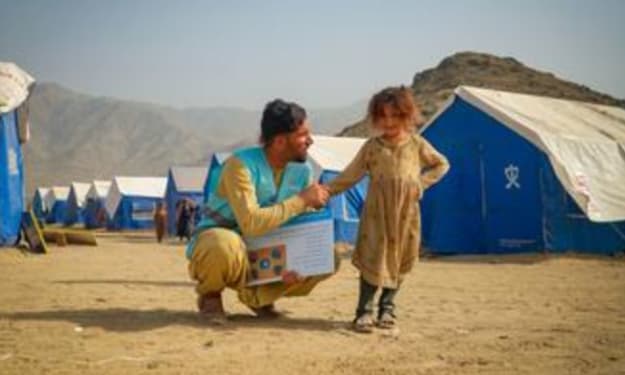
Deadly clashes along the volatile border between Afghanistan and Pakistan have once again exposed the fragility of regional stability, prompting urgent calls for restraint and diplomacy. Volker Türk, the United Nations High Commissioner for Human Rights, has urged both sides to engage in meaningful dialogue, warning that continued violence risks escalating tensions and worsening humanitarian conditions for civilians living in the conflict zone.
By Jameel Jamali2 days ago in The Swamp



Comments
There are no comments for this story
Be the first to respond and start the conversation.