
House Passes SAVE America Act, Sending Trump-Backed Election Reform Bill to the Senate
The SAVE America Act clears the House in a narrow vote, setting up a high-stakes Senate showdown over voter ID laws, proof of citizenship, and federal election rules.

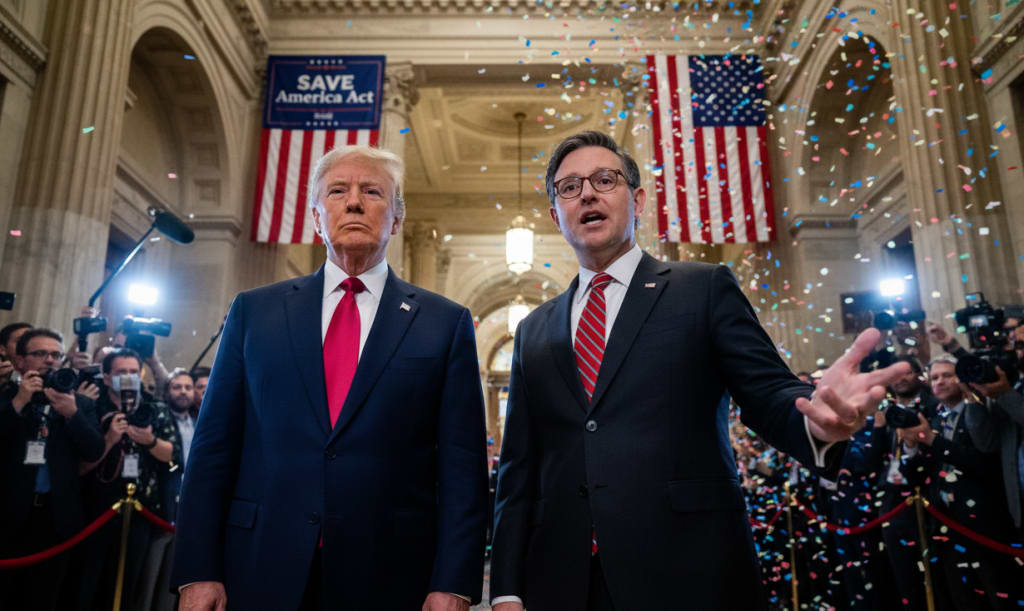
In a closely divided vote, the U.S. House of Representatives has passed the SAVE America Act — a Trump-backed election reform bill that would impose new nationwide standards for federal elections. The legislation now heads to the Senate, where it faces an uncertain future amid intense partisan disagreement.
The SAVE America Act (Safeguard American Voter Eligibility Act) aims to tighten voter registration requirements and strengthen identity verification rules across all 50 states. Supporters argue it is a necessary step to protect election integrity and restore public confidence. Critics warn it could create new barriers for eligible voters and expand federal authority over state-run elections.
With the House vote complete, the national debate over voting rights and election security has entered a new phase.
________________________________________
What Is the SAVE America Act?
At its core, the SAVE America Act would require stricter documentation for voter registration and mandatory photo identification for voting in federal elections.
While states currently set many of their own election procedures, this bill would establish uniform federal standards for federal races — including presidential and congressional elections.
The legislation is backed by former President Donald Trump and House Republican leadership, who frame it as a safeguard against voter fraud and unlawful participation in elections.
Opponents counter that non-citizen voting in federal elections is already illegal and rare, and they argue the proposed changes could disenfranchise lawful voters.
________________________________________
Key Provisions of the SAVE America Act
The bill contains several major components that would significantly reshape federal election procedures.
1. Proof of U.S. Citizenship to Register
Under the proposed law, individuals would need to provide documentary proof of U.S. citizenship when registering to vote in federal elections.
Acceptable documents may include:
• A valid U.S. passport
• A certified birth certificate
• Naturalization documents
• Other federal documentation verifying citizenship
States would be restricted from accepting voter registrations without this proof.
Supporters say this ensures that only U.S. citizens are added to voter rolls. Critics argue that millions of eligible Americans do not have immediate access to such documents.
________________________________________
2. Mandatory Photo ID at the Polls
The SAVE America Act would also require voters to present a valid government-issued photo ID before casting a ballot in federal elections.
While many states already enforce some form of voter ID law, this measure would standardize the requirement nationwide.
Backers say photo ID laws are widely supported in public opinion polls and help increase confidence in election outcomes.
Opponents argue that strict ID requirements disproportionately affect low-income voters, elderly citizens, students, and individuals living in rural areas.
________________________________________
3. Voter Roll Verification Measures
The legislation requires states to take “affirmative steps” to verify citizenship status on voter rolls. This may involve:
• Cross-checking federal databases
• Sharing registration data with the Department of Homeland Security
• Conducting audits to remove ineligible registrants
While supporters describe this as a proactive safeguard, privacy advocates have raised concerns about increased data sharing and the protection of sensitive personal information.
________________________________________
4. Legal Accountability and Penalties
The bill would allow private citizens to sue election officials who register individuals without proper citizenship documentation.
It also establishes criminal penalties for knowingly registering ineligible voters.
Proponents argue this strengthens enforcement. Critics warn it could expose election officials to politically motivated lawsuits and complicate administration.
________________________________________
How the House Vote Unfolded
The SAVE America Act passed the House by a narrow 218–213 vote.
• All Republicans present voted in favor.
• Nearly all Democrats voted against it.
• One Democrat crossed party lines in support.
The party-line split underscores how deeply divided Congress remains on election reform.
House Republicans described the vote as a decisive move to protect federal elections. Democrats characterized it as an unnecessary measure that could suppress voter participation.
________________________________________
Supporters Say It’s About Election Integrity
Backers of the SAVE America Act argue the legislation strengthens public trust in American elections.
They emphasize:
• Ensuring only citizens vote
• Creating consistent national standards
• Preventing potential administrative loopholes
• Reinforcing confidence after contentious election cycles
Republican leaders argue that uniform federal standards prevent inconsistencies between states that could undermine confidence.
For many supporters, the bill reflects broader concerns about election security and transparency.
________________________________________
Critics Warn of Voter Disenfranchisement
Opponents argue the SAVE America Act could make voting harder for millions of eligible citizens.
Access to Documents
Studies suggest that tens of millions of Americans do not possess a passport. Others may not have immediate access to certified birth certificates, especially if records were lost or never formally issued.
Obtaining documentation can require time, fees, and travel — barriers that critics say could discourage participation.
Impact on Married Women and Name Changes
Advocates also note that married women and others who have legally changed their names may face complications if identification documents do not perfectly match older records.
Federal vs. State Authority
The Constitution grants states primary authority to administer elections. Opponents argue that imposing federal mandates disrupts long-standing state control and could create logistical challenges for election offices.
Privacy Concerns
Data-sharing requirements between states and federal agencies have prompted concerns about cybersecurity and the safeguarding of personal information.
________________________________________
What Happens in the Senate?
The bill now moves to the Senate, where its path forward is uncertain.
To advance, most legislation must overcome a 60-vote threshold to end debate — meaning bipartisan support would likely be required.
Given strong Democratic opposition and hesitancy among some moderates, the SAVE America Act faces significant hurdles.
Some Republican lawmakers have floated procedural strategies to lower the threshold, but such moves would themselves spark controversy.
For now, the Senate vote represents the next major battleground in the debate over federal election reform.
________________________________________
National Reaction and Political Impact
The SAVE America Act has ignited debate nationwide.
Election Officials
Local election administrators warn that implementing new documentation requirements across all states would demand significant funding, updated systems, and training.
Community Response
Public reaction is sharply divided. Some voters support stricter identification laws as common-sense protections. Others fear that increased documentation requirements could discourage participation among marginalized communities.
Political Consequences
The bill’s movement could shape campaign messaging ahead of upcoming elections. Election integrity and voting access remain powerful political issues that resonate deeply with voters.
________________________________________
The Bigger Question: Security vs. Access
At the heart of the SAVE America Act debate lies a fundamental question:
How should the United States balance election security with broad voter access?
Supporters argue that clear documentation rules strengthen the system. Critics maintain that accessibility is equally essential to democracy.
The answer will likely define the future of federal election policy.
________________________________________
Final Thoughts
The House passage of the SAVE America Act marks a significant moment in the ongoing national debate over voter ID laws, proof of citizenship requirements, and federal election reform.
With its narrow House approval, the bill now faces a challenging Senate battle that could determine whether it becomes law.
Supporters view it as a safeguard for election integrity. Opponents see it as a potential barrier to participation.
As the legislation moves forward, the discussion will continue to center on one of the most fundamental pillars of American democracy — the right to vote and how it is protected.
About the Creator
Adil Ali Khan
I’m a passionate writer who loves exploring trending news topics, sharing insights, and keeping readers updated on what’s happening around the world.
Keep reading
More stories from Adil Ali Khan and writers in The Swamp and other communities.
Trump Named in Epstein Files? Raskin’s “Million Mentions” Claim Sparks Political and Media Firestorm
A new political controversy has erupted after Representative Jamie Raskin alleged that former President Donald Trump appears “more than a million times” in unredacted files connected to Jeffrey Epstein. The striking claim has quickly gained traction across major media platforms, social media feeds, and late-night television shows — raising questions about transparency, political rhetoric, and the ongoing public fascination with the Epstein case.
By Adil Ali Khan3 days ago in The Swamp
Why Black History Matters in America?
The United States of America is celebrating their 250th anniversary in 2026. I'm proud to be an American and as someone who was born here, I wouldn't imagine myself living anywhere else. This is a country where opportunities are possible. Where anyone can be successful in anything they desire to do. Equality, community, and togetherness are the backbones of what America is and should be about. However, we have an administration who wants to erase and disregard those who have made positive, meaningful impacts in our country, specifically Black figures, such as Martin Luther King, Jr., Rosa Parks, and Maya Angelou. President Trump and his administration have been constantly complaining and fighting against what they call the "Woke agenda". They use this excuse as a distraction from other issues they refuse to address, such as the high cost of living, climate change, and inflation. That equality is dividing America, when in reality, it's bringing us together. Being woke is not tied to a specific political party. No matter where you stand on the political spectrum, you can still care about other people and their plights. Compassion and empathy for others isn't tied to a political party, either. We were taught as children to treat others the way we want to be treated and not judge others because they're different from us. Caring about others isn't a personal attack on your beliefs. It doesn't make you any less of a person. People who are easily offended over African American figures, past or present, or anything related to it, are grasping at straws. Current and future generations need to know who people like Harriet Tubman and Shirley Chisholm were, especially in the classroom. Black History is part of American History. It should be recognized, not hidden or forgotten. Besides, you can't shield children from everything, just because your feelings are easily hurt.
By Mark Wesley Pritchard 13 days ago in The Swamp
Telegram Is Reportedly Being Slowed and Restricted in Russia
In recent days, Telegram — one of the world’s most widely used messaging platforms — has reportedly been slowed and restricted in Russia, prompting concern among millions of users. The Russian communications regulator, Roskomnadzor, has been throttling Telegram’s network traffic, affecting media uploads, downloads, and the smooth operation of voice and video messages. While text messaging continues to work, the degraded performance has left many users frustrated. This is part of a broader effort by Russian authorities to tighten control over foreign technology platforms and push citizens toward government-backed alternatives. For Telegram users in Russia, this has significant implications for daily communication, business operations, and access to news. What Exactly Is Happening? Reports indicate that Telegram’s functionality has slowed significantly across Russia. Media-heavy features such as voice messages, videos, and large file transfers are experiencing delays, while connections often drop intermittently. Users have noted that group chats and channels that rely on fast updates have become less reliable. The slowdown appears to be a deliberate measure by Roskomnadzor, citing Telegram’s alleged non-compliance with Russian laws, including content regulation and data localization requirements. However, no official security threat has been publicly disclosed. This partial throttling means that Telegram is still accessible but its performance is noticeably hindered. Why Russia Is Targeting Telegram Russia’s authorities claim that Telegram has failed to comply with multiple legal requirements: Removing content flagged by authorities Hosting user data on Russian servers Preventing misuse of the platform for criminal or extremist activity The Kremlin has also been promoting “digital sovereignty,” encouraging the use of state-backed messaging platforms. Telegram’s refusal to fully comply with local laws makes it a prime target for regulation, as the government seeks greater control over online communication. Telegram’s founder, Pavel Durov, has criticized these measures, arguing that they violate privacy and freedom of expression while attempting to force users into government-supervised alternatives. Historical Context: Telegram and Russia Telegram has faced Russian restrictions before. In 2018, the platform was temporarily banned for failing to provide encryption keys to authorities, only for the ban to be lifted later due to widespread public disruption. In 2025, Russia also imposed partial restrictions on voice and video messaging. These recurring measures highlight a broader pattern: Russian regulators increasingly control foreign platforms through fines, throttling, or outright bans, often citing security, compliance, or national legislation. Telegram’s current slowdown is the latest example in a decade-long tension between the platform and Russian authorities. Impact on Users The restrictions have multiple consequences for Russian Telegram users: 1. Disrupted Communication Slower media uploads and downloads affect how users share photos, videos, and voice messages. Large group chats and public channels face delays, reducing their reliability for real-time communication. 2. Reduced Access to Information Telegram channels are widely used as news sources. Throttling media-rich content hampers the app’s role as a source of updates and public information, particularly in regions with restricted press freedom. 3. Adoption of VPNs Many users are turning to VPNs or proxy services to bypass the throttling, illustrating both the demand for unrestricted access and the limitations of government-imposed restrictions. 4. Shift Toward State-Backed Apps Russia is encouraging the adoption of its government-backed messaging platform, Max, raising concerns over privacy, surveillance, and state control. International Reactions Human rights organizations, including Amnesty International, have criticized the throttling as a restriction on freedom of expression. Limiting Telegram’s performance undermines digital rights and the ability of citizens to communicate privately and securely. Globally, the situation in Russia raises questions about the future of encrypted messaging and the balance between government oversight and personal privacy. Telegram’s challenges could set a precedent affecting other countries’ regulatory approaches to tech platforms. What Comes Next for Telegram? Telegram continues to function in Russia, but the future remains uncertain. Possible scenarios include: Further throttling or partial blocking of the platform New fines or legal actions against the company Full bans if compliance is not achieved Increased use of VPNs by users to bypass restrictions The platform’s commitment to privacy and free communication will continue to be tested as Russian authorities tighten regulatory controls. Users, both inside and outside Russia, will likely monitor the situation closely to see how it evolves. Conclusion Russia’s throttling of Telegram highlights a growing global tension between government control and digital freedom. While users in Russia still have access to the platform, its performance degradation affects daily communication, business activities, and access to news. For the international community, the Telegram situation serves as a reminder of the challenges facing encrypted communication in countries with strict online regulations. It also underscores the ongoing struggle between user privacy, freedom of expression, and government oversight in the digital age. As Telegram navigates these challenges, the resilience of both the platform and its users will be critical. For now, Russian users are adapting with workarounds, while the world watches closely to see if more severe restrictions are coming next.
By Ayesha Lashari4 days ago in The Swamp




Comments
There are no comments for this story
Be the first to respond and start the conversation.