
Gold Continues to Surge: JPMorgan Sees a Scenario Where It Tops $8,000
Central bank buying, geopolitical risk, and a shifting global monetary order fuel bold long-term forecasts for the precious metal

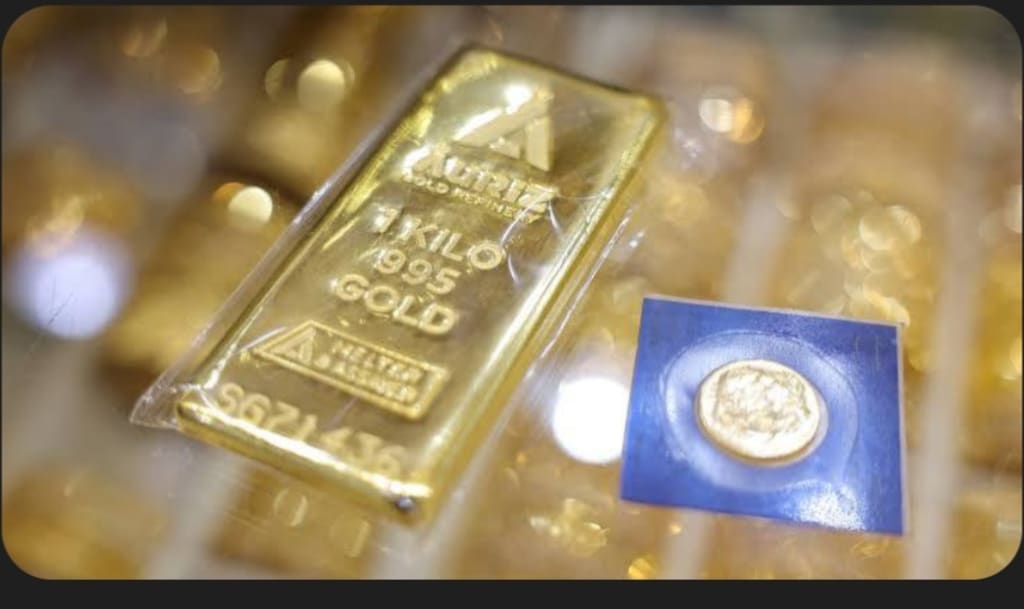
Gold’s relentless rise has reignited one of the oldest debates in financial markets: how high can the world’s most trusted store of value really go? As prices continue to climb, analysts at JPMorgan have outlined an extreme but plausible long-term scenario in which gold could surge beyond $8,000 per ounce, a level that would once have seemed unthinkable.
While such a price target is not JPMorgan’s base case, the very fact that it is being discussed reflects how profoundly global economic and geopolitical dynamics are shifting — and how central gold has become to those changes.
---
Gold’s Strong Momentum
Gold has been on a powerful upward trajectory, supported by a combination of macroeconomic uncertainty, persistent geopolitical tensions, and strong institutional demand. In recent years, the metal has repeatedly defied expectations, holding firm even during periods of rising interest rates — a time when gold traditionally struggles.
This resilience has forced major banks and investors to reassess long-held assumptions about gold’s role in modern portfolios. JPMorgan’s analysis suggests that under certain conditions, gold could enter a super-cycle, driven less by short-term speculation and more by structural changes in the global financial system.
---
Why JPMorgan Sees an $8,000 Scenario
JPMorgan’s $8,000 outlook is not a near-term forecast but a stress-test scenario built around extreme, yet increasingly discussed, developments in the global economy.
At the heart of this scenario is accelerated de-dollarization. If confidence in the U.S. dollar were to weaken significantly — due to rising debt levels, persistent fiscal deficits, or geopolitical fragmentation — demand for alternative reserve assets could surge. Gold, with no counterparty risk and universal acceptance, would be a natural beneficiary.
The bank also points to massive central bank gold accumulation as a key driver. In recent years, central banks, particularly in emerging markets, have been buying gold at record levels. If this trend were to intensify — for example, if major economies sought to reduce reliance on dollar-denominated reserves — gold prices could reprice dramatically higher.
---
Central Banks: The Quiet Force Behind Gold
One of the most important structural shifts in the gold market has been the behavior of central banks. Unlike speculative investors, central banks tend to buy gold with long time horizons and little sensitivity to short-term price movements.
This steady demand has created a strong underlying floor for prices. JPMorgan notes that if central banks were to raise gold’s share of total reserves meaningfully — even by a few percentage points — the impact on prices could be enormous, given the relatively limited supply of above-ground gold.
In an extreme scenario where gold regains a much larger role in the global monetary system, prices would need to rise substantially to accommodate that demand.
---
Inflation, Debt, and Monetary Credibility
Another pillar of JPMorgan’s bullish framework is the long-term outlook for inflation and government debt. While inflation may cool cyclically, many analysts believe the world has entered a period of structurally higher price pressures due to deglobalization, energy transition costs, and demographic shifts.
At the same time, government debt levels across advanced economies continue to rise. Servicing that debt without financial repression or currency debasement may prove difficult. Historically, gold has performed best in environments where trust in monetary discipline erodes.
In a scenario where investors lose confidence in fiat currencies as reliable stores of value, gold’s appeal could increase exponentially — pushing prices into territory once considered unrealistic.
---
Geopolitics and the Fragmentation of Finance
Geopolitical risk has become a persistent feature of the global landscape rather than a temporary disruption. Sanctions, trade wars, and regional conflicts have accelerated the fragmentation of global finance.
JPMorgan highlights that countries seeking to insulate themselves from financial sanctions may increasingly turn to gold, which exists outside the traditional banking system. If this trend accelerates, gold could shift from a portfolio diversifier to a core strategic asset for nations and institutions alike.
Such a transformation would require a dramatic repricing of gold to reflect its expanded role.
---
What $8,000 Gold Would Mean
A gold price above $8,000 would have profound implications:
Currencies: It would likely signal a significant loss of confidence in major fiat currencies.
Markets: Equity and bond markets could face prolonged volatility as investors reassess risk.
Wealth Preservation: Gold would dramatically outperform most traditional assets, reshaping portfolio strategies.
Mining Industry: Higher prices would unlock previously uneconomic reserves but would also bring political and regulatory scrutiny.
However, such a scenario would almost certainly be accompanied by global economic stress — making it less a cause for celebration than a warning signal.
---
Is $8,000 Gold Likely?
It’s important to stress that JPMorgan does not see $8,000 as a base-case outcome. Rather, it represents a tail-risk scenario — one that becomes possible only if multiple extreme factors converge: rapid de-dollarization, surging central bank demand, persistent inflation, and deep geopolitical fragmentation.
More moderate forecasts still see gold benefiting from lower real interest rates, ongoing central bank purchases, and investor demand for hedges. Even without extreme outcomes, many analysts believe gold has room to move higher over the long term.
---
The Bigger Picture
The discussion of $8,000 gold reflects something deeper than a price target. It signals a growing recognition that the global financial order is evolving, and that gold’s role within it may be expanding.
As JPMorgan’s analysis suggests, gold is no longer just a hedge against inflation or market volatility. In a world marked by rising debt, geopolitical uncertainty, and questions over monetary credibility, gold is increasingly viewed as a form of financial insurance against systemic change.
Whether or not gold ever reaches $8,000, its continued surge underscores a simple truth: when confidence in the system wavers, gold’s relevance — and value — tends to rise.
About the Creator
Keep reading
More stories from Salaar Jamali and writers in The Swamp and other communities.
Aoun’s Tightrope: Daily Israeli Attacks and Hezbollah’s Refusal to Disarm
Lebanon’s President Joseph Aoun is walking an increasingly perilous political tightrope. On one side are near-daily Israeli attacks along the southern border, threatening to escalate into a wider conflict. On the other is Hezbollah’s firm refusal to disarm, a stance rooted in decades of resistance ideology and regional power dynamics. Caught between external military pressure and internal political realities, Aoun must navigate a crisis that tests Lebanon’s fragile sovereignty, unity, and future stability.
By Salaar Jamalia day ago in The Swamp
"UK Introduces Major Police Reform: 'British FBI' to Oversee Terrorism and Fraud Investigations"
Introduction The United Kingdom has recently announced a sweeping overhaul of its law enforcement structure, with a bold initiative aimed at tackling terrorism and fraud more effectively. As part of the reforms, a new national agency—often referred to as the ‘British FBI’—will take on the responsibility of leading investigations into these complex and high-stakes crimes. This move marks a significant shift in how the UK addresses national security threats, organized crime, and financial fraud.
By Ayesha Lashari6 days ago in The Swamp
“Storm on Ice: Why the U.S. Deployment of ICE Agents to the Winter Olympics Has Sparked Italian Fury”
the 2026 Winter Olympics in Milan and Cortina d’Ampezzo draw near, an unexpected diplomatic storm has erupted — not over medals or weather, but over the proposed involvement of U.S. federal agents from Immigration and Customs Enforcement (ICE) in security operations on Italian soil. What began as a technical announcement of logistical support has swiftly spiraled into one of the most contentious pre‑Games controversies yet, triggering sharp criticism from political leaders, civil society, and ordinary Italians who see the move as deeply incompatible with Italian values and Olympic ideals. �
By Ayesha Lashari3 days ago in The Swamp




Comments
There are no comments for this story
Be the first to respond and start the conversation.