
Global Submersible Pumps Market Poised for Steady Growth as Water, Energy, and Infrastructure Demands Rise
Market Expected to Reach US$ 20.17 Billion by 2033, Driven by Urbanization, Agriculture, and Industrial Expansion


Global Submersible Pumps Market Outlook
The Global Submersible Pumps Market is entering a decade of sustained growth, supported by rising global demand for water management, agricultural irrigation, and industrial dewatering solutions. According to Renub Research, the market is projected to grow from US$ 12.88 billion in 2024 to US$ 20.17 billion by 2033, expanding at a CAGR of 5.11% during 2025–2033.
Submersible pumps are uniquely designed to operate while fully immersed in the fluid they are pumping. Unlike surface pumps, which pull water upward, submersible pumps push fluid to the surface, making them significantly more energy efficient. Their sealed motor design prevents water ingress, reducing the risk of mechanical failure and ensuring long operational life even in harsh conditions.
These pumps are indispensable across a wide range of applications—from agriculture and municipal water systems to mining, oil & gas, power generation, and industrial processing. Their ability to operate silently, efficiently, and reliably under water has made them a preferred solution for both residential and large-scale industrial uses. As global water stress intensifies and infrastructure expands, submersible pumps are increasingly becoming a foundational technology for sustainable development.
Key Growth Drivers in the Global Submersible Pumps Market
Rising Demand for Groundwater Extraction
One of the strongest growth drivers for the submersible pumps market is the increasing demand for groundwater extraction. Rapid population growth, expanding agriculture, and erratic rainfall patterns are putting immense pressure on surface water resources, especially in emerging economies. As a result, deep groundwater extraction has become essential, particularly in countries such as India, China, and across Africa.
Submersible pumps are the preferred choice for these deep-water applications due to their efficiency and reliability at high depths. In drought-prone and water-scarce regions, these pumps are critical for sustaining agricultural productivity and ensuring reliable household water supply. Government programs supporting irrigation and rural water access further amplify demand, making groundwater pumping one of the most stable growth segments of the market.
Urbanization and Infrastructure Development
Accelerated urbanization across Asia-Pacific, Latin America, and the Middle East is fueling investment in water supply, wastewater treatment, and drainage infrastructure. Cities require advanced pumping systems to manage sewage, stormwater, and flood control—areas where submersible pumps excel due to their compact design and ability to operate in confined underground spaces.
Governments worldwide are investing heavily in smart city projects, sanitation infrastructure, and clean water initiatives. These projects rely on modern pumping solutions that are energy-efficient, low-maintenance, and reliable under continuous operation. Submersible pumps, with their sealed and space-saving architecture, are becoming the backbone of urban water management systems.
Expansion of the Oil, Gas, and Mining Industries
The oil & gas and mining sectors are major users of high-capacity submersible pumps for dewatering, slurry transport, and fluid handling in extreme conditions. With increasing energy demand and ongoing exploration activities, especially offshore, the need for durable and efficient pumping systems is growing steadily.
Electro-submersible pumps (ESPs) are particularly important in offshore and deep-well oil extraction, where performance reliability directly impacts productivity. As industries push for automation and energy efficiency, demand is shifting toward technologically advanced pump systems that offer better control, lower energy consumption, and longer service life.
Market Challenges Restraining Growth
High Installation and Maintenance Costs
Despite their efficiency, submersible pumps often require high upfront installation costs. Proper housing, precise installation, and specialized servicing can make them expensive, especially in developing economies. Maintenance in remote or deep-water locations also adds to operational expenses, which may discourage adoption among small-scale farmers or rural users.
Manufacturers are responding by developing more affordable models, modular designs, and improved materials to reduce long-term maintenance costs. However, balancing performance with affordability remains a key challenge.
Volatility in Raw Material Prices
Submersible pumps are manufactured using materials such as stainless steel, cast iron, and bronze—all of which are subject to global price fluctuations. Volatile raw material costs directly impact manufacturing margins and pricing strategies. Supply chain disruptions, geopolitical tensions, and trade restrictions can further complicate procurement, creating uncertainty for manufacturers and buyers alike.
To mitigate this risk, companies are increasingly exploring alternative materials, local sourcing strategies, and long-term supplier agreements.
Segment Analysis
Borewell Submersible Pumps Market
Borewell pumps are widely used in agriculture and rural households to draw water from deep underground sources. Their quiet operation, high efficiency, and durability make them ideal for regions facing groundwater depletion. With growing water scarcity and rising food demand, borewell pumps are becoming essential for agricultural sustainability.
Government subsidies, electrification programs, and low-interest financing schemes are accelerating adoption, especially in developing economies.
Multi-Stage Submersible Pumps Market
Multi-stage submersible pumps are designed for high-head applications where constant pressure is required. They are commonly used in irrigation, industrial water supply, firefighting systems, and high-rise buildings. Multiple impellers allow these pumps to generate higher pressure efficiently, making them ideal for deepwater and long-distance pumping.
With industries demanding consistent flow and energy efficiency, multi-stage pumps are seeing rising adoption across sectors.
Medium Power Submersible Pumps Market
Medium-rated pumps serve a broad range of applications, including small-scale irrigation, building services, and light industrial operations. They offer an optimal balance between power consumption and performance, making them attractive to small and medium enterprises. Their compact size and ease of installation further enhance their appeal, supporting steady market growth in this segment.
Application Insights
Water & Wastewater Management
Water and wastewater remain the largest application segment for submersible pumps. Growing urban populations and stricter environmental regulations are forcing municipalities and industries to invest in efficient wastewater treatment systems. Submersible pumps are critical for sewage lifting, drainage, and stormwater management, offering reliable performance even in submerged and contaminated environments.
Energy & Power Generation
In the energy sector, submersible pumps are used for cooling systems, dewatering, and fluid transfer in thermal, hydro, and renewable power plants. As global power generation capacity expands, especially in emerging economies, the demand for high-performance pumps continues to rise. The shift toward automation and energy-efficient infrastructure further strengthens this segment.
Food & Beverage Industry
Hygiene and reliability are paramount in food processing, where submersible pumps are used for clean water supply, wastewater handling, and food-grade fluid transfer. The sealed design minimizes contamination risk and simplifies cleaning, aligning with strict safety regulations. Growing consumption of processed foods and beverages, particularly in Asia and Latin America, is driving demand in this segment.
Country-Level Market Insights
United States
The U.S. submersible pumps market benefits from advanced infrastructure, strong oil & gas activity, and stringent environmental regulations. Water treatment, agriculture, and energy sectors are key demand drivers. The push for energy-efficient systems and EPA compliance is accelerating the replacement of older pumping technologies.
France
France’s focus on sustainability, water conservation, and environmental protection supports steady demand for submersible pumps. Investments in renewable energy, wastewater treatment, and smart cities are opening opportunities for advanced, energy-efficient pump solutions. EU regulations further encourage adoption of green technologies.
India
India is one of the fastest-growing submersible pump markets globally, driven by agriculture, groundwater dependence, and government-led water initiatives. Rural electrification, irrigation schemes, and drinking water programs have boosted demand for borewell and medium-capacity pumps. Rapid urbanization is also increasing demand for sewage and drainage systems.
Brazil
Brazil’s extensive agricultural base, mining industry, and urban growth make it a strong market for submersible pumps. While economic volatility and import dependence pose challenges, government efforts to modernize water infrastructure and improve rural irrigation continue to create opportunities for manufacturers.
Saudi Arabia
Saudi Arabia’s arid climate and reliance on groundwater and desalination systems make submersible pumps essential. Under Vision 2030, the country is investing heavily in water conservation, infrastructure, renewable energy, and agriculture—all of which require advanced pumping technologies. Oil & gas remains a major demand driver, especially for high-capacity and corrosion-resistant pumps.
Competitive Landscape
The global submersible pumps market is moderately consolidated, with leading players focusing on innovation, energy efficiency, and geographic expansion. Major companies covered in the market include:
Atlas Copco
Flowserve Corporation
Grundfos Holding A/S
ITT Gould’s Pumps Inc.
Kirloskar Brothers Limited
KSB Aktiengesellschaft
Schlumberger
Sulzer AG
Weir Group Plc.
Xylem Inc.
Each company is analyzed across five viewpoints: overview, key personnel, recent developments, SWOT analysis, and revenue performance. Strategic partnerships, acquisitions, and R&D investments are shaping competition as companies seek to strengthen their presence in high-growth regions.
Market Segmentation Snapshot
By Type:
Open Well, Borewell, Non-Clog
By Operation:
Single Stage, Multi-Stage
By Power Rating:
Low, Medium, High
By Application:
Water & Wastewater, Mining & Construction, Pulp & Paper, Energy & Power, Food & Beverages, Chemicals & Pharmaceuticals, Others
By Region:
North America, Europe, Asia Pacific, Latin America, Middle East & Africa
Final Thoughts
The Global Submersible Pumps Market is positioned for consistent and sustainable growth through 2033, driven by the critical need for efficient water management, infrastructure expansion, and industrial development. As water scarcity, urbanization, and energy demands intensify, submersible pumps will remain a cornerstone technology across sectors and geographies.
While challenges such as high installation costs and raw material volatility persist, ongoing technological innovation and government support programs are expected to offset these barriers. With rising emphasis on sustainability, efficiency, and resilience, the market is set to play a vital role in shaping the future of global water and energy infrastructure.
About the Creator
Keep reading
More stories from Aaina Oberoi and writers in The Swamp and other communities.
Global Wind Power Market Size & Forecast 2025–2033: Clean Energy Momentum Reshapes the Global Power Landscape
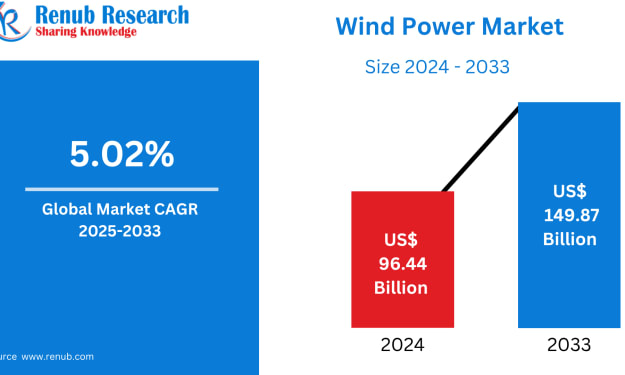
Global Wind Power Market Outlook The global energy landscape is undergoing a historic transformation as nations move away from fossil fuels and embrace renewable sources of electricity. At the center of this transition stands wind power—one of the fastest-growing and most scalable clean energy technologies worldwide. According to Renub Research, the Global Wind Power Market is expected to grow from US$ 96.44 billion in 2024 to US$ 149.87 billion by 2033, expanding at a compound annual growth rate (CAGR) of 5.02% during 2025–2033.
By Aaina Oberoiabout 22 hours ago in The Swamp
Prosecutors Seek Death Penalty for Ex-South Korean President Yoon
Severe Charges Against a Former Leader Spark National Debate South Korea finds itself at the center of a political and legal storm as prosecutors have formally sought the death penalty for former President Yoon, a move that has sent shockwaves across the nation. The decision to pursue the harshest possible sentence comes amid a high-profile trial in which Yoon faces charges related to corruption, abuse of power, and actions deemed to have gravely undermined public trust. The unprecedented nature of this legal pursuit has sparked intense discussion on the balance between justice, political accountability, and the role of the judiciary in a modern democracy. The Allegations Against Yoon The case against Yoon includes multiple counts of corruption, bribery, and misuse of presidential authority. Prosecutors argue that during his tenure, he accepted substantial illicit payments from corporations and individuals seeking favorable government treatment. Additionally, evidence presented alleges that Yoon leveraged his position to suppress opposition voices and manipulate key political outcomes, further eroding democratic norms. While South Korea has a history of holding leaders accountable — with former presidents Park Geun-hye and Lee Myung-bak having faced imprisonment for corruption — the pursuit of the death penalty marks a striking escalation. Analysts suggest that prosecutors aim to signal a zero-tolerance stance toward systemic corruption at the highest levels of government, reinforcing public faith in legal institutions. Public and Political Reactions News of the death penalty recommendation has sparked a wave of reactions across South Korean society. Citizens who have long demanded greater accountability from political elites have expressed cautious support, framing the move as a necessary step to curb entrenched corruption. However, there are also widespread concerns about the precedent this may set, particularly regarding the politicization of legal proceedings. Political parties have sharply divided over the matter. Opposition leaders have condemned the move as “judicial overreach,” arguing that such extreme measures could polarize society and undermine democratic principles. Supporters of the prosecutors’ stance, on the other hand, assert that no individual — regardless of political stature — should be above the law. International Attention The case has drawn attention beyond South Korea, as international observers monitor how the nation navigates this high-profile trial. Democracy watchdogs and human rights groups have highlighted the need for transparent and fair judicial procedures, emphasizing that the pursuit of the death penalty requires rigorous evidence and impartial consideration. Analysts note that how South Korea handles the trial may influence global perceptions of its legal and political systems. The nation, often seen as a beacon of stable democracy in East Asia, is under scrutiny to demonstrate that its institutions can deliver justice without succumbing to political pressure. Implications for South Korea’s Political Landscape The trial and potential sentencing of a former president carry profound implications for South Korea’s political future. If the death penalty is imposed, it would represent a historic turning point, signaling to both political elites and the public that accountability is absolute. At the same time, it risks deepening divisions among citizens and political factions, particularly if perceptions arise that the trial is motivated by partisan considerations. Legal scholars note that the case could prompt debates over constitutional reforms, including clarifying limits on executive power and the proper mechanisms for holding leaders accountable. Such discussions may shape the next generation of political leadership and governance norms in South Korea. Balancing Justice and Democracy Ultimately, the case against former President Yoon reflects the ongoing tension between justice, accountability, and the preservation of democratic principles. While prosecuting corruption is essential for the health of any democracy, the pursuit of capital punishment for a political figure introduces complex ethical and legal questions. How South Korea reconciles these competing priorities will likely define both its domestic political climate and its reputation on the world stage. As the trial progresses, citizens, political leaders, and international observers will continue to scrutinize each development closely. The outcome could either reinforce faith in the rule of law or provoke renewed debate about the role of punishment in democratic societies. What remains clear is that South Korea is facing one of its most consequential legal and political tests in recent memory — a moment that will resonate far beyond the courtroom walls. Conclusion The recommendation of the death penalty for former President Yoon marks a dramatic chapter in South Korea’s history, intertwining questions of legality, morality, and political accountability. As the nation watches, it confronts the difficult challenge of balancing the demand for justice with the need to protect democratic norms. How this unprecedented case unfolds will undoubtedly shape South Korea’s political and judicial landscape for years to come.
By Fiaz Ahmed Brohi7 days ago in The Swamp



Comments
There are no comments for this story
Be the first to respond and start the conversation.